



Firm management made easy

Revenue forecasting in A&E has always been complex. But the current market makes it nearly impossible using traditional methods. With 66% of projects experiencing postponement, scaling, or cancellation within six-month periods, and 78% of firms discounting project fees below standard rates, historical trending no longer works.
The AIA Architecture Billings Index has been below 50 for 35 months out of the last 38, indicating persistent weakness but not an unbroken 35‑month streak. Industry forecasts are missing actual outcomes by 12-14 percentage points. If your revenue projections feel more like guesswork than analysis, you're not alone.
Here are ten methods that actually move the needle on forecast accuracy: backed by industry data and built for how A&E firms really operate.
1. Prioritize Revenue Factor Over Utilization
We've all tracked utilization percentages thinking they told the whole story. But they don't. Utilization tells you how busy people are, not whether projects are profitable. Revenue factor (revenue per direct labor dollar) directly correlates to actual revenue generation. The median target multiplier for AEC firms is 3.13. Track this metric across projects and phases to identify where your firm generates actual profit versus simply consuming hours.
A designer billing at 75% utilization on a poorly scoped project contributes less to revenue than one at 65% utilization on well-negotiated work with clear scope protection. Revenue factor captures that distinction by accounting for both billing rates and project profitability.
2. Implement Real-Time KPI Tracking
Firms using connected platforms with real-time KPI tracking report 21% revenue increases in their first year, with additional benefits including 25% time savings on administrative tasks, 50% efficiency gains in project delivery, and 25% less overtime for teams.
Twelve essential KPIs matter most for A&E revenue forecasting:
- Net Profit Margin - Bottom-line profitability
- Operating Overhead Ratio - Indirect cost efficiency
- Utilization Rate - Billable time percentage (role-specific targets)
- Multiplier (Revenue Factor) - Revenue per direct labor dollar (around a 2.90 industry median in recent benchmarks)
- Direct Labor Rate - Actual billing efficiency
- Average Collection Period - Cash timing indicator
- Backlog-to-Revenue Ratio - Pipeline health (6-12 months healthy)
- Project Profitability Index (PPI) - Project-level performance
- Revenue Growth Rate - Trend analysis
- Proposal Hit Rate - Pipeline conversion accuracy
- Earned-vs-Planned Revenue Variance - Forecast calibration metric
- Cash-Flow Forecast Accuracy - Liquidity prediction reliability
The goal isn't to track everything but to track the things that predict future revenue.
3. Use Earned Value Management
Earned Value Management connects three dimensions (Planned Value, Earned Value, and Actual Cost) to predict project outcomes with mathematical precision. For A&E firms managing multi-phase projects, EVM provides early warning signals that enable forecast corrections before variance accumulates into profit impact (our EVM guide).
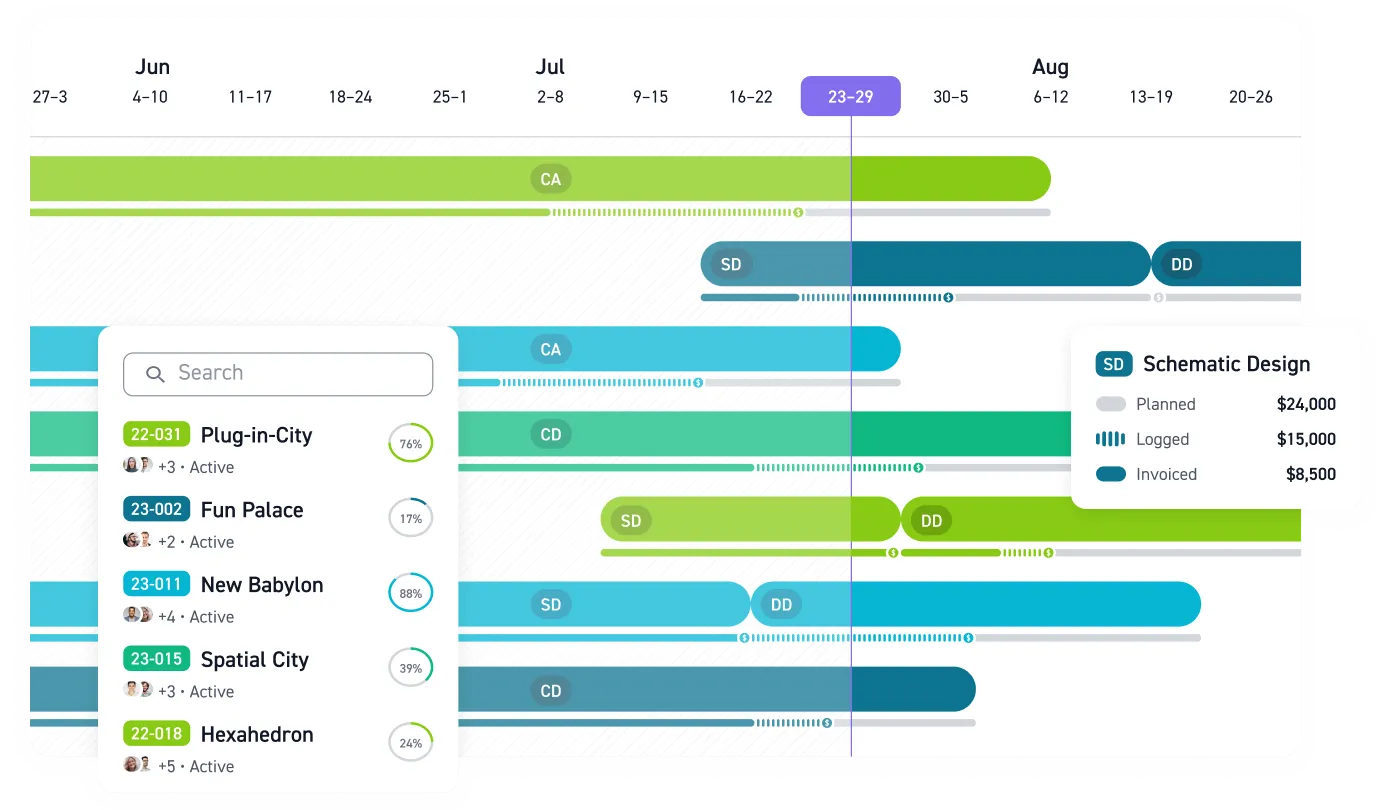
The Cost Performance Index (CPI = Earned Value / Actual Cost) tells you immediately whether a project is trending over budget. A CPI below 1.0 indicates you're spending more to earn each dollar of value. Monograph's MoneyGantt™ provides visual budget tracking that makes these variances immediately visible across design phases.
4. Adopt Phase-Based Revenue Recognition
Basic accounting systems cannot handle phase-based budgeting, consultant coordination, or the real-time project dashboards needed for effective A&E management. That's a problem when your work moves through Schematic Design, Design Development, Construction Documents, and Construction Administration with different profitability profiles at each stage.
69% of A&E firms lack real-time budget visibility, discovering cost overruns only after they've already impacted profitability. Phase-based tracking solves this by enabling revenue estimation at project, phase, and task levels. When a designer logs two hours in Schematic Design in Monograph, you immediately see the burn hit the SD budget line, eliminating the lag between work performed and financial visibility.
5. Switch to Rolling Forecasts
Your baseline budget shows where you hope to finish. A living forecast shows where the project is actually heading as hours, expenses, and scope shift week by week (See more in this Budgeting & Forecasting Guide).
Static annual budgets become outdated the moment a project pauses or a client delays approval. Rolling forecasts updated with actual data generate measurable results: 25% time savings on administrative tasks, 50% efficiency gains in project delivery, and 25% less overtime for teams.
6. Track Realization Rates by Project Type
Realization rate (the percentage of contracted fees actually collected) varies dramatically across firms. Top quartile performers achieve 103.9% average realization. Bottom quartile firms average 76.5%.
On a $10M revenue base, that gap represents $2.74 million annually. More importantly for forecasting, tracking realization by project type identifies structured errors. Projects consistently finishing above budget indicate conservative forecasting. Projects with low realization can indicate hidden issues such as scope creep, but leading benchmarks for A&E firms do not identify an 85% realization threshold or treat scope creep as the primary cause of realization below that level.
7. Apply Capacity-Constrained Backlog Analysis
Here's a reality CFOs can't ignore: Among firm executives expressing negative sentiment in Q3 2025, 45% cited labor shortages as their primary concern, a 13-point increase from the previous quarter.
Revenue forecasts must be capacity-capped based on available technical staff, not just backlog volume. Two firms with identical dollar backlog values may have vastly different revenue timelines depending on their ability to actually deliver the work. Effective backlog forecasting now incorporates project history, automated scheduling, and real-time staffing data.
8. Weight Pipeline by Probability and Segment
Assign probability weights based on specific pipeline stages: qualification, proposal, negotiation, and award pending. Then calibrate those weights using your actual Proposal Hit Rate, which reflects historical win rates by client type and project category.
Different construction segments show dramatically different patterns. According to ACEC data, manufacturing construction showed strong growth at 54.9% while multifamily declined 5.5% and commercial fell 2.8%. Engineering and design services revenue grew more modestly at 5.3% in 2024, reaching $459 billion. Weight opportunities by market segment performance to improve forecast accuracy.
9. Classify Paused and Delayed Projects
Late payments and project delays consistently rank among the biggest cash-flow and forecasting headaches for A&E firms. A three-category classification system brings discipline:
- Active/On-Track: Full revenue recognition per original schedule
- Delayed/Slow: Adjusted timeline with extended revenue recognition period
- Paused/On-Hold: Removed from near-term forecast, tracked separately with defined reactivation triggers
Weekly Review Process (15 minutes):
- Flag aging invoices approaching 30 days old
- Identify unbilled work older than two weeks
- Track projects overrunning scope
This operational cadence feeds real status data into monthly forecast updates, directly addressing the reality that project schedules are inherently unreliable.
10. Connect Time, Project, and Accounting Systems
Professional services firms using connected systems achieve 95%+ forecast accuracy at rates 9 points higher than peers (76% vs. 67%). One documented A&E firm achieved $4.7M profit improvement from a 3% operational efficiency gain enabled by enhanced project management systems. California-based Workbench achieved 8x faster staffing, 4x faster billing, and 75% reduction in unbilled fees after implementing connected practice management systems, demonstrating how integration directly improves forecast accuracy through better data flow.
Connected systems aren't optional enhancement. They're foundational infrastructure. Phase-based tracking requires connection between project and accounting systems. Earned value management requires real-time time tracking connected with budgets. That's why 13,000+ architects and engineers across 1,800+ firms rely on platforms purpose-built for A&E workflows. No amount of spreadsheet sophistication replaces connected systems that update in real time.
Stop Guessing. Start Forecasting.
Revenue forecasting doesn't have to feel like throwing darts blindfolded. The firms that nail their forecasts aren't using magic. They're using connected systems that surface problems before they become profit killers.
Monograph gives A&E firms real-time visibility into the metrics that actually predict revenue: earned value progression, utilization by role, backlog health, and cash flow timing. When your time tracking, project management, and accounting live in one platform, forecast accuracy stops being aspirational and starts being operational.
Your competitors are already moving. Book a demo with Monograph.
Frequently Asked Questions
How long does it take to see improvements in forecast accuracy?
Most firms see measurable improvement within 60-90 days of implementing consistent KPI tracking. The key is starting with a few critical metrics (revenue factor and earned value variance) rather than trying to track everything at once. Connected systems accelerate this timeline because you're not waiting for manual data compilation.
What if our historical data is unreliable for calibrating forecasts?
Start fresh. Use the last 6-12 months of data even if it's imperfect, then improve data quality going forward. Rolling forecasts self-correct over time as actual results feed back into your models. The worst approach is waiting for perfect data. You'll never have it.
Do we need to track all twelve KPIs to improve forecast accuracy?
No. Start with three: revenue factor, backlog-to-revenue ratio, and earned-vs-planned revenue variance. These give you profitability insight, pipeline health, and forecast calibration in one dashboard. Add complexity only when you've mastered the fundamentals.
How do we handle forecast accuracy when 25-30% of projects are paused?
Classify projects explicitly using the three-category system (active, delayed, paused) and remove paused projects from near-term forecasts entirely. Track reactivation triggers separately so you can add them back quickly when they restart. This discipline alone can improve forecast accuracy by 15-20%.