


Firm management made easy

Most A&E firms spend more time compiling status reports than analyzing what they mean. You know the drill: hunting through three different systems, chasing consultants for updates, and manually assembling project data that's already outdated by the time you hit send.
The industry recognizes this problem. Recent surveys indicate that roughly 78% of executives across industries plan to invest in AI and automation tools within the next two years. Yet despite this overwhelming interest, only 6% of architects regularly use AI tools in practice, while 27% of AEC firms currently use AI for automation, problem-solving, or decision-making. This gap exists because most firms approach AI as a technology purchase rather than a structured process.
AI-driven progress reporting automates the administrative burden so you can focus on what actually matters: proactive project management, stakeholder communication, and strategic decision-making.
Step 1: Define Business Problem, Not Technology Solution
Before evaluating any AI tools, quantify the specific problems eating your time. Track these metrics for two weeks across your current projects:
- Hours spent gathering project data from different systems
- Time lag between when something happens and when it appears in reports
- Frequency of stakeholder follow-up questions about project status
- Number of systems you access to compile one progress report
Routine documentation tasks consume 15-20% of project time in most A&E firms. That includes email organization, meeting minutes, project correspondence, and field reporting.
Your business case isn't "we need AI." It's "we're losing X hours per week on manual coordination that could be spent on design decisions and client relationships."
Step 2: Assess Current State and Build Internal Buy-In
Most A&E firms still blend paper and digital workflows, making consistent data capture nearly impossible. While more than half of A&E firms report using AI tools, many still rely on paper in project workflows.
Start with an honest audit:
- What percentage of project data exists in digital, searchable formats?
- How many different platforms do you use for project management, time tracking, and financial reporting?
- Where do communication gaps create delays or errors?
- Which team members resist new technology adoption and why?
The key insight is this: AI amplifies your current processes. If your existing workflows are chaotic, AI won't fix them. It will automate the chaos faster.
Step 3: Establish Governance and Professional Standards
A&E professionals face regulatory and liability obligations that don't apply to general business AI adoption. ASCE Policy Statement 573 establishes the non-negotiable principle: AI cannot replace professional judgment and cannot be held accountable for engineering decisions.
Your firm needs documented AI policies addressing these critical areas:
- Permitted uses (data analysis, report formatting, schedule improvement)
- Prohibited uses (final design decisions, stamped drawings, safety calculations)
- Review protocols requiring licensed professional oversight per ASCE standards
- Client communication with transparent disclosure of AI assistance
- Data privacy protection and federal compliance requirements
Establishing documented AI guidelines is a key part of a complete governance framework. Design professionals should never promise perfection, reduced errors, or faster delivery when using AI tools, and must secure enough fees and time to execute statutory responsibilities as engineer of record.
Step 4: Design Domain-Based Transformation
Think of domain transformation like structural analysis. You wouldn't evaluate a single beam without understanding the entire load path. The same principle applies to AI.
Digital transformations succeed when teams focus on changing entire domains rather than isolated use cases. For progress reporting, this means transforming your complete "Project Progress Visibility & Forecasting Domain."
Consider the entire ecosystem:
- Real-time data capture from time tracking, budget systems, and consultant coordination
- Analysis of schedule performance, cost variance, and resource utilization
- Stakeholder communication informed by project phase and audience needs
- Predictive modeling for cost and schedule forecasting (achieving variances near 5-7% with quality historical data)
When selecting a pilot project, choose one complete project type with measurable impact. Ensure your team includes an executive sponsor, domain expert, technical lead, data architect, licensed professional reviewer, and change champion.
Step 5: Prepare Data Infrastructure
This step represents 80% of implementation work according to industry analysis. Since this effort is predominantly spent on data collection, cleaning, and organization, the quality and consistency of your project data directly determines the accuracy of AI-driven insights.
Firms should focus on these critical data preparation steps:
- Exporting BIM databases to SQL or JSON for query capability
- Using OCR on scanned drawings to make them machine-readable
- Applying consistent metadata tagging to project photos and documents
- Adopting open data standards like IFC or COBie for machine-readable design data
- Establishing real-time connections between project management, time tracking, and accounting systems
Many project managers discover that structured data infrastructure improves project management processes beyond AI capabilities alone.
Step 6: Execute Controlled Pilot with Validation
Select your pilot domain and assemble a team with executive sponsorship, domain expertise, technical capability, and licensed professional oversight.
Your pilot execution must include mandatory validation protocols:
- Daily AI output review by licensed professionals comparing results to human judgment
- Weekly accuracy measurement tracking AI forecasts against actual project outcomes
- Bias monitoring to identify errors or blind spots in model performance
- Transparent client communication about AI assistance while maintaining professional responsibility
Research shows that inaccuracy is the #1 AI risk that organizations have experienced and are working to mitigate.
Track these success metrics: forecast accuracy improvement, time savings on administrative tasks, stakeholder satisfaction with project visibility, resource utilization improvement, and overall project profitability.
The results are clear. BRNS Design, a 13-person Texas architecture firm, achieved 50% time savings on admin tasks and 4x faster billing after deploying AI-driven project management solutions. For engineering firms, Dynamic Engineering, a 10-person Florida firm, achieved 25% profit growth and 2x efficiency gains.
Start Building AI-Driven Progress Reports With Monograph
The architecture and engineering industry stands at an inflection point. While 27% of AEC firms currently use AI, 94% of users plan to increase investment.
Project Managers: Start with one pilot domain to demonstrate measurable ROI to leadership. Track the hours you're currently losing to manual reporting and show how AI-driven progress tracking transforms that time into project oversight.
Operations Leaders: Assess your current data infrastructure using Step 5 as your checklist. Identify which systems already contain digital project data and where quick wins exist.
Principals and Owners: Build internal buy-in by quantifying the real cost. Calculate how many hours your team loses each week to manual reporting, multiply by your average billing rate, and present the annual opportunity cost.
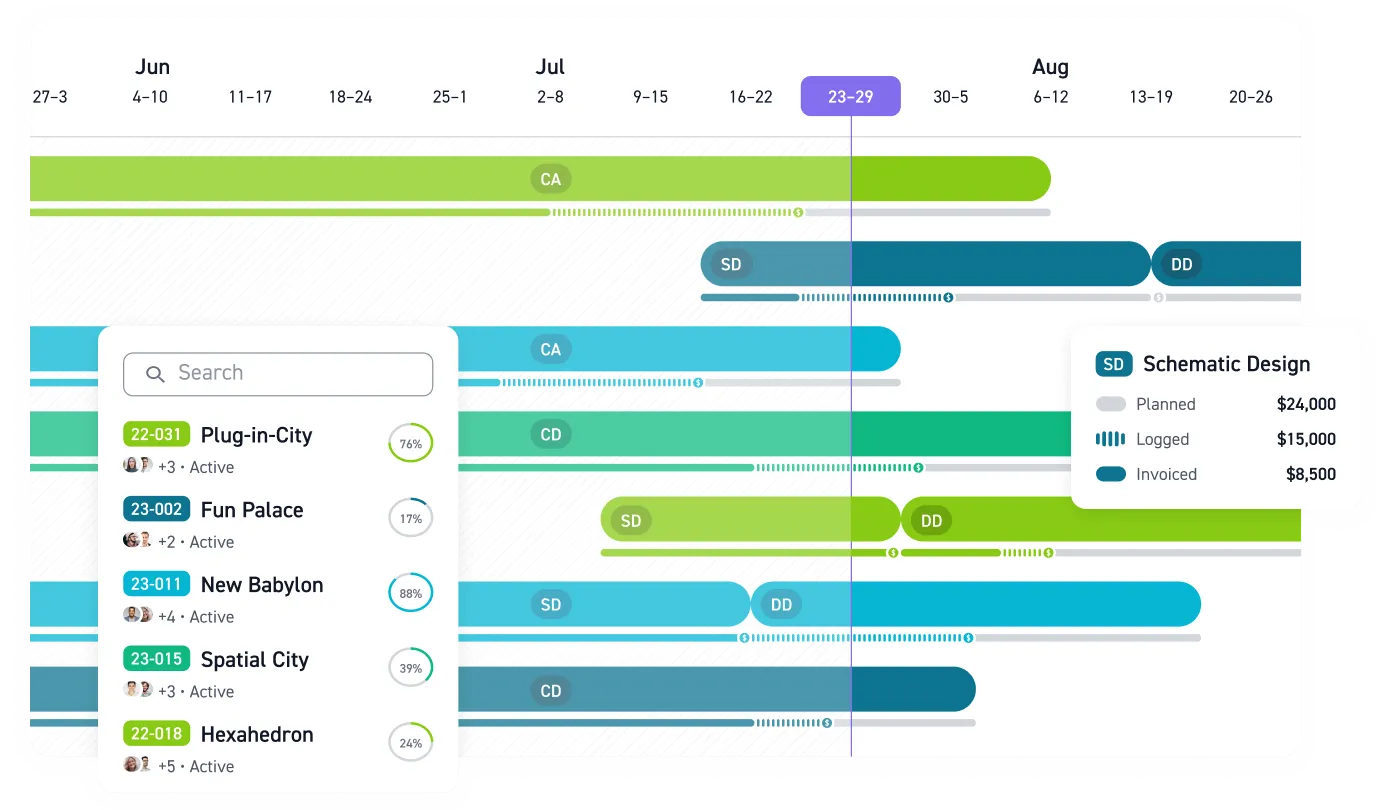
Monograph's AI-powered project management platform handles the data infrastructure and workflow automation while you focus on the process. Monograph's signature MoneyGantt™ feature provides the real-time project visibility that makes AI-driven forecasting possible, connecting time tracking, budget analysis, and progress reporting in one unified system built specifically for A&E worflows.
Your competitors are already automating progress reports. Stop spending 20 hours per week compiling outdated project data. See how Monograph transforms AI-driven progress reporting into competitive advantage.
Frequently Asked Questions
What data infrastructure do we need before implementing AI-driven progress reports?
Start with data that already exists in digital formats rather than trying to digitize everything at once. You need real-time connections between your project management, time tracking, and accounting systems. Exactly what platforms like Monograph provide out of the box.
Focus on three foundational elements: consistent project phase structures across all projects, regular time entry workflows that capture actual work patterns, and budget tracking that links planned fees to actual costs. According to industry analysis, 80% of AI effort goes to data preparation, so begin with your most organized project data to build momentum.
How do we maintain professional responsibility when using AI for project reporting?
AI assists your professional judgment but never replaces it. Establish clear governance policies that define permitted uses (data analysis, report formatting, schedule improvement) versus prohibited uses (final design decisions, stamped drawings, safety calculations).
According to ASCE Policy Statement 573, AI cannot be held accountable for engineering decisions. Licensed professionals must review all AI outputs that impact project safety, code compliance, or design intent. Daily validation protocols where licensed professionals compare AI forecasts to human judgment and document the review process are essential.
Be transparent with clients about AI assistance while maintaining your professional responsibility. Never promise perfection, reduced errors, or faster delivery because you're using AI tools. The key is combining AI's pattern recognition capabilities with your professional experience to deliver better outcomes than either could achieve alone.
How long does it take to see results from an AI progress reporting pilot?
Architecture and engineering firms see measurable improvements within 2-4 weeks of deploying AI-driven progress reporting, though complete transformation takes 3-6 months.
BRNS Design achieved 50% time savings on admin tasks within their first quarter, while Dynamic Engineering saw 2x efficiency gains in a similar timeframe. The timeline depends on your data infrastructure readiness. Firms with clean, connected project data see faster results than those still consolidating scattered spreadsheets.
What if our team resists AI adoption for project tracking?
Resistance stems from three concerns: fear of job displacement, skepticism about accuracy, and frustration with learning new systems. Address these directly by positioning AI as eliminating administrative burden rather than replacing professional judgment.
Show your team the 15-20% of project time currently consumed by routine documentation tasks and ask which activities they'd prefer to focus on instead. Start with voluntary early adopters who become internal champions demonstrating tangible benefits.
How accurate are AI-generated project forecasts compared to manual methods?
AI-generated forecasts achieve 5-7% variance from actual outcomes when trained on quality historical data, compared to 15-25% variance for manual forecasting methods. However, accuracy depends entirely on your data infrastructure and validation protocols.
According to McKinsey's AI research, inaccuracy is the #1 risk organizations experience with AI, which is why validation protocols matter. AI excels at pattern recognition across multiple concurrent projects. It identifies utilization trends, cost variance patterns, and schedule risks that human project managers miss when juggling 8-12 active projects simultaneously.