

Every engineering firm principal has a pricing horror story. It might be the project you quoted at a flat fee, only to discover the client's "minor revisions" consumed 40% more hours than planned. It might be the proposal you won because you were the cheapest, then spent six months wondering if you'd break even. Engineering fees are the financial foundation your practice stands on, and getting them wrong has consequences that compound across every phase of every project.
The A&E industry has more data on what works than ever before. The challenge is turning that data into a fee strategy that protects your margins project after project.
Five Pricing Models, One Decision Framework
Industry benchmark data breaks down how the A&E industry actually prices work:
- Lump sum / fixed fee (59%): The dominant model, especially for small firms. Firms with 1–20 staff use fixed fees for 76% of their work. Efficiency becomes your competitive advantage because anything delivered under budget stays in your pocket.
- Time-and-materials (23%): Preferred for renovation work with unknown existing conditions, consulting engagements with evolving scope, or projects where hours are hard to predict. Government clients use T&M at nearly double the rate of private sector clients (32% vs. 19%).
- Not-to-exceed T&M (12%): Clients have little reason to limit scope changes once a cap is in place, while your firm absorbs the overrun risk.
- Percentage of construction cost: This model is more commonly used in architectural practice. Peer-reviewed research shows that percentage-based fee schedules have eroded in real value for decades as construction costs inflated without corresponding fee adjustments, making this a risky default.
A fifth model, value pricing, is gaining traction but remains small enough that benchmark surveys don't yet track it separately. As AI tools begin handling work that previously required significant junior staff hours, the question of how to price for delivered expertise rather than time spent becomes more pressing for forward-looking firms. The 2026 A&E financial outlook points to this as an emerging strategic consideration.
Choose pricing models based on project conditions and scope clarity. Well-defined deliverables with predictable scope favor fixed fees. Unknown conditions and evolving requirements call for T&M. Strategic advisory and rare expertise deserve value-based pricing. Defaulting to one model for everything leaves money on the table.
The Benchmarks That Define Profitability
Three numbers should be on every principal's dashboard. Each one reveals a different dimension of fee performance.
Net revenue multiplier: The median target across A&E firms reached a record high of 3.25 in 2025, up from 3.10 in 2019 per multiplier trend data. That upward movement reflects both rising labor costs and better fee discipline across the industry.
Operating profit margin: The median sits at 19.0%, while top-performing firms in PSMJ's Circle of Excellence reached 37.2%. Firms performing below the median often show visibility gaps in project financial data, alongside operational issues like chronic budget overruns.
Realization rate: The national average holds near 95%, with top-quartile firms exceeding 97%. That 2% difference sounds small until you run the math: on a $10M revenue firm, it equals $200,000 in additional annual profit. A dip in realization flags hidden leaks, from unpriced scope creep to write-offs granted too quickly.
Small firms face particular pressure here. Firms with billings under $250K average just 9% net margins compared to 14.1% for firms exceeding $5M. Tighter margins mean less room for pricing mistakes and more to gain from disciplined fee management.
Setting Fees That Hold Up Under Pressure
Fee proposals grounded in actual project data consistently outperform those based on gut instinct. One engineering firm compared proposal rates against actual cost-to-complete across 20 past projects, identified chronically underpriced services, and achieved measurable margin gains without losing a single client.
The sequence matters more than most principals realize: scope first, fee second. ACEC guidance on lump sum contracts emphasizes that deliverables should be clearly defined before a fee proposal is developed. Firms that negotiate fees before scope is locked down inevitably absorb requirements that emerge mid-project.
Before any fee discussion, lock down these elements:
- Written phase scope with phase-by-phase deliverables and explicit exclusions
- Documented assumptions about site conditions, regulatory requirements, and client responsibilities
- An agreed change order process with approval thresholds defined before work begins
- Contingency allowances for scope risk on projects with significant unknowns
Beyond scope discipline, principals should differentiate pricing across service types. Applying undifferentiated hourly rates to every engagement ignores market reality. Commodity services like standard new construction design command different rates than specialized work like forensic engineering or retrofit analysis.
Fixed-Fee Contracts: Managing the Model You Use Most
Because smaller firms often do a larger share of their work on fixed-fee contracts, the risks of that model deserve attention. A 2024 ACEC study found that inadequately defined or uncertain scope ranked as the top challenge on lump sum projects, cited by both client organizations and engineering firms. Roughly a third of client organizations rely on lump sum for fewer than 10% of their contracts, pointing to ongoing adoption friction on both sides of the contract table.
Firms are adapting in practical ways. Phasing services allows fixed fees for well-defined stages while maintaining flexibility for discovery phases. Hybrid contracts pair lump sum work where scope is clear with reimbursable terms for exploratory tasks like geotechnical investigation. Practice leaders have found portfolio fee management useful for fixed-fee profitability: some projects overrun, others underrun, and the goal is overall margin health rather than project-by-project perfection.
Even on fixed-fee work, internal time tracking is not optional. Actual hours-by-phase data is what calibrates future proposals and surfaces scope creep before it erodes margins. The fee is fixed to the client. Your firm still needs visibility into how that fee gets consumed internally.
From Tracking Hours to Protecting Revenue
The average A&E firm bills only 81% of available staff time. That 19% gap represents hours worked but never captured, invoiced, or recovered.
Three mechanisms drive this leakage:
- Incomplete labor tracking turns project costs into fiction when hours get rounded or misallocated.
- Delayed scope creep recognition means firms deliver thousands in unbilled work before anyone notices.
- Missed change orders compound the problem: when project managers can't see budget burn in real time, they absorb scope changes rather than document and price them.
Each leak is preventable with the right visibility. Financial management benchmarks consistently show that firms with tighter tracking systems make better decisions earlier, catching fee erosion while there's still time to act. Consistent use of a straightforward system outperforms an elaborate one that sits unused.
Dynamic Engineering, a 10-person engineering firm in Florida, reported 25% profit growth, 2x efficiency gains, and 2x more confidence after gaining real budget visibility. That kind of result matters here because fee performance depends on setting the right number up front and seeing hours, budgets, and billing clearly enough to protect revenue as work progresses.
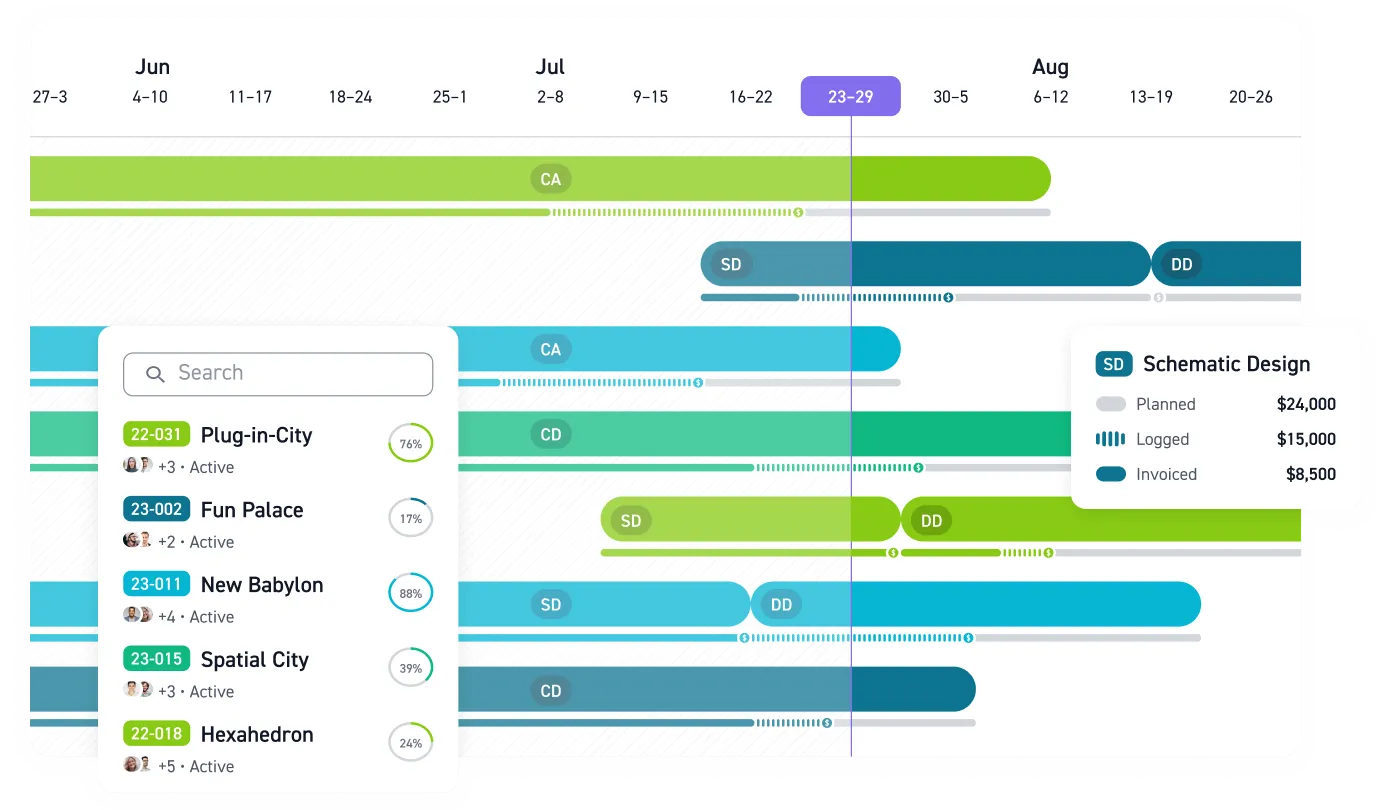
Monograph gives A&E firms clarity into budgets, projects, time, and clients so teams can make smarter decisions and keep projects on track. 13,000+ architects and engineers across 1,800+ firms use Monograph to work smarter, faster. Monograph's MoneyGantt™ shows cash progression across four stages, from planned to logged to invoiced to paid, giving teams a clear view of budget-to-cash movement and where each project stands financially. When time gets logged, teams gain clearer visibility into budget status and project progress. Consultant bills can also be tracked alongside fee budgets, so PMs and principals can see financial impact earlier. With QuickBooks Online connected, firms get clearer project-level financial visibility without rebuilding their existing accounting workflows.
Price Your Work With More Confidence
Engineering fees hold up better when they're built on real project data, clear scope, and visibility into what happens after the contract is signed. If your firm is still pricing work from memory, disconnected spreadsheets, or incomplete time data, the gaps will show up in your margins.
A practical next step is straightforward. Review your recent projects, compare estimated hours to actual hours by phase, and look for the services that repeatedly overrun. Tighten scope language, define exclusions earlier, and make sure your change order process is agreed before work begins. Then give project managers better visibility into budgets, hours, and consultant costs so they can catch fee erosion before it turns into lost profit.
Monograph supports that work by connecting budgets, time, invoicing, and project performance in one place. For principals, PMs, and operations leaders trying to protect fees on fixed-fee and hybrid contracts, that kind of clarity is a useful next step.
Start sooner. The longer pricing, scope, and tracking stay disconnected, the longer avoidable margin loss stays hidden. Book a demo.
Frequently Asked Questions
What pricing model works best for most engineering firms?
It depends on the project. Fixed fees work best when deliverables are well defined and scope is predictable. Time-and-materials fits renovation work, unknown conditions, and consulting engagements where requirements may evolve. Firms usually get into trouble when they default to one pricing model for everything.
How do we know if our fees are too low?
Look at actual cost-to-complete, hours by phase, realization, and which services repeatedly go over budget. The example in this article of one firm improving margins by 9% came from comparing proposal rates against real project performance. If the same work keeps consuming more effort than planned, your fee, your scope definition, or both need attention.
Do we still need time tracking on fixed-fee projects?
Yes. Fixed fee changes how you bill the client, but it does not remove the need to understand labor burn and phase performance. Without actual hours-by-phase data, future proposals become guesswork and scope creep is harder to spot before it damages margins.
What's the simplest way to protect fees from scope creep?
Start with scope before fee. Define deliverables and exclusions in writing, document assumptions, and agree on a change order process before work starts. Then review budget burn often enough to catch added work early, while there's still time to document it, price it, and protect the value of work already being delivered.
What should firm leaders review regularly to protect profitability?
Start with net revenue multiplier, operating profit margin, and realization rate. Then look at hours-by-phase, budget burn, and whether consultant costs or added services are pushing work past the original fee. Those numbers show whether a project is performing as planned or quietly consuming your margin.