


Firm management made easy

You finished the project. The client is happy. Then you run the numbers and realize you worked three months for half the margin you expected. The worst part? You had no idea it was happening until it was already done.
This is the default experience for too many A&E project managers still relying on spreadsheets and month-end reconciliation to understand project finances. We've talked with hundreds of firms facing this exact pattern. The gap between when work gets performed and when cost data becomes visible is where profit disappears. Project cost tracking software closes that gap from weeks to minutes.
The Financial Damage Is Worse Than You Think
The numbers tell a clear story. Across A&E firms, the gap between average and top-quartile realization rates represents 3–5% in revenue leakage from unbilled work. At a firm doing $2M in annual revenue with a 12% net margin, that leakage of $60,000 wipes out a quarter of annual profit.
Scope creep makes it worse. Industry benchmark data documents that by the time leaders recognize a project has expanded beyond the original agreement, the firm has already delivered thousands of dollars in unbilled services. And because timekeeping often gets treated as busywork, hours get rounded, time gets misallocated, and project costs become fiction. Leaders end up pricing future projects based on flawed historical data, perpetuating the cycle.
The current market environment raises the stakes further. The AIA Architecture Billings Index dropped to 43.8 in January 2026, signaling declining activity, with backlog at its lowest since 2020. When new work slows down, profitability on existing projects becomes the difference between stability and crisis.
Why Spreadsheets Can't Keep Up
A&E financial management research identifies three systemic failures that plague firms managing costs manually:
- Hidden project costs go unallocated. Software subscriptions, consultant fees, travel expenses, and equipment rentals get tracked imprecisely or not at all. Small inaccuracies compound across projects, making true project economics invisible.
- Management stays reactive instead of proactive. Spreadsheets tell you what was spent. They don't show what was spent against what remains. Top performers track both.
- Revenue growth masks margin compression. Firms scaling from 10 to 20+ employees often mistake growing revenue for growing profitability, missing the quiet erosion underneath.
The core issue is timing. Spreadsheet-based tracking gives you a rearview mirror. By the time you see the overrun, the money is already gone. Purpose-built project cost tracking software makes budget impact visible the moment someone logs time, turning financial data from a post-mortem into an early warning system.
What A&E Firms Actually Need in Cost Tracking Software
Generic project management tools miss the nuances of design professional services. A&E project managers should prioritize capabilities built around how architecture and engineering work actually gets delivered.
Phase-based budget tracking is foundational. Costs need to map to standard project phases like SD, DD, CD, and CA, not generic task categories. This structure mirrors AIA contract frameworks and reflects how budget actually gets consumed: conceptual thinking early, production-intensive work later. Generic milestone tracking misses these patterns.
Real-time alerts at the phase level protect margins before problems become write-offs. Only a fraction of A&E projects finish within budget over a three-year period, and 52% of firms report at least one in four projects exceeding budget. Automated notifications when phases hit 75% and 90% of budget give you time to act.
Beyond those two essentials, effective platforms also need to deliver:
- Consultant cost allocation that separates internal labor from external expenses, tracks markup, and reconciles consultant invoices against budgeted fees
- Multi-project dashboards that show profitability and milestones across all active projects, so you can spot patterns and rebalance resources
- Accounting system integration that eliminates double-entry between your project management and financial accounting systems
- Flexible billing support across lump sum, hourly with caps, percentage of construction cost, and cost-plus-fixed-fee structures
These capabilities matter at a structural level. With 73% of architecture firms regularly using stipulated sum contracts and limited evidence on lump sum engineering work, every dollar of untracked cost overrun comes directly out of profit. There is no mechanism to bill additional hours.
The Profitability Payoff
The business case for switching from manual tracking to purpose-built software is well documented. Industry benchmark data confirms firms that implement proper tracking systems consistently improve performance by 15–20% within the first year. The improvement comes from visibility: when you can see a phase burning hot, you adjust before the margin disappears.
Named firm outcomes reinforce the range. Abel City reported 15% profit growth after replacing manual processes with real-time project visibility, and ART Architects reported 25% profit growth alongside significant efficiency gains after tightening their tracking and billing rhythm.
The efficiency gains extend beyond margins. Firms using purpose-built project management software have reclaimed up to 15% more billable time across teams. For a 10-person team at $150/hour, even five recovered hours per person weekly means $390,000 in annual revenue. In practice, that time shows up quickly when billing is no longer a monthly fire drill.
Building a Tracking Rhythm
Software alone doesn't fix cost tracking. The firms that get the most value pair their tools with a consistent review cadence:
- Weekly: A five-minute scan per active project to flag red items and identify accelerating costs
- Biweekly: Financial review to catch overruns early and verify invoice alignment with phase milestones
- Monthly: Full budget-versus-actual analysis with all project managers, plus utilization and multiplier review
- Post-close: A one-hour deep dive into variances, scope creep, and allocation issues
This rhythm works because it matches the pace at which A&E projects actually move. Weekly scans catch small deviations, monthly reviews reveal trends, and post-close analysis builds the institutional knowledge that improves future pricing.
Two additional practices accelerate results. First, track net revenue, meaning total revenue minus consultant and reimbursable costs, instead of total revenue at the project level. Net revenue represents the actual money available to pay staff and generate profit. Second, maintain rolling three-month cash flow forecasts. The three-month window balances actionability with enough lead time to plan payroll, consultant invoices, and tax payments.
Smaller Firms Need This More, Not Less
AIA data shows firms with billings under $250K average just 9% net margins compared to 14.1% for firms exceeding $5M. The margin cushion at smaller firms is thinner, which means cost tracking failures hit harder. A 3–5% revenue leakage at a large firm is uncomfortable. At a small firm, it can be the difference between profitability and loss.
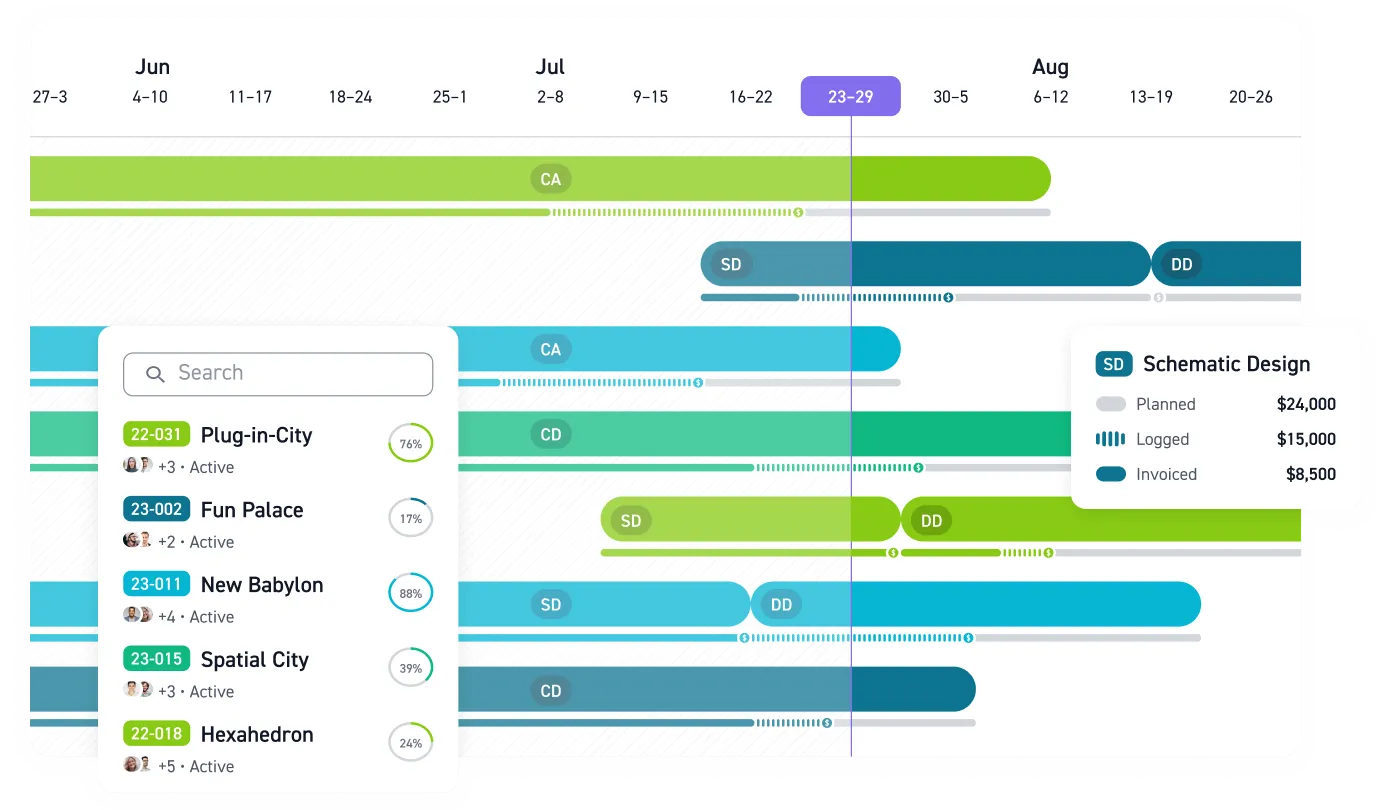
Monograph was built for exactly this reality. Its phase-based budgeting aligns with AIA project phases, and Monograph's MoneyGantt™ feature gives you instant visual intelligence into budget-to-cash progression across planned, logged, invoiced, and paid statuses. You can spot an off-track phase in seconds, not weeks.
Stop Guessing Where Your Profit Went
You already have the data you need to run projects profitably. That data is sitting in timesheets, consultant invoices, reimbursables, and phase budgets. The problem is that spreadsheets hide the story until month-end, when the only option left is writing off hours and hoping the next job goes better.
Purpose-built project cost tracking software closes that gap. When time and expenses hit the right phase in real time, project managers can act while there's still room to adjust: tighten scope, rebalance staffing, align invoicing, or have the hard client conversation before the margin disappears.
Firms that build this visibility into their weekly rhythm see measurable results. The data to see your true project costs already exists, and it's time to use it. Book a demo.
Frequently Asked Questions
Is dedicated cost tracking software really necessary for a small firm?
Yes, because small firms don't have much margin to absorb mistakes. One phase that runs hot on a fixed-fee project can erase the profit from a month of work.
Dedicated cost tracking is less about adding more process and more about getting an honest feedback loop. After a few projects, you stop guessing what SD or CA actually costs for your firm, and your next proposal gets easier to price.
How is this different from just using our accounting software to track project costs?
Accounting systems are built to produce clean financial statements. They aren't built to help project managers manage phase budgets day to day.
Cost tracking software for A&E connects what project managers control, such as time entries, phase budgets, consultant allocations, and billing, to what accounting needs, such as accurate costs and clean reconciliation. The goal is faster visibility for the project team without turning your accounting file into a project management workaround.
How do we get our team to actually use the software consistently?
Make it match how your projects are already structured. If your system mirrors SD/DD/CD/CA and your staffing plan, time entry stops feeling like translation work.
Then use the data in real meetings. When teams see that phase-level tracking prevents late-night deadline pushes, surprise write-offs, and awkward client calls, consistency goes up because the payoff is obvious.
What costs should we track besides labor hours?
Start with consultant fees and reimbursables. They're large enough to swing project profit, and they're also the easiest to miscode when invoices arrive late or projects change direction.
Track them by project and phase, and review them alongside labor burn. That combination reveals the real story: whether the project is truly over budget, or whether one discipline or phase is carrying more load than your plan assumed.