


Firm management made easy

Every architecture firm principal has faced this scenario: you're putting together a project budget, and you need to nail down consultant costs before presenting to the client. Structural engineering fees can make or break your project margins, yet the pricing landscape feels anything but transparent.
We've seen this scenario play out across hundreds of A&E firms. The scramble to get accurate consultant quotes, the awkward conversation when structural fees come in higher than expected, and the margin squeeze that follows. Here's what actually drives those numbers.
Industry benchmarks from ASCE, ACEC, and Zweig Group provide clear frameworks for budgeting structural engineering services. These resources help you negotiate fair contracts and protect your margins.
How Structural Engineers Price Their Services
Structural engineers employ four primary fee structures, each suited to different project circumstances.
Percentage of Total Design Fee remains the most common structure. Professional engineering practitioners report structural engineering fees typically represent 17-21% of total design fees, which range from 4-8% of construction costs for new construction. This yields approximately 0.68-1.68% of construction cost.
Percentage of Construction Cost offers direct calculation. Fees generally range from 1-5% of construction costs, with renovations reaching up to 7%. This traditional approach remains widely used despite concerns that percentage-based fees haven't kept pace with project complexity, as ENR's analysis demonstrates.
Hourly Rate Structure with Multipliers provides flexibility for projects with scope uncertainty. Firms commonly apply multipliers of 2-4x pay rates to establish billing rates, allowing fair compensation without padding fees with risk contingencies.
Lump Sum Agreements work best for well-defined projects, providing complete budget certainty. However, every design change becomes a negotiation point.
Think of choosing a fee structure like selecting a structural system: each has trade-offs. Percentage-based fees are like steel framing, offering predictability and scalability. Hourly rates are like custom design, providing flexibility but requiring more coordination.
When evaluating proposals, AIA's fee-setting guidance recommends validating any structural engineer fee using multiple calculation methods.
Current Hourly Rates and Market Trends
Here's what billing rates look like across experience levels, based on ACEC provincial fee guidelines and practitioner reports:
- Entry-level engineers (0-2 years): $110-$175/hour
- Intermediate engineers (3-7 years): $150-$210/hour
- Senior engineers (8-15 years): $190-$280/hour
- Principal engineers (15+ years): $250-$350/hour
These ranges reflect billing rates, not salary, and account for overhead, profit margins, and liability costs.
Zweig Group's 2025 analysis found that 95% of surveyed AEC firms raised billing rates between 2022-2025, with a median increase of 11%. Budget for annual 3-5% structural engineering rate increases.
What Drives Fee Variations
Project Complexity tops the list. High-rise buildings, industrial facilities with heavy equipment loads, healthcare buildings needing vibration control, and historic renovations all command premium fees due to extensive analysis requirements and greater professional liability exposure.
Scope of Services directly multiplies fees. Construction administration represents 10-15% of construction costs compared to 3-15% for design services alone.
Geographic Location affects pricing through regional labor rates, local building code requirements, and seismic or wind design criteria per ASCE 7. Coastal metropolitan areas and high-seismic zones command higher rates.
Construction Cost Relationship isn't linear. Smaller projects command proportionally higher percentages due to fixed minimum service requirements for basic analysis and code compliance.
Phase-Based Fee Allocation
Official structural engineering fee guidelines do not prescribe fixed phase percentage breakdowns. Instead, ACEC guidelines organize compensation around hourly rate classifications rather than phase-based percentages. This differs fundamentally from architectural practice.
When phase-based contracts are required, estimate proportional effort distribution:
- Schematic Design: Structural system selection, preliminary sizing, coordination with architectural massing
- Design Development: Refined calculations, foundation design, code compliance, MEP coordination
- Construction Documents: Complete drawings, specifications, final documentation
- Construction Administration: Shop drawing review, RFI responses, construction observation
If you're like most architecture firm principals we work with, you've probably tried to map structural engineering effort onto your standard AIA phase breakdown and found the fit imperfect. That's because structural complexity often front-loads differently than architectural work. Foundation design and structural system selection require significant analysis early, while construction administration can vary dramatically based on project delivery method.
Note: Structural engineering fees do not follow prescriptive phase allocations per ACEC guidelines. Construction phase services typically represent approximately 27% of basic design fees. Use hourly rates with estimated hours per phase for greatest accuracy.
Additional Services Requiring Separate Budget
Beyond base fees, additional services require explicit budget allocation:
- Peer review services (0.25-0.50% of construction cost): Increasingly required for design-build and CMAR projects
- Advanced seismic analysis: Site-specific analysis and performance-based design require specialized expertise
- Foundation design for challenging conditions: Deep foundation systems and ground improvement
- Special inspections coordination: Oversight of required special inspections
Request explicit line items for each additional service in initial proposals to avoid mid-project negotiations.
For projects with unknown soil conditions, seismic requirements, or complex geometries, budget 20-30% contingency on structural fees. Always clarify whether consultant proposals include full construction phase services or only design deliverables. This distinction can mean the difference between healthy margins and significant budget overruns.
Building Type Implications
Research demonstrates dramatic variation in structural cost as a percentage of total building cost. Healthcare projects average approximately 8% while pre-engineered warehouses can reach 50%. However, structural cost percentage does not directly correlate to engineering fees. Building type serves as a proxy for typical complexity, but actual fees depend on specific structural requirements, regulatory environment, and existing conditions.
For your fee budgeting, focus less on building type percentages and more on the specific structural challenges. A simple office building in a high-seismic zone may require more engineering effort than a complex mixed-use project in a mild seismic region. Ask your structural consultant what drives their fee for each project.
Take Control of Consultant Fee Management
After working with A&E firms on practice management, we've noticed a pattern: the firms maintaining healthy project margins aren't necessarily getting lower consultant fees. They're budgeting accurately from the start, tracking actual hours against benchmarks, and catching scope creep before the invoice arrives.
Brunton Architects & Engineers, an 18-person A&E firm in Minnesota, reduced budget overages by 25% and cut billing time in half by implementing systematic project tracking. This kind of visibility makes consultant fee management predictable rather than reactive.
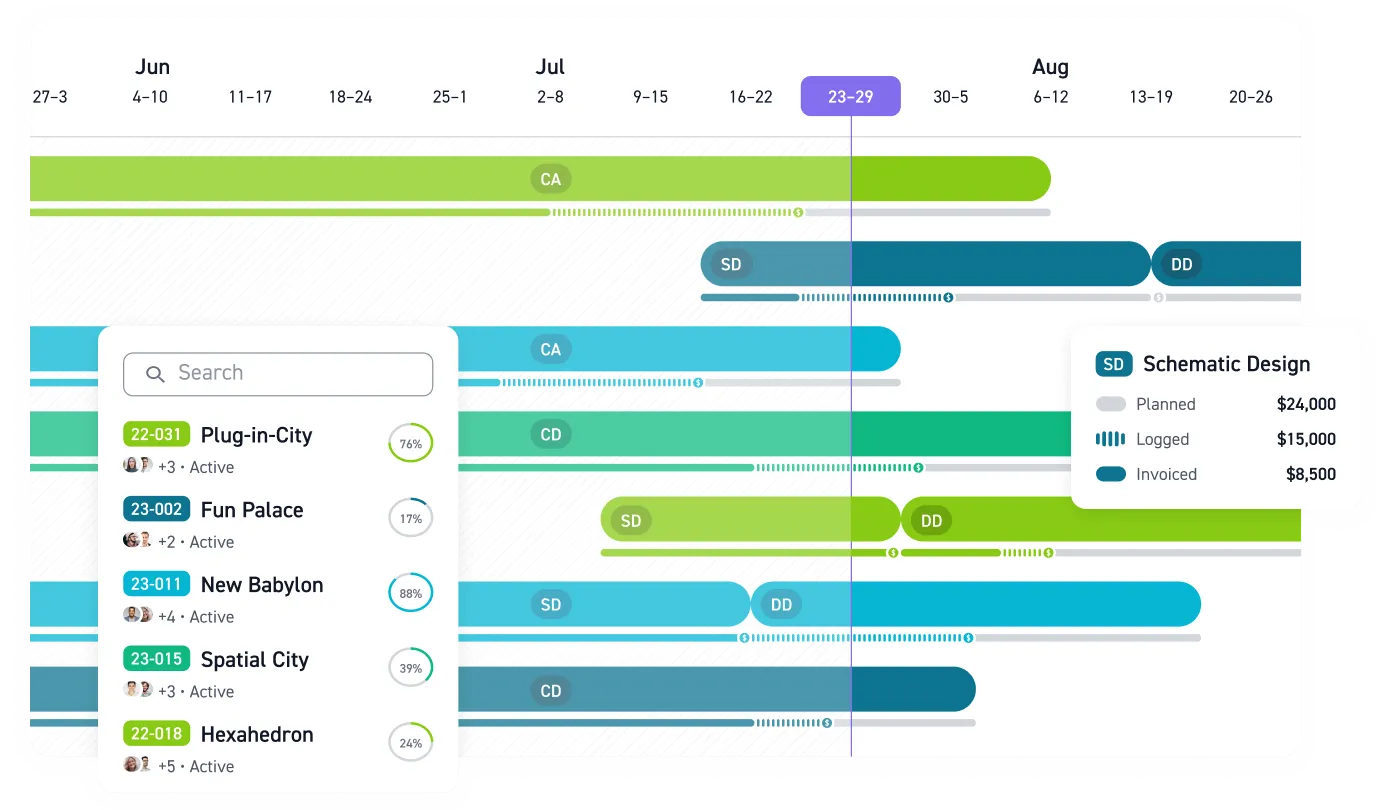
Monograph helps A&E firms track consultant costs alongside internal hours, giving you real-time visibility into project profitability before structural fees eat your margins. No more piecing together spreadsheets to figure out if a project is still on track.
Every hour spent hunting for consultant quotes is an hour lost on design. Book a demo with Monograph.
Frequently Asked Questions
How do I negotiate structural engineering fees without damaging the relationship?
Focus on scope clarity rather than rate reduction. Ask your structural consultant to break down their fee by deliverable or phase so you can see where the effort goes. This opens productive conversations about what's truly necessary versus nice-to-have, and it shows you respect their expertise. The best negotiations happen when both sides understand the work, not when you're haggling over hourly rates.
What should I do when structural fees exceed my initial budget estimate?
First, identify where the variance came from. Was it scope creep, underestimated complexity, or rate increases you didn't anticipate? If you're consistently underbudgeting structural fees, your benchmarks need updating. Track actual consultant costs against estimates across multiple projects to build more accurate internal data. The firms that manage this well treat every project as a learning opportunity for the next one.
How do I compare competing structural engineering proposals fairly?
Don't compare bottom-line numbers alone. Request itemized breakdowns showing hours by phase, hourly rates by role, and any exclusions or assumptions. Two proposals with identical totals can have wildly different scopes. One might include full construction administration while another covers design only. Create a comparison matrix that normalizes for scope so you're evaluating equivalent services.
When should I use percentage-based fees versus hourly rates with my structural consultant?
Use percentage-based fees for straightforward projects with well-defined scope where you want budget certainty. Use hourly rates when project complexity is uncertain, when you need flexibility for design changes, or when the project might pause mid-stream. Many experienced principals negotiate hybrid structures, combining a lump sum for core design services with hourly rates for construction administration and additional services.
How do I budget for potential scope changes with structural consultants?
Build a 20-30% contingency into your structural fee budget for projects with unknowns like poor soil conditions, historic structures, or complex geometries. More importantly, establish change order protocols upfront. Agree on how scope changes will be documented, priced, and approved before the project starts. The awkward mid-project negotiation usually happens because nobody defined the process at kickoff.