



Firm management made easy

Budget Variance Guide for A&E Firms
A $300,000 project that finishes at $325,000 is 8.3% over budget. You already knew that math. The harder question is whether you caught the overrun at week three, when you could adjust staffing and renegotiate scope, or at project closeout, when the only thing left to do was write it off.
Budget variance in A&E firms carries a specific wrinkle that generic project management ignores: your variance calculations need to focus on net revenue rather than gross project fees. Consultant fees and reimbursables can represent 40% or more of a total project contract. If your variance tracking uses gross fees as the baseline, you are measuring the wrong number and making decisions on distorted data. Net revenue is the portion of gross revenue that remains after deducting returns, allowances, and discounts, and before subtracting operating expenses such as employee compensation, overhead, and profit. Everything else passes through.
How A&E Firms Should Calculate Budget Variance
The basic formula is straightforward: Budget Variance = Budgeted Amount – Actual Amount. A positive number means under budget. Negative means over. But for fixed-fee projects with multiple phases and consultants, you need more than subtraction.
Earned Value Management gives finance leaders the precision that basic variance formulas lack. These metrics matter most:
- Cost Performance Index (CPI): Earned Value divided by Actual Cost. Above 1.0 means you're under budget. Below 1.0 means you're burning through fee faster than you're completing work.
- Cost Variance (CV): Earned Value minus Actual Cost. This gives you the dollar amount of your overrun or savings at any point in the project.
- Estimate at Completion (EAC): Uses current performance trends to forecast what the project will actually cost when finished.
- Schedule Performance Index (SPI): Earned Value divided by Planned Value. Below 1.0 means you're behind schedule, which on a fixed-fee project almost always means you're about to be over budget.
These metrics only work if your system calculates them automatically. Manual EVM tracking across a portfolio of active projects guarantees inconsistency. The firms that get real value from earned value are the ones whose tools do the math in real time, freeing finance leaders to focus on decisions rather than data entry.
Why A&E Budgets Go Sideways
The causes are structural. Understanding them helps you build prevention into your process rather than chasing problems after they appear.
Scope creep dominates. Industry research identifies inadequately defined scope as the top issue, cited by both clients and firms. Scope assumptions often lead engineering teams to complete additional work before realizing a client has quietly expanded the deliverable list beyond the original agreement. One large engineering firm reduced negative variances from 0.12 times direct labor to zero net variance through improved scope management, saving $9 million annually.
Fee distribution concentrates risk late. Construction Documents alone accounts for roughly 40% of total fees, with 60% or more landing in the final three phases. Variance discovered during CD or CA has limited correction opportunity. The budget is mostly spent by the time you see the problem.
Coordination time goes unbudgeted. Firms should budget 10% more for coordination activities that task-based estimates consistently miss: PM weekly calls, principal client meetings, and administrative time processing consultant invoices. That project you thought was profitable loses money when nobody accounts for these hours.
Consultant-heavy projects need bigger buffers. For projects with significant consultant coordination, 15-20% contingency is more realistic than the standard 10%. Heavy consultant coordination always takes longer than expected, and tracking each consultant separately keeps overruns visible rather than buried in general project variance.
Benchmarks: What Good Looks Like
Industry median operating profit margin on net revenue reached 20.1% in 2023, the highest level in recent history. High-performing firms hit 25.7%. But those numbers only tell part of the story.
Benchmark data from industry surveys and financial studies reveals discipline-specific targets worth tracking:
- Architecture firms: Median net multiplier of 3.09 with high-profit firms reaching 3.35, utilization at 62-63%, median collection period of 70 days
- Engineering firms: Billing multiple of 3.20 with a breakeven multiple of 2.73, direct labor utilization at 63.1%, median collection period of 76 days
- Variance thresholds: See the threshold guidance for when variances move from routine (under 5%) to documented (5-10%) to immediate management review (above 10%).
According to industry research, firms targeting 15% profit on fixed-fee work have reported actual results landing between 16% and 17%. A one- or two-point swing from the target falls within acceptable variance. The real risk comes when firms lack visibility into what is driving those swings in the first place.
Weekly Monitoring Changes Everything
The single most impactful process shift finance leaders can make is moving from monthly to weekly budget reviews. According to Monograph's analysis, firms implementing structured variance management achieve a 44% reduction in budget overruns by identifying problems early enough to correct them. After moving to real-time financial tracking, Woodhull reported 66% fewer budget overages while also saving 66% of the time they previously spent on administrative work and speeding up billing by 50%.
A survey of nearly 400 firms reinforces this point. Roughly two-thirds of firms with mature financial visibility tools project profit rates of 20% or higher, while firms with less developed tracking capabilities report lower expectations.
Five metrics belong in every Monday morning report: profitability by project manager, budget-versus-actual tracking, labor utilization, cost-to-complete forecasting, and phase-level burn rates. When CPI drops below 0.9 on any project, involve the client immediately. Transparency creates collaborative budget conversations.
Phase-Gate Reviews and Reporting That Works
Phase-gate reviews create formal decision points where projects can be paused, redirected, or terminated before losses accumulate. Gates placed at the end of project initiation, end of planning, mid-execution, and during monitoring give finance leaders structured opportunities to assess whether a project's financial trajectory justifies continued investment.
Reporting structure matters as much as frequency. Tailor the message to the audience:
- Executives and principals: High-level cost-to-complete and variance trends with traffic light indicators
- Project managers: Granular phase-level data with burn rates and CPI/SPI calculations
- Clients: Phase-specific explanations tied to deliverables and clear drivers of change
Weekly budget scorecards with traffic light indicators give teams instant visibility into financial health. Simple color-coding helps everyone respond to emerging issues without waiting for a monthly report that arrives too late for meaningful course correction.
Building the Financial Foundation
Effective budget variance management requires locked baseline budgets preserved for comparison, rolling forecasts updated with current performance data, and phase-based tracking aligned with the standard phases. Your project management platform needs to connect time tracking, billing, and financial reporting in one place so variance alerts fire automatically when budgets hit critical thresholds.
Monograph was built for exactly this workflow. Phase-based profitability analysis, consultant cost tracking, utilization monitoring by role, and automated variance alerts give finance leaders and principals real-time visibility that spreadsheets and disconnected systems cannot deliver. When your tools do the tracking, you spend your time making decisions.
Firms that protect their margins see variance early, understand why it happened, and act before the correction window closes.
Stop Managing Budgets in the Dark
You cannot fix a budget overrun after the project is closed. When your budget-to-actuals live in disconnected spreadsheets and month-end reports, you are always reacting after the fee is already gone.
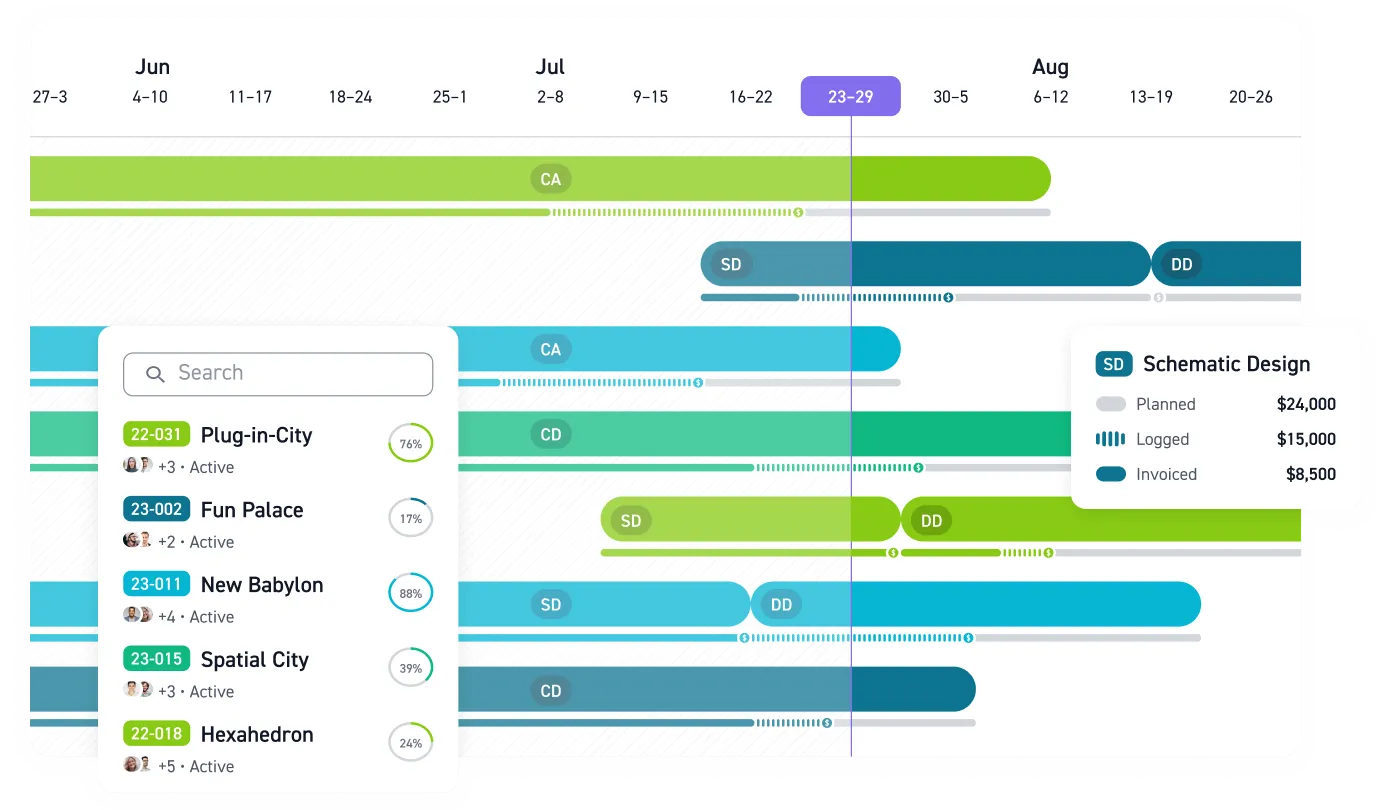
Monograph connects time tracking, billing, and project phases in one place, so CPI, burn rates, and cost-to-complete forecasts stay current without manual math. Monograph's MoneyGantt™ gives you real-time visual intelligence into budget-to-cash progression, making overruns obvious while there is still time to correct them.
Act before the variance becomes a write-off. Book a demo.
Frequently Asked Questions
How do we track variance on projects with heavy consultant involvement?
Start by treating consultants as their own cost bucket, separate from your net revenue baseline. Require invoices to be coded to a phase, whether DD, CD, or CA, before approval so overruns show up where they happen. If consultant costs get lumped into a single "outside services" line at the end of the month, you will always find the problem too late.
Is weekly budget monitoring realistic for a small firm?
Yes, as long as the system does the calculations for you. Manual weekly tracking in spreadsheets turns into a second job, and it usually fails the first time someone gets busy. Weekly reviews work when time entries, consultant costs, and phase budgets roll up automatically into a simple Monday snapshot.
What is the first step to fixing scope creep?
Write down deliverables in a way you can track against them: phases, milestones, and number of iterations. Then tie time tracking to those phases so you can say, in real dollars and hours, "We have consumed the budget for this phase." That visibility gives you the leverage to issue an additional services request while the project is still moving.
What variance threshold should trigger a client conversation?
Use an early-warning trigger. A CPI below 0.9, a phase burn rate that is outpacing deliverables, or an EAC that shows you finishing beyond your fee are all reasons to talk now. The goal is a clean, documented scope and staffing reset that holds up at closeout.