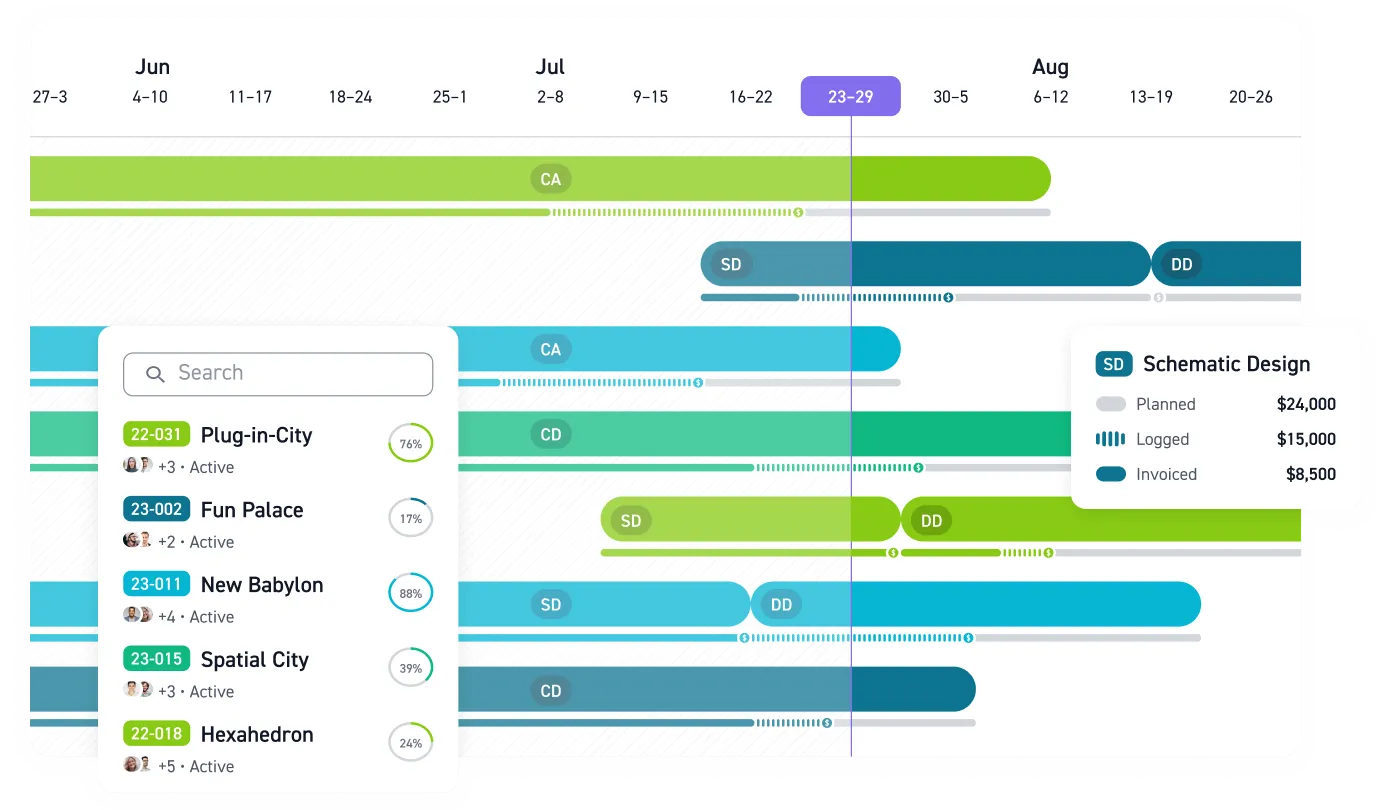

Most A&E firms have lived this problem. A project chews through a phase budget while a lot of the work is still sitting in front of the team. Standard billing reports usually won't show the gap soon enough. By the time it's obvious, the margin is already gone.
The estimate at completion formula exists to catch that disconnect early, before it turns into a write-off. For A&E firms running fixed-fee contracts with thin operating margins, EAC gives you a way to see trouble while you still have options. Architecture firm profitability averaged 13.2% of net billings in 2023. On a fixed fee with a modest margin target, a comparable cost overrun can wipe out the profit entirely.
The Core Variables Behind Every EAC Calculation
Earned value terms can sound academic, but the inputs are familiar to most A&E teams:
- Budget at Completion (BAC): Your total internal cost target by phase.
- Earned Value (EV): The budgeted cost of work actually performed, calculated as percent complete multiplied by BAC. This number is separate from billing or spending to date.
- Actual Cost (AC): All costs incurred to date, including internal labor, direct expenses, and subconsultant costs accrued in the period work was performed.
- Cost Performance Index (CPI): Earned value divided by actual cost. CPI shows whether spending is keeping pace with budgeted output.
Add physical progress into the comparison so you can see whether your spending rate matches your work output. Percent spent and percent complete are separate tracking metrics, and EAC turns the difference into a forecast you can act on.
Four EAC Formulas and When Each One Fits
Every EAC formula answers the same question: what will this project actually cost when it's done? Each formula makes a different assumption about the remaining work.
- Formula 1: EAC = BAC / CPI. Assumes current cost efficiency will continue through completion. Peer-reviewed research found that CPI-based EAC formulas can become reasonably stable and may serve as a conservative cost floor after the project reaches a certain level of completion.
- Formula 2: EAC = AC + (BAC - EV). Assumes past overruns were one-time events and remaining work will proceed at the planned rate. This approach can produce unreliable forecasts under some conditions.
- Formula 3: EAC = AC + Bottom-Up ETC. Throws out the original plan and re-estimates remaining work phase by phase. For many A&E fixed-fee projects, scope changes and phase-specific complexity make re-estimating remaining hours more reliable than formula-based extrapolation.
- Formula 4: EAC = AC + [(BAC - EV) / (CPI x SPI)]. Captures cost overrun and schedule slippage at the same time. Research suggests it can yield a relatively conservative, sometimes more pessimistic, cost forecast.
In practice, each formula fits a different management situation:
- Use Formula 1 when cost performance has stayed consistent across phases.
- Use Formula 2 when you can point to a specific, resolved cause for the early overrun.
- Use Formula 3 when scope, complexity, or staffing assumptions have changed enough that the original plan no longer helps.
- Use Formula 4 when the team is over budget and behind schedule at the same time.
Formulas 1 and 4 can also bracket a defensible cost range for troubled projects. For principals and project managers, that range is often more useful than one overconfident number.
A Hypothetical Project: Formulas in Action
Take a design project where early phases are complete, but one phase ran over budget because client review cycles stretched longer than expected. BAC, EV, and AC now show weak cost performance.
At that point, Formula 2 gives you one forecast if you believe the overrun was isolated. Formula 1 gives you a harsher forecast if current cost performance is likely to continue. That spread signals where management needs to step in.
Making EAC Stick in Practice
EAC only works if percent complete is credible. Gut-feel progress updates distort every downstream calculation, so the cleanest approach is to use objective measures wherever possible:
- CD phases: Count sheets issued versus total sheets planned. This is a units-complete measurement with minimal guesswork.
- SD and DD phases: Assign weighted milestone values to deliverable packages.
- CA phases: Use fixed-formula milestones tied to submittal review completion, site visits, and punch list sign-off.
Those methods make percent complete harder to argue with. Recalculate EAC at billing cycle close, and review the remaining work before authorizing the next phase. Industry data points to a recognized gap in project management training at A&E firms, particularly around financial forecasting.
Subconsultant timing also matters. Accrue estimated subconsultant costs in the period work is performed, then reconcile when invoices arrive, or your EAC will understate actual costs.
From Project Tracking to Fee Intelligence
Applied consistently across projects, EAC creates compounding value at the portfolio level.
- Accurate EAC tracking helps you see where margins slipped before the invoice told the story.
- Completed projects add to a historical CPI record by project type, size, and phase.
- That history supports more accurate fee proposals on the next project.
- Leading A&E guidance recommends tying fees to performance as a consistent practice.
Disciplined project tracking converts past performance into sharper estimates on future work. The 2026 benchmark data shows a wide gap between low-performing and high-performing firms, with realization rates ranging from 83% at the low end to 107% at the top.
One firm using Monograph reported 66% less budget overage, cut admin time by two-thirds, and accelerated billing by 50%. For firms trying to catch margin erosion before it shows up in invoicing, that kind of visibility reinforces the value of disciplined EAC tracking.
Protect Margin Before Late-Phase Losses Compound
If you're a principal, operations leader, or project manager, the next step is straightforward. Standardize how your team measures percent complete, review EAC at billing cycle close, and require a bottom-up re-estimate when the numbers stop matching the story.
That discipline gets harder when budgets, timesheets, consultant costs, and invoices live in different places. For firms still running EAC in spreadsheets alongside QuickBooks, a dedicated A&E platform like Monograph provides phase-based budget management, real-time cost visibility, and profit forecasting in a single view.
See whether your projects will be profitable before the answer is locked in. Book a demo.
Frequently Asked Questions
What is the best EAC formula for a fixed-fee A&E project?
It depends on why the project is off track. If current cost performance is likely to continue, Formula 1 can help forecast the likely outcome. If the overrun came from a specific one-time issue that has been resolved, Formula 2 may be reasonable. If scope, complexity, or phase conditions have changed enough that the original plan no longer reflects reality, Formula 3 is the better choice because it re-estimates the remaining work directly.
How often should an A&E firm recalculate EAC?
Recalculate EAC at billing cycle close. The article also recommends reviewing the remaining work before the next phase is authorized. That cadence gives you a recurring forecast and a decision checkpoint before more budget is committed.
What should we do if percent complete is unreliable?
Use more objective inputs. For CD, count sheets issued against sheets planned. For SD and DD, assign weighted milestone values to specific deliverable packages. For CA, tie progress to fixed milestones such as submittal reviews, site visits, and punch list sign-off. Gut-feel estimates make every downstream EAC number weaker.
Should subconsultant costs be accrued before invoices arrive?
Yes. Accrue estimated subconsultant costs in the period the work is performed, then reconcile when invoices arrive. If you wait for the invoice date instead of the work date, your EAC will understate actual cost and make the project look healthier than it is.
Data was collected as of April 2026.