

If you've ever finished a project wondering whether you actually made money, you're not alone. Fee estimation is where profitability is won or lost, before a single line is drawn or calculation made. Yet most A&E firm principals still rely on gut instinct, outdated percentages, or whatever the competition charged last time.
The firms that consistently protect their margins approach fee estimation systematically. They understand when percentage-based models work, when hourly billing makes sense, and how to allocate fees across phases so Construction Administration doesn't eat their profit. Here's what current industry standards actually recommend.
The Three Fee Structures That Dominate A&E Practice
Most project fees fall into three categories, each suited to different circumstances and risk profiles.
Percentage of Construction Cost remains the standard for full-service architectural projects. AIA B101-2017 made a critical update: fees are now tied to the "owner's budget" at contract signing rather than final construction cost. This protects your firm when clients reduce budgets mid-project—compensation for completed work won't be clawed back. Private sector architecture typically ranges from 7-10% of construction costs for general projects, while high-end residential can justify 10-20%.
Hourly billing is the most common approach overall. In fact, 67% of A&E firms use it as their primary pricing mechanism. It's particularly appropriate for renovation work with unknown existing conditions, consulting engagements with evolving scope, or any project where time requirements are difficult to predict upfront. The tradeoff is client uncertainty about final costs.
Fixed-fee contracts have gained significant traction in architectural practice because they reward efficient firms. Internal tracking remains essential, even with fixed-fee contracts, profitable firms charge time internally at billing rates to understand true project profitability.
Regardless of which model you choose, one thing is consistent: billing rates have increased across the industry. Every firm surveyed by Zweig Group increased rates over the past three years, with a median rise of 11%. If you haven't adjusted your rates recently, you're falling behind market standards.
Current Benchmarks by Project Type
Understanding where your fees fall relative to industry standards helps you price competitively without leaving money on the table:
- Private sector architecture: 7-10% of construction cost for general commercial work; residential commands 8-15%, with renovations at 15-20% due to added complexity
- Federal projects: DoD caps fees at 10% statutory maximum, with a 5.42% baseline for projects under $5M; VA projects are limited to 6% maximum
- MEP engineering: Typically 5-15% of construction cost depending on facility complexity
- Infrastructure and civil: Sliding scale averaging approximately 6.8% for $1-2M projects, 5.9% for $5-10M projects, and 5.4% for projects exceeding $20M
These percentages provide starting points, not absolute rules. Project complexity, client relationship history, and your firm's capacity all factor into final pricing.
Phase Allocation: Where Most Firms Lose Money
Even with accurate total project fees, poor phase allocation creates cash flow problems and margin erosion. Construction Administration is the consistent offender—the research reveals it systematically exceeds allocation because low-bid contractors often need extensive hand-holding, changes, or re-dos. Traditional models allocated 15-20% of fees to CA. Recent industry surveys generally show Construction Administration allocated around 20–22% of total architectural fees, with a typical range of roughly 15–30%, and some firms using 25–30% in their own internal breakdowns. The gap between what firms budget and what CA actually requires reflects a fundamental reality: contractors who win low bids often need extensive hand-holding, RFI responses multiply, and submittals require multiple review cycles.
The following phase distribution reflects current practice for full-service architectural projects:
- Schematic Design: 15-18% of total fee
- Design Development: 15-20% of total fee
- Construction Documents: 35-50% of total fee
- Construction Administration: 25-30% of total fee (minimum 25%)
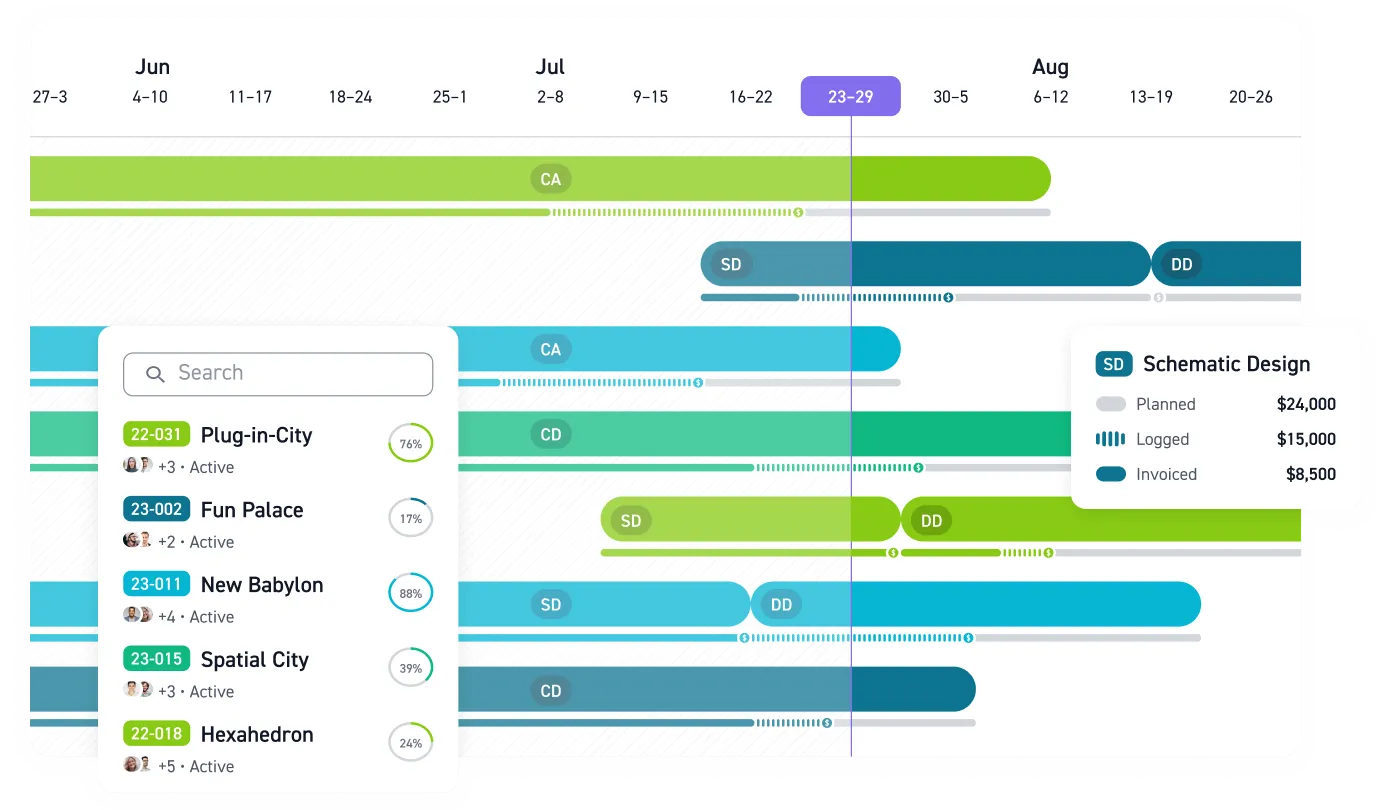
After establishing these allocations, track actual hours against estimates religiously. Firms using project management platforms like Monograph monitor project phases through the platform's phase-based budget tracking and Monograph's MoneyGantt™ visualization, which provides instant visual intelligence by overlaying budget-to-cash progression on project timelines—helping identify projects going off-track without complex calculations.
Building Estimates That Protect Your Margins
The difference between firms that make money and firms that wonder where it went often comes down to estimation discipline. Start with historical project analysis. Study similar projects your firm has completed in terms of size, complexity, and client type. What did you actually spend versus what you estimated? This comparison builds the empirical foundation for accurate future pricing.
Then triangulate using three approaches:
- Bottom-up calculation: Estimate hours by task, apply billing rates, add consultant costs and overhead recovery. This method tends to produce the highest fees because it captures the full scope of work.
- Market-based pricing: Compare your resulting fee to industry percentages and competitor positioning. Use ZweigWhite's fee reports as one reference point alongside your own market data, project complexity, and firm positioning.
- Value assessment: Consider what specific value you're delivering: accelerated schedules, risk mitigation, design innovation, energy savings. Check whether your fee captures it. This triangulation across all three methods catches estimation errors before proposals are submitted.
Define project risks upfront rather than absorbing unforeseen complications later. AIA guidance recommends structuring risk-related services as "if-needed additional services" documented at project onset. This creates scope boundaries, establishes change order justification before problems emerge, and documents the assumptions underlying your original fee.
Making Systematic Tracking Work for Small Firms
The practices described above require data—specifically, accurate records of where time actually goes on projects. This is where many small and mid-size firms struggle. Spreadsheet tracking quickly becomes outdated, and chasing time entries from busy staff feels like administrative busywork.
Modern practice management tools address this directly. Woodhull, a 25-person Maine architecture firm, reduced budget overages by 66% and cut administrative time in half after switching from BQE Core to dedicated practice management software, demonstrating how systematic tracking transforms fee estimation from guesswork into reliable profitability management.
Monograph provides phase-based budget tracking with real-time tracking of burn rates, automated profitability reports, and Monograph's MoneyGantt™ visualization that transforms complex financial data into simple visual insights by showing budget-to-cash progression (planned → logged → invoiced → paid) on project timelines. The platform integrates with QuickBooks Online for firms that want project accounting without replacing their existing accounting system.
The specific tool matters less than the discipline. Whether through dedicated software like Monograph or rigorous manual tracking, successful firms transform fee estimation from guesswork into informed decision-making grounded in empirical project data.
Turn Fee Estimation Into a Competitive Advantage
While you're still piecing together estimates from memory and outdated spreadsheets, your competitors are using historical project data to price with precision. They know exactly how long Construction Administration actually takes, which project types generate the best margins, and where scope creep hits hardest.
Monograph's phase-based budget tracking and Monograph's MoneyGantt™ visualization help you compare estimates against actual performance. So every proposal builds on what you've learned from past projects. Stop guessing at fees and start pricing based on real data.
Your margins depend on the systems you build today. Book a demo with Monograph.
Frequently Asked Questions
When should I use percentage-based fees versus hourly billing?
Percentage-based fees work best for full-service architectural projects where scope is well-defined and you have historical data on similar work. Hourly billing makes more sense for renovation projects with unknown existing conditions, consulting engagements where scope will evolve, or any situation where time requirements are genuinely unpredictable. The key is matching your fee structure to your risk profile—if you can't accurately estimate hours upfront, don't lock yourself into a fixed percentage.
Why does Construction Administration consistently exceed my budget?
CA overruns are an industry-wide problem, not a failure unique to your firm. Low-bid contractors often need extensive hand-holding, RFI responses multiply beyond expectations, and submittals require multiple review cycles. Traditional models allocated only 15-20% to CA, but current practice suggests budgeting 25-30% minimum. If you're still using the old allocations, you're setting yourself up to lose money on every project that goes to construction.
How do I respond when clients compare my fees to lowball competitors?
Start by understanding what you're actually being compared against. Lower fees often mean reduced scope, less experienced staff, or firms desperate for work. Walk clients through your fee breakdown by phase and explain what they're getting—particularly around Construction Administration and risk mitigation services. If a client only cares about the lowest number, they may not be the right fit for your firm. Competing on price alone is a race to the bottom that erodes margins industry-wide.
How can a small firm implement systematic tracking without major overhead?
The key is choosing tools designed for A&E workflows rather than forcing generic software to work. Start by tracking time daily rather than reconstructing it weekly—accuracy drops dramatically when you're guessing at last Tuesday's hours. Use phase-based budget tracking that mirrors how you actually structure projects. Modern practice management platforms like Monograph connect time tracking directly to project budgets and invoicing, eliminating duplicate data entry. The firms that succeed treat tracking as a project management discipline, not administrative busywork.


.png)