


Firm management made easy

You've been asked the same question a hundred times: "When will this project be done?" You already know that "estimated time of completion" means different things to different stakeholders. The answer feels simple until you try to calculate it. Between client review cycles, consultant coordination, and the inevitable scope changes, estimating project completion in architecture and engineering can feel more like guesswork than methodology.
Here's the reality most A&E professionals discover the hard way: "Estimated Time of Completion" is not a standardized metric in the A&E industry. Instead, successful project managers use an approach that combines phase-based planning with proven estimation techniques, real-time tracking, and the industry-standard five-phase project structure to forecast completion with confidence.
Step 1: Speak the Industry's Language
Before calculating anything, you need to understand what "completion" actually means in professional practice. The term "estimated time of completion" does not appear in standard AIA contracts or ASCE guidance, and using vague terminology can create confusion with clients, contractors, and your own team. Instead, use industry-standard terminology: Substantial Completion Date (contractual), Scheduled Completion Date (based on Critical Path Method), or specific phase milestone dates.
AIA defines key milestones that carry real legal weight. Substantial Completion marks when work is sufficiently complete for the owner to occupy and use the project for its intended purpose. Final Completion signifies the full conclusion of all work, including punch list items.
Professional scheduling uses the Critical Path Method rather than a single completion estimate. ASCE's scheduling curriculum establishes CPM as the fundamental scheduling technique for engineering projects, requiring activity-level duration tracking rather than a rolling end date.
When communicating timelines, use these terms:
- Substantial Completion Date (contractually binding per AIA standards)
- Final Completion Date
- Scheduled Completion Date (derived from CPM analysis)
- Phase-based milestone dates (Programming, Schematic Design, Design Development, Construction Documents, Construction Administration)
This terminology aligns with industry contracts. Contractors become entitled to full payment less retainage upon certification of Substantial Completion, making accurate milestone forecasting directly tied to your firm's cash flow.
Step 2: Apply the Standard Phase Structure
Architecture and engineering projects follow a universally recognized five-phase framework. These phases form the foundation of any completion estimate. Effective project management requires structured phases so teams can maintain schedule and budget discipline.
Industry benchmarks confirm consistent allocation patterns across firm types. Here's how time typically distributes across phases:
- Programming/Pre-Design: 5-10% of total design effort
- Schematic Design: Approximately 15% of design time
- Design Development: Approximately 20% of design time
- Construction Documents: 40% of total design time (the dominant phase)
- Bidding and Construction Administration: 5% for bidding; 20% for CA over construction duration
The CD phase requires the largest resource allocation because it encompasses both permit/regulatory documents and construction bid/build documents. Since this phase dominates project timelines, inaccurate estimation of CD duration significantly impacts overall schedule performance. Research on public construction projects found that 39% of cost overruns stemmed from plans and modifications, making detailed CD work particularly critical to accurate scheduling.
To manage the CD phase effectively, establish coordination checkpoints at 30%, 60%, 90%, and 100% milestones to ensure disciplines review connected drawings and identify conflicts before they become expensive problems.
Step 3: Select the Right Estimation Method
We don't apply the same estimation approach to every project. Think of estimation methods like structural systems, and choose the right approach for the loads your project will carry. Project managers should match estimation methods to project complexity, client sophistication, contract type, team size, and regulatory requirements.
Three estimation methods serve different project needs:
- Analogous (Comparative) Estimation
- Three-Point Estimation (PERT)
- Critical Path Method Analysis
Analogous Estimation uses historical data from completed projects to forecast new ones. Select 3-5 similar projects, extract actual hours by phase, normalize the data by hours per square foot or hours per sheet, and adjust for differences in complexity and team experience. Build in contingency based on degree of similarity: 10-20% for close matches and 25-40% for loose analogies.
Three-Point Estimation (PERT) quantifies uncertainty by gathering optimistic, most likely, and pessimistic estimates for each phase. The formula produces a weighted average that accounts for risk: Expected Time = (optimistic + 4×most likely + pessimistic) ÷ 6. After project pauses, increase the pessimistic estimate by 15-25% to account for team reorientation time.
Critical Path Method Analysis maps all project activities and their dependencies to identify the longest sequence of tasks that determines minimum project duration. Activities on the critical path cannot slip without delaying completion, while activities with float can absorb delays without schedule impact.
Begin every estimate by understanding the client's business and project drivers.
Step 4: Build Strategic Buffers
Budget strategic buffers at these critical points:
- Cross-disciplinary review buffers: time for coordination at each phase transition, particularly when engaging engineering consultants
- Paused project buffers: 10-20% additional time upon restart for team reacquaintance with project status
- Scope change buffers: tracked via change log with cumulative schedule impact
Project managers who involve engineers during Schematic Design achieve better schedule performance compared to those who delay coordination until Design Development.
Configuration management systems provide the paper trail needed to track scope evolution and prevent uncontrolled changes from derailing schedules.
Step 5: Track Progress in Real-Time
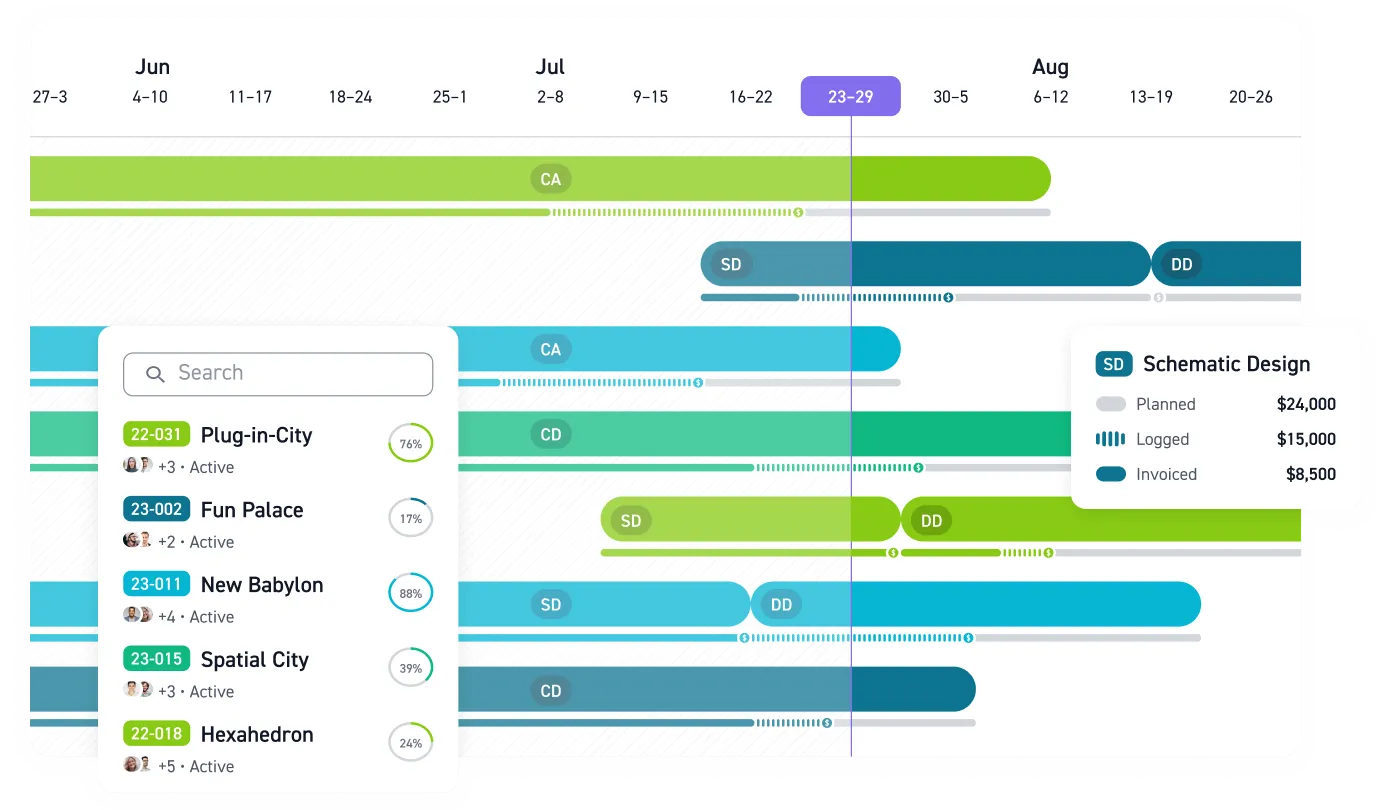
Rather than maintaining separate systems for time tracking, scheduling, and budgeting, firms are adopting project management platforms that connect these workflows. When hours tracked against a phase immediately appear alongside original estimates, project managers can intervene before small variances become schedule-breaking problems.
We see firms transform their forecasting accuracy when they track time daily against phase allocations, compare progress to Critical Path Method milestones, and maintain real-time visibility into resource utilization across all active projects. For example, Woodhull, a 25-person Maine architecture firm, reduced budget overages by 66% after implementing phase-based tracking with daily time logging. This transformed their completion forecasting from reactive to predictive.
The stakes for getting this right are significant. Industry research found that 44% of construction projects end at a loss. Timeline accuracy directly impacts whether your firm lands in that category or among the profitable majority.
Turn Estimation Methods Into Accurate Forecasts
You now have the framework: industry-standard terminology, phase-based planning, proven estimation methods, strategic buffers, and real-time tracking. The question is whether your current systems can actually execute these concepts.
Monograph connects the dots between estimation and reality. Phase-based budgets flow directly into daily time tracking. Hours logged against each phase appear instantly alongside your original estimates, so you can spot variances before they become budget-breaking problems. When a project drifts from schedule, you'll know, and you'll have the data to explain exactly why.
Every inaccurate estimate costs you money and credibility. Book a demo and see how phase-based tracking transforms completion forecasting from guesswork into defensible planning.
Frequently Asked Questions
How do I estimate completion when 25-30% of my projects pause unexpectedly?
Build pause buffers into your initial estimates by adding 10-20% additional time upon restart for team reorientation. Track paused projects separately and update your PERT pessimistic estimates when projects resume. The key is maintaining accurate records of where you stopped so restart doesn't require rediscovering project status.
Should I give clients a single completion date or phase-based milestones?
Always provide phase-based milestones rather than a single date. Clients understand that Schematic Design approval comes before Construction Documents can begin. Phase milestones give you natural checkpoints to discuss progress and manage expectations, and they align with how AIA contracts actually structure deliverables and payments.
How often should I update my completion forecasts?
Update forecasts at every phase transition and whenever actual hours exceed 10% of phase budget. Weekly check-ins work well for active projects. The firms with the best forecasting accuracy track time daily and compare progress to CPM milestones weekly, catching variances before they compound.
Is three-point estimation worth the effort for smaller projects?
For projects under $50,000 or with straightforward scope, analogous estimation using 2-3 similar past projects is usually sufficient. Reserve PERT for complex projects with multiple unknowns, new project types you haven't done before, or when you need to communicate schedule risk to clients who want to understand the range of possible outcomes.
How do I communicate schedule slippage to clients without damaging the relationship?
Lead with data, not apologies. Show the original estimate, the actual hours tracked, and the specific factors that caused the variance, whether that's scope changes, consultant delays, or permit review timing. Clients respect transparency and concrete explanations far more than vague promises to get back on track.