


Firm management made easy

The majority of A&E firms plan to invest in AI and automation tools in the next two years. Yet many project managers still aren't clear on what generative AI actually does or how it differs from the automation tools they already know.
The confusion is understandable. Every software vendor claims their platform is "AI-powered," and generic business advice rarely addresses the specific challenges of coordinating consultants, managing design phases, and tracking project profitability. But generative AI represents a major change that's beginning to transform how architecture and engineering firms operate, though most are still in early adoption stages.
Understanding Generative AI Beyond Automation
Generative AI differs fundamentally from traditional automation in how it handles complex work. Traditional automation analyzes your existing project data, flags issues, and improves schedules based on historical patterns. Generative AI, by contrast, creates entirely new content that didn't previously exist. This includes design alternatives, specification language, and detailed project narratives drawn on patterns learned from massive training datasets.
While traditional automation excels at high-volume repetitive tasks like data entry and status tracking, generative AI handles complex knowledge work requiring synthesis, creativity, and contextual understanding. For A&E project managers, this means AI transitions from being a tool that makes repetitive tasks faster to becoming a creative partner. It can draft specifications, generate design alternatives, and synthesize complex project information using natural language instructions.
Think of it this way: traditional automation is like a sophisticated filing system that instantly retrieves documents and generates reports from structured data. Generative AI is like having a knowledgeable colleague who has read every project manual, specification, and building code your firm has used, and can now help you draft new documents or synthesize complex information using conversational language.
The core difference lies in three key areas. Traditional tools follow pre-programmed rules requiring explicit instructions for each scenario. Generative AI learns patterns from massive training data and adapts contextually. Traditional automation excels at repetitive tasks like timesheet compilation and invoice generation. Generative AI handles complex knowledge work requiring synthesis and creativity. Most importantly, traditional systems analyze what already exists and improve based on historical patterns. Generative AI creates entirely new content including designs, documents, specifications, and solutions that didn't previously exist.
AI is codifying, automating, and distributing organizational expertise in ways that fundamentally reshape knowledge work. It transforms AI from a productivity tool for repetitive tasks into a creative partner for complex work.
Eight Practical Applications for A&E Project Managers
AI applications in project coordination have been documented by industry organizations, but the A&E industry remains in early adoption stages. While these applications represent practical solutions to common project management challenges (document automation, communication tracking, scheduling assessment, design review, compliance monitoring, financial documentation, risk forecasting, and knowledge management), most civil engineering firms have not yet effectively integrated AI into daily operations at scale.
Documentation and communication applications represent the most immediate opportunities:
- Automated document organization and version control reduces time spent hunting through project files and maintains consistent documentation standards
- Communication log capture and searchability transforms scattered email threads and meeting notes into organized, retrievable project history
- Compliance tracking and verification automatically monitors code requirements, permit conditions, and contractual obligations while checking project documentation against these standards
These tools address the administrative burden that pulls project managers away from higher-value work. Research estimates that as much as 80% of today's project management tasks could be eliminated by 2030 as AI takes over routine activities like data collection, tracking, and reporting. However, realizing these benefits requires careful implementation. AI-generated outputs are neither repeatable nor explainable and demand rigorous professional review before use in project decisions.
Rather than spending hours organizing files and tracking compliance manually, AI can handle routine coordination tasks. But only when data quality is sufficient and humans remain involved to verify results and manage complex decision-making that depends on contextual judgment and professional accountability.
Advanced project management capabilities tackle coordination challenges across disciplines:
- Schedule feasibility assessment and scenario simulation automates evaluation of multiple timeline approaches before committing resources. Contractors like Zachry use AI to evaluate scheduling possibilities.
- Design review and quality control checking automates error detection across disciplines. Major firms including AECOM implement AI-based review tools.
- Risk forecasting and resource planning analyzes historical project data to predict likely issues and recommend deployment strategies.
These applications shift project managers from reactive problem-solving to more proactive project coordination. AI-powered tools like ALICE Technologies help assess construction schedule feasibility and simulate multiple timeline scenarios before committing to specific approaches. Predictive tools analyze patterns to warn when scope creep is building, allowing early intervention before it impacts deadlines. Rather than discovering problems after they cascade, project managers can now anticipate challenges and evaluate alternative approaches proactively.
The most sophisticated applications focus on knowledge management and insights:
- Information retrieval from standards provides instant access to technical guidance and lessons learned from previous projects. For example, ASCE launched AI-powered search tools in November 2025, including "Eaves" (a chat-style search function) and "CORI" (Collaborate's Organizational Research Intelligence) to help civil engineers quickly locate information from ASCE's standards and publications, providing "detailed, tailored answers and guidance using ASCE's trusted standards"
- Accounting and financial documentation automation speeds up cost tracking, budget monitoring, and financial reporting processes. AI-based tools automate these functions to shift project managers from document creation to review and approval roles.
ASCE has already deployed this approach with their "Eaves" search tool, providing civil engineers with detailed answers using ASCE's trusted standards. This represents practical implementation of AI for daily technical decision-making rather than experimental technology.
Expected Benefits and Timeline
For A&E project managers specifically, generative AI targets the most time-consuming aspects of coordination work that industry research has identified as automation opportunities. Status report generation, schedule updates, resource allocation documentation, compliance tracking, and meeting minutes represent the primary administrative burdens AI can handle automatically. McKinsey's research projects even broader impact, estimating that generative AI could automate up to 70% of business activities by 2030. This includes project coordination, documentation creation, client communications, meeting preparation, and proposal development. These are core responsibilities for most A&E project managers.
However, this represents role transformation rather than elimination. While routine administrative tasks become automated, humans remain essential for complex problem-solving, long-term planning, client relationship management, and creative solution development. Specifically, this shift allows project managers to focus on higher-value work requiring professional judgment, stakeholder coordination, and the kind of contextual understanding that complex project delivery demands.
Implementation Strategy That Works
Starting with enterprise-wide AI deployment is a recipe for failure. As many as 30% of generative AI projects are abandoned after proof of concept, with poor data quality, escalating costs, and unclear business value as primary failure factors.
Successful implementation requires targeted pilot programs focused on specific use cases, following research-backed best practices. Success rates improve dramatically when firms focus on AI that’s integrated with proprietary data rather than generic applications.
Identify 1-2 applications aligned with business priorities (schedule assessment, cost forecasting, or document coordination) and establish measurable success metrics before expanding. This approach prevents the common failure pattern of escalating costs and unclear business value. Focus specifically on areas where your firm possesses proprietary data creating competitive advantage, such as your project history, internal standards, or specialized methodologies, rather than generic business applications that lack differentiation.
Workshop/APD, a 50+ person New York firm, achieved 50% profit growth by focusing their implementation on specific workflow improvements rather than enterprise-wide deployment. This demonstrates the effectiveness of targeted pilot programs over broad AI initiatives.
The research emphasizes this disciplined pilot approach as essential: measure specific KPIs, validate business value, and only then scale to broader implementation. This strategy directly addresses why only approximately 6% of organizations achieve sustained AI success. Early adopters in the A&E industry are gaining competitive advantages over firms deploying AI more broadly without clear focus.
Data quality and privacy considerations require proactive attention rather than reactive responses:
- Audit current data quality and accessibility before implementing AI tools. Poor data quality ranks as the primary reason for generative AI project abandonment.
- Establish clear policies defining what project data can be used with AI systems, particularly protecting client information, proprietary designs, specifications, and cost data from exposure through public AI tools.
- Document governance procedures for client transparency and professional liability protection, especially regarding how AI-generated content is reviewed and verified before use in client communications.
- Evaluate enterprise AI solutions with private environments versus public tools that may expose confidential information. Public AI platforms may use prompts and replies as additional training data.
Change management becomes critical for sustainable adoption. Expecting junior professionals to teach senior colleagues creates problematic dynamics despite their eagerness with new technology. Instead, treat AI adoption as company-wide changes requiring executive sponsorship, structured training programs appropriate to role and experience level, and communities of practice for peer learning. This approach, rather than relying on informal knowledge transfer, ensures consistent adoption and reduces resistance across experience levels.
Never assume AI outputs are accurate without professional review. Establish workflows where AI generates initial outputs and humans verify all results, particularly for client communications and technical decisions affecting project delivery.
The Reality of Early Adoption
Early adopters are already gaining competitive advantages through systematic approaches. Many A&E firms have already established formal AI policies, indicating that forward-thinking firms are moving beyond experimentation into structured adoption.
The key insight from successful early adopters is that AI works best as an enhancement to existing workflows rather than replacement of entire processes. For project managers, the point is that the technology is mature enough for practical application but requires systematic implementation. The question isn't whether AI will transform project management in A&E firms. It's whether you'll be among the early adopters who shape how that transformation unfolds.
Stop Managing AI-Era Projects with Spreadsheet-Era Tools
The challenge has never been understanding AI's potential. It's implementing solutions that actually work for A&E firms managing complex, multi-phase projects.
While you're hunting through spreadsheets for budget data and chasing down consultant updates across five different systems, firms across town are using AI-powered platforms built specifically for architecture and engineering workflows. They're getting real-time project intelligence, automated documentation, and predictive insights that let them focus on delivering great work instead of administrative coordination.
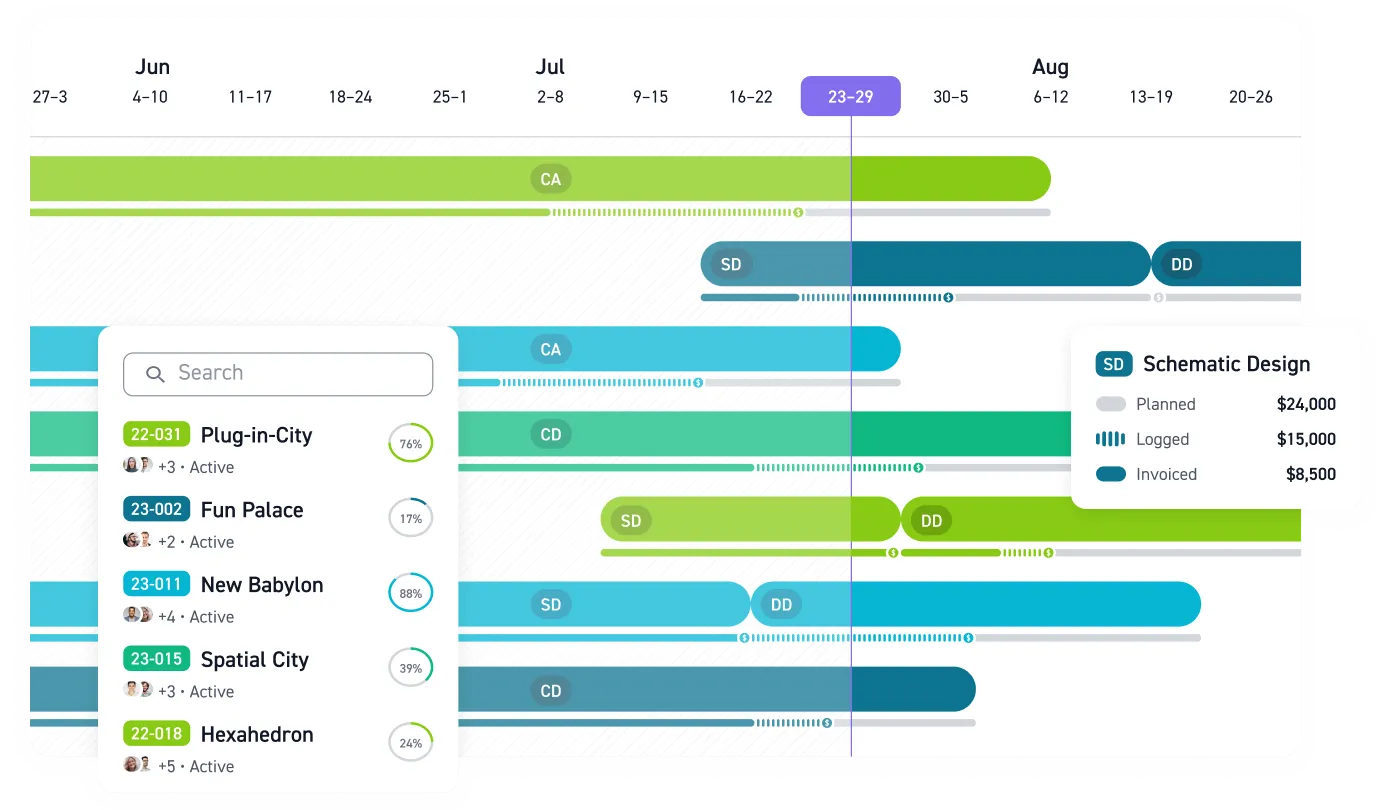
Monograph brings AI capabilities to the workflows you already use. Track project profitability in real-time with our signature Monograph's MoneyGantt™ visual intelligence. Automatically capture time entries that flow into accurate invoices. Get early warnings when projects drift off budget before problems cascade. Monitor utilization and capacity across your entire team without manual spreadsheet updates.
13,000+ architects and engineers across 1,800+ firms already use Monograph to work smarter. These aren't experimental pilots. They're daily operations that combine A&E-specific workflows with the kind of intelligent automation that actually helps project managers coordinate better and deliver more profitably.
Whether you're a project manager drowning in coordination tasks, an operations leader simplifying workflows, or a principal seeking profitability clarity, Monograph gives you the AI-powered intelligence A&E firms need to compete today.
Your competitors are already using AI-powered project management. Close the gap. Book a demo with Monograph.
Frequently Asked Questions
How do we start implementing AI without disrupting active projects?
Start with one or two pilot applications on new projects rather than retrofitting existing work. Focus on administrative tasks like documentation organization or schedule assessment that won't impact active design or engineering deliverables. Firms like Workshop/APD achieved 50% profit growth by targeting specific workflow improvements instead of enterprise-wide deployment. Run your pilot for 2-3 months, measure specific results, then expand gradually based on what actually works.
What if our project data isn't ready for AI tools?
Most A&E firms worry their data is too messy for AI implementation. The truth is you don't need perfect data to start. You need to begin where you are and improve as you go. Audit your current project documentation and time tracking first. Identify 1-2 areas where data quality is strongest (like recent project budgets or consultant billing) and pilot AI tools there. Poor data quality ranks as a primary reason for AI project abandonment, so address gaps proactively rather than waiting for perfect information that never arrives.
Will AI-generated outputs create professional liability issues?
AI outputs require professional review before use in client communications or technical decisions. No exceptions. Establish workflows where AI generates initial drafts and licensed professionals verify all results. MIT Sloan research notes that generative AI tools produce outputs that are "neither repeatable nor explainable," creating specific liability considerations. Document your review processes, maintain audit trails, and ensure your professional liability insurance covers AI-assisted work. Many firms are already using AI with proper governance. The key is treating it as a tool requiring professional oversight, not autonomous decision-making.
How long before we see ROI from AI implementation?
Targeted pilot programs show measurable results in 2-4 months when focused on specific use cases. Woodhull, a 25-person architecture firm, cut billing process time in half within six months through automated documentation tools. The key is choosing applications with clear, measurable outcomes (time saved on administrative tasks, faster invoicing cycles, improved budget accuracy). Avoid enterprise-wide deployments that take 12-18 months to show value. Start small, measure specific KPIs, validate business impact, then scale what works.
Do we need technical expertise to use AI project management tools?
No programming required. Purpose-built platforms like Monograph integrate AI capabilities into workflows A&E professionals already use (time tracking, budget monitoring, project coordination). The best AI tools for A&E firms work behind the scenes, automating routine tasks without requiring you to learn complex new systems. Focus on platforms designed by practitioners who understand architecture and engineering workflows rather than generic business software requiring extensive customization.

.png)