


Firm management made easy

A&E billing is unlike any other professional service. A law firm bills hours. A software company bills subscriptions. An architecture firm might bill the same client differently on five concurrent projects, depending on contract structure, phase completion, consultant involvement, and client-specific format requirements. When your invoicing process can't handle that complexity, you lose efficiency and money.
And right now, the industry is losing a lot of it. The average collection period for architecture firms sits at 81 days. For underperforming firms, the full billing-to-collection cycle stretches to 90–120 days, meaning a full quarter of revenue is tied up in work-in-progress and receivables at any given time. Firms carry heavy fixed overhead, including specialized talent, high-end workstations, and Revit licenses, that doesn't pause while invoices wait for approval. The gap between work performed and cash collected is where A&E firms quietly bleed out.
The Billing Complexity That Generic Tools Can't See
Industry contract guidance from ACEC identifies phase-based billing as a persistent challenge for both firms and clients, and the problem is structural rather than procedural.
Three factors make A&E invoicing fundamentally different from standard business billing:
- Multi-phase project structures. Each project phase, from SD through DD, CD, and CA, carries its own budget, billing schedule, and cost tracking requirements. A single project might have five phases billed under three different methodologies.
- Consultant cost reconciliation. Consultant fees represent 40% or more of total fees on architectural projects. For a $2M firm, that's $800K+ in pass-through costs that must be tracked per phase, reconciled against contracts, and itemized correctly on client invoices.
- Project-specific customization. A&E firms often face custom requirements per project that demand nuance at invoice time, from lump-sum phase caps to hourly additional services to consultant markup structures.
Generic invoicing tools like standalone QuickBooks, FreshBooks, or Xero have no native concept of project phases. They can't connect consultant bills to specific phases, enforce budget caps, or generate invoices that reflect the billing logic embedded in A&E contracts. The result is elaborate spreadsheet systems that Finance Managers maintain alongside their accounting software, each one a separate source of potential error, each one producing data that's a week to a month out of date.
The Measurement Gap Costing You More Than You Think
The most expensive billing problems are the ones you can't quantify. Many firms still run invoicing with limited visibility into the KPIs that actually move profitability. Industry benchmarks from the annual A&E industry study highlight how closely realization, overhead, and DSO track firm performance.
Three measurement gaps show up repeatedly in billing and collections work:
- Realization visibility. Teams need a consistent way to compare worked time to billed revenue and collected cash, then trace write-downs back to the phase, scope, or staffing plan that caused them. Published realization benchmarks are a useful baseline for what healthy firms aim for.
- Overhead visibility. If overhead is only understood at tax time or after year-end close, project-level course correction comes too late. Industry overhead benchmarks make it clear how quickly small variances add up.
- Market pressure signals. When billings soften, firms feel it first in delayed approvals, slower scopes, and longer DSO. The ABI trend data is one of the clearest public signals that the billing environment can tighten quickly.
Firms that can't measure realization can't identify unbilled time, benchmark billing performance, or calculate the return on any improvement effort. Small firms often feel slowdowns first, and recent ABI readings have reflected that volatility. The pressure is real, and firms without visibility into their own billing metrics are navigating it without a compass.
What A&E Invoice Management Software Needs to Do
Industry analysts consistently identify specific capabilities that separate effective A&E billing tools from generic invoicing software. One leading consultancy names the top priority clearly: stronger project accounting controls to avoid errors and delays in billing.
In practice, this means specific functionality across four areas:
- Phase-level budget tracking. Every phase needs its own budget, billing schedule, and real-time cost visibility. Professional guidance requires firms to track net revenue per project, not just total revenue. This requirement sits at the foundation of project accounting.
- Automated time-to-invoice workflows. Time entries should populate invoice line items with zero manual re-entry. Collections best practices recommend generating invoices immediately after milestones or phases are completed. Every day between milestone completion and invoice submission extends your collection timeline.
- Subconsultant billing reconciliation. With consultant fee data often representing nearly half of total project fees, your software must handle pass-through billing with configurable markup, reconcile consultant invoices against phase budgets, and generate client invoices that properly itemize those costs.
- Bidirectional QuickBooks sync. One-way integrations mean project managers and finance teams work from different data. A two-way sync updates both systems, prevents double entry, and keeps everyone on the same numbers without monthly reconciliation marathons.
Beyond these fundamentals, CFOs managing 15–30 active projects need real-time dashboards that drill from firm-level overview down to individual phase profitability. Effective platforms must provide interactive analytic tools that make it easy to draw insight from data and measure progress against KPIs. Static monthly reports don't cut it during a billings slowdown, when projects can pause and restart mid-month.
What Tighter Billing Actually Produces
Customer results show what's possible when invoicing gets tighter. Workshop/APD, a 50+ person firm in New York, reported 50% profit growth after moving to Monograph, alongside a 50% efficiency gain and a 2x confidence boost.
For firms like Workbench, a 30-person practice in California, documented results include a 4x faster billing process and 75% less unbilled fees, directly converting operational cleanup into captured revenue.
When billing cycles tighten, the impact shows up fast: less time assembling invoices, fewer fees stuck in work-in-progress, and fewer write-downs caused by late consultant costs or missed billable time. Project teams get that capacity back for design work and client management instead of spreadsheet reconciliation.
Broader collections benchmarks show what's possible when billing processes improve. Against the industry's 81-day average, even modest DSO improvements free meaningful working capital.
How Monograph Fits This Picture
Monograph was built specifically for this problem. It operates as a layer above QuickBooks, handling A&E-specific operations like phase budgeting, staff utilization, time tracking, and invoicing, while QuickBooks manages core accounting. Finance teams keep their existing infrastructure while gaining billing capabilities designed for project-based work.
The invoicing workflow eliminates manual data re-entry by connecting each step in the billing cycle:
- Timesheets generate drafts. Approved timesheets populate draft invoices with phase percentages, consultant costs, and reimbursable expenses already in place.
- Finance teams push to QuickBooks. Completed invoices sync to QuickBooks with a single action, keeping both systems aligned without double entry.
- Phase costs update in real time. Labor costs appear next to estimates per phase, and consultant fees are tracked as separate line items by discipline.
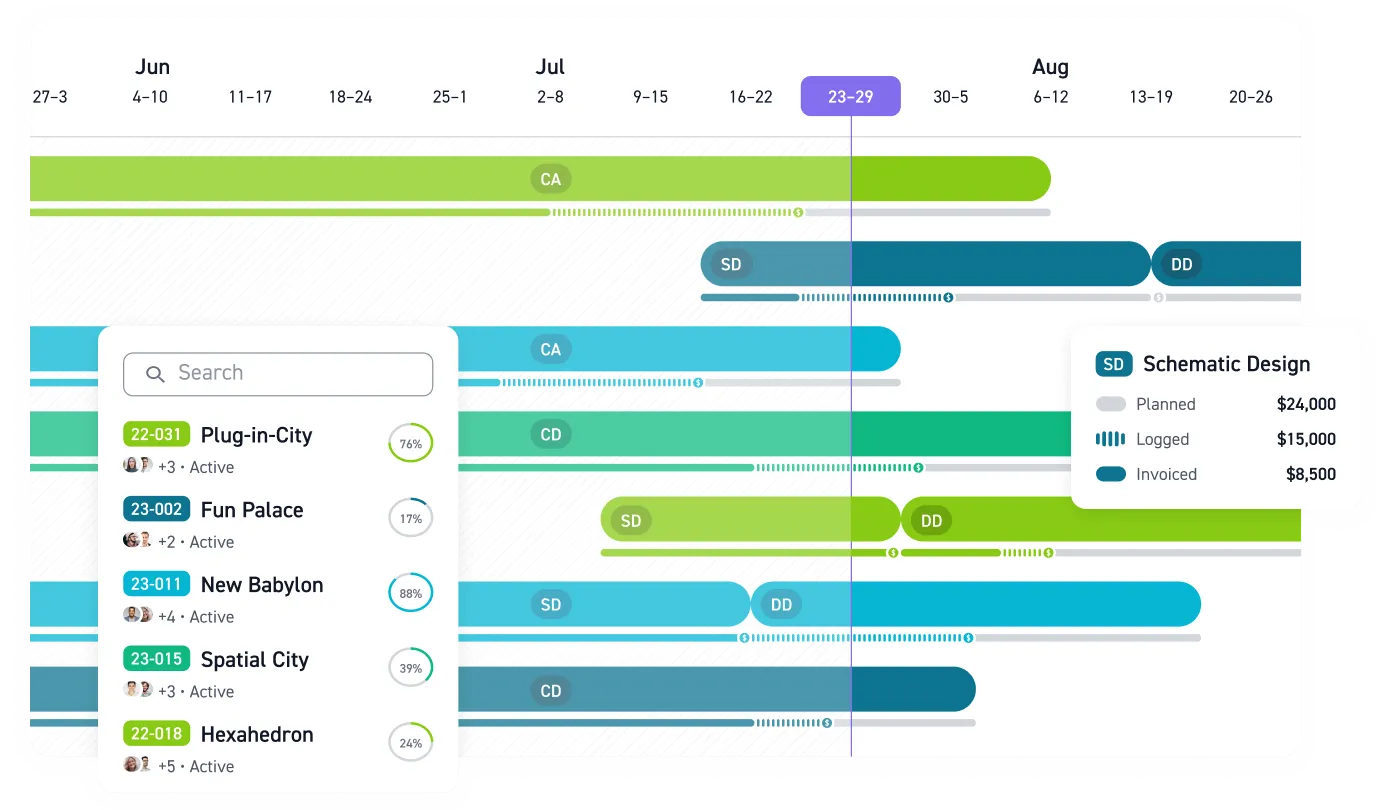
- Budget burn stays visible. Monograph's MoneyGantt™ feature overlays budget-to-cash progression on project timelines, giving Finance Managers a visual budget burn view without building it manually in Excel.
For firms running 10–20 active projects with multiple phases each, the difference between managing billing through disconnected spreadsheets and managing it through a purpose-built system is significant. Finance Managers catch budget overruns the week they start instead of discovering them at month-end close.
Stop Losing Revenue in Your Invoicing Process
Generic invoicing tools don't understand phases, fee caps, or consultant pass-through costs. So your team builds a parallel system in spreadsheets, then spends the month reconciling the spreadsheet back to accounting. That's where the write-offs, delays, and cash-flow gaps start.
Monograph was built for A&E billing realities: phase-level budget tracking, time-to-invoice workflows, consultant cost visibility, and a workflow that works alongside QuickBooks.
Don't wait another billing cycle to find out what you missed. Book a demo and see what invoice management looks like when your software understands how A&E projects actually run.
Frequently Asked Questions
Our firm already uses QuickBooks. Why do we need another tool for invoicing?
QuickBooks is a strong general ledger, but it wasn't built around how A&E projects work day to day. It doesn't natively handle phase-based budgets, phase-specific billing logic, or the messy reality of pass-through consultant costs tied to specific phases.
Monograph sits on top of QuickBooks as the A&E operations layer. Your project teams manage time, phases, and invoice drafts in a project-first system, and Finance keeps accounting clean by syncing invoices back to QuickBooks.
Can invoice management software handle mixed contract types on the same client?
It should. A&E billing almost always turns into a blend: fixed-fee base services, hourly additional services, reimbursables, consultant pass-through, and phase caps that vary by project.
The practical test is whether your system can track budgets and actuals by phase, generate invoice drafts that match the contract structure, and keep that logic consistent without rebuilding spreadsheets every month.
How do we keep consultant pass-through costs from turning into write-offs?
Start by treating consultant costs like first-class project financials and reconciling them early. When consultant invoices aren't coded to the right project and phase, they show up late, blow past phase budgets, and force awkward invoice corrections.
The right workflow ties consultant costs to the same phase budgets you're billing against, so PMs and Finance can see overruns while there's still time to respond.
What kind of ROI is realistic from fixing invoicing and billing workflows?
It usually shows up in three places: less time spent assembling invoices, fewer billing mistakes, and higher realization because fewer billable hours and costs slip through the cracks.
The documented outcomes in the industry are meaningful. Firms have reported significant profit lifts after switching to modern firm-management systems, and teams like Workbench have shared results including 4x faster billing and 75% less unbilled fees. Even small improvements in DSO and write-downs can free up real cash when you're running high fixed overhead.