

If you're spending Friday afternoons chasing timesheets instead of reviewing design work, you already know the problem. Most A&E firms start with spreadsheets that feel manageable at five people but become unreliable by fifteen. A practitioner in the AIA Technology community described exactly this: their 15-person firm's Excel-based tracking had become problematic as they grew.
The real cost goes beyond the administrative headache. It's the profitability you can't see. The numbers back this up: 52% of firms report at least one in four projects going over budget. That number drops significantly when firms track time and expenses at the phase level using time tracking software built for how A&E projects actually work.
Why Phase-Level Tracking Changes Everything
Here's what aggregate project tracking hides: profitable phases masking losses in other phases until it's too late to correct. Project performance research confirms that phase-level tracking reveals the true cost drivers that firm-level averages obscure.
One case study makes the point clearly. A firm with a 3.06 direct labor multiplier, sitting just below the 3.10 breakeven threshold, still found $4.7 million in annual profit improvement by implementing phase-level tracking through PSMJ's Enterprise Project Performance System. Their overall numbers looked fine. Their phase-level numbers told a different story.
The results hold at smaller firms too. Woodhull, a 25-person architecture firm in Maine, reduced budget overages by 66% and cut administrative time by 66% after implementing systematic phase-based tracking. Small firms implementing profitability management report 15-25% margin improvements within their first quarter.
Structuring Time Tracking Around Project Phases
Time tracking in A&E firms should map directly to AIA-standard project phases, each with a specific budget allocation. These percentages, synthesized from AIA data, give you a starting framework:
- Schematic Design (SD): 15-20% of total fee
- Design Development (DD): 20-25% of total fee
- Construction Documents (CD): 35-40% of total fee
- Construction Administration (CA): 15-20% of total fee
For a $100,000 fee project, that translates to roughly 150-200 hours for SD, 200-250 for DD, 350-400 for CD, and 150-200 for CA. These aren't just planning numbers; they're the guardrails that prevent phases from quietly consuming your margin.
The AIA Design Development checklist addresses management, quality management, schedules, and project tracking. This vigilance requires real-time phase-level data, not end-of-month reconciliation.
Construction Administration deserves special attention. Break it into distinct categories: site visits, RFI reviews, submittal reviews, change order reviews, and punch list activities. When your CA phase runs hot, you need to know exactly why. Generic hour totals won't tell you.
Four Expense Categories That Need Separate Treatment
Time is only half the picture. A&E firms manage four distinct expense types, each requiring its own tracking approach:
- Consultant and subconsultant fees: Track as separate line items by discipline (structural, MEP, civil, landscape) with distinct cost codes. Fee and billing research identifies passthrough versus markup treatment, contract structure differences, and payment timing misalignment as key reasons these need individual tracking.
- Reimbursable expenses: Mileage, travel, parking, and project-specific costs billed with different markup structures than professional services.
- Direct labor costs: Professional hours by staff level plus project-specific supplies and materials, the foundation of your profitability calculation.
- Overhead allocation: Indirect costs spread across projects using multipliers, requiring a consistent allocation method.
For firms in the 5-50 employee range, firm-wide overhead allocation typically works better than project-specific methods. It's simpler to maintain and still provides the profitability visibility you need. That said, many successful A&E firms combine both approaches, tailoring cost allocation to suit different project types.
Track every category at the phase level. When consultant invoices and reimbursables are attributed to the correct phase, you get an accurate picture of where your money actually goes, not just where your hours go.
The Metrics That Tell You Where You Stand
You can't manage what you don't measure, but you also can't manage what you measure wrong. These four metrics connect daily time entries to the financial outcomes principals and PMs care about.
Based on benchmarking data from analysis of 337 architecture firms, here are the numbers to target:
- Utilization rate: Target an 82.4% median, with top-performing firms reaching 95.2%. Role-specific targets should place production staff at 75-85%, with principals lower due to business development responsibilities.
- Realization rate: The industry average sits at 91.3%, measuring how much billable time actually gets invoiced and collected. Yet 41% of firms don't track this metric at all.
- Net multiplier: A&E benchmarking data positions this as the most consistent single indicator of operating performance in A&E firms, combining utilization, labor multiplier, and overhead into one number.
- Revenue per employee: The average sits at $171,163 per FTE in net revenue against $123,625 in net cost per FTE.
These benchmarks become actionable when you review them weekly, not monthly. Multiple authoritative sources, including Monograph, recommend weekly profit reviews and resource allocation cycles. A shortened feedback loop lets you course-correct before a phase budget is consumed.
From Data Collection to Decisions
Here's the gap most firms fall into: they collect time data but don't convert it into decisions. Industry research on ERP data utilization has found that many A&E leaders still struggle to turn ERP data into timely, actionable insight, even with tools in place.
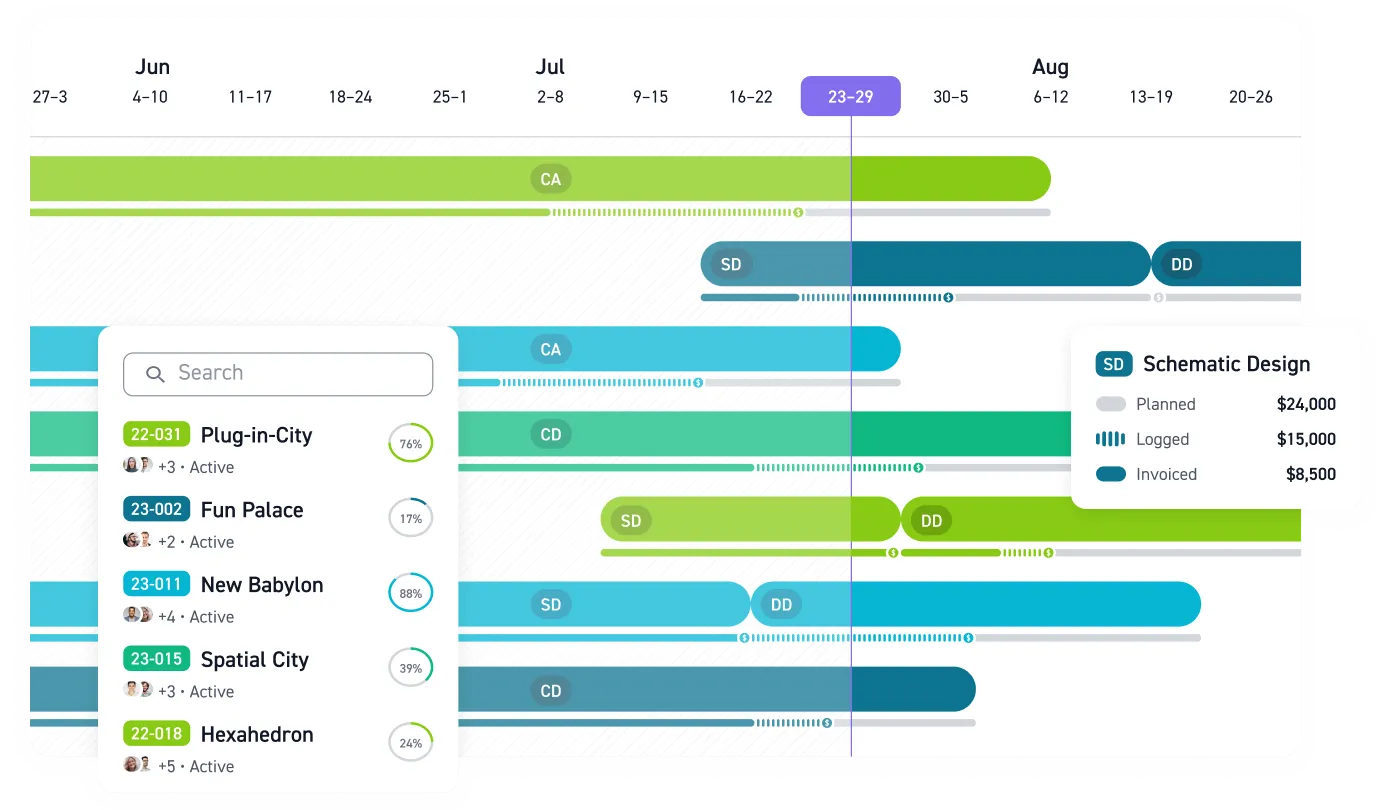
The fix is connecting time tracking directly to budgets, billing, and project health. Monograph does this by auto-assigning timesheets with project phases and budgeted hours, connecting that data to staffing and invoicing. Your time entries flow directly into budget-to-actual comparisons. The signature MoneyGantt™ feature overlays budget-to-cash progression on project timelines, visual intelligence without spreadsheet gymnastics.
Billing accuracy data shows why this connection matters: A&E firms lose 3–5% of revenue annually to preventable billing errors, and with average DSO stretching past 60 days, the gap between work performed and cash collected compounds across phases.
That misalignment between hours worked and fees invoiced signals scope creep or billing timing problems, but you'll only catch it if your time and expense tracking software connects to your billing workflows.
For finance managers, the QuickBooks Online integration matters. When time data is logged in Monograph, you can monitor how labor is affecting your project budgets in real time within Monograph's own project accounting views. When that time data flows into QuickBooks Online, labor costs can appear directly next to your original estimates for clearer budget visibility inside your accounting workflow.
Building a System That Grows With Your Firm
Technology solves the data problem. Training solves the people problem.
PSMJ's Project Management Bootcamp, which has trained over 41,000 engineering firm professionals, teaches PMs how to apply financial management techniques to every project decision. The curriculum covers A&E financial realities, budgeting discipline, and team accountability. Technical professionals promoted into PM roles often excel at design but lack this financial foundation.
Revenue leakage analysis shows why this connection matters: professional services firms lose 1–5% of annual revenue through inaccurate or incomplete billing, and AEC-specific benchmarking puts typical DSO for architecture and engineering firms between the low 50s and upper 80s, meaning the gap between work performed and cash collected compounds across phases.
When your team sees how their time data connects to project health and firm profitability, tracking stops feeling like administrative busywork. It becomes the structural system holding everything else together, invisible when it works and impossible to ignore when it doesn't.
See Your True Profitability, Phase by Phase
You can't afford to fly blind. When time and expenses aren't tracked at the phase level, profitable work masks losses until it's too late. Spreadsheets and disconnected tools hide the very details you need to protect your margins and guide projects to success.
Monograph connects every timesheet and expense directly to your project phases and budgets. Our signature MoneyGantt™ gives you a real-time visual of where your money and hours are going, so you can spot overruns before they happen and bill with confidence.
Your firm's profitability is hiding in the details. Find it. Book a demo.
Frequently Asked Questions
Is phase-level tracking really necessary for a small firm?
Yes, and it's often more critical. Small firms have less margin for error, and one overrunning phase can wipe out profit on an entire fixed-fee job. Phase-level tracking isn't bureaucracy; it's how you learn what your work actually costs so you can price the next proposal with confidence.
How do I get my team to track their time accurately by phase?
Make it easy and make the "why" visible. Use a system that matches how your projects are structured (phases, not generic tasks), and review the data regularly so people see it used for planning and course-correction, not just timesheet policing. When staff see that clean phase data prevents weekend fire drills and last-minute budget surprises, compliance goes up.
What's the first step to implementing phase-based expense tracking?
Start with consultants. Their fees are often the largest, most variable cost outside of direct labor, and they're easy to miscode when invoices arrive in a rush. Require that every consultant invoice is assigned to a specific project and phase before it's approved. This one change quickly reveals which phases are absorbing hidden cost.
Besides budget control, what's the biggest benefit of tracking time and expenses by phase?
Better future proposals. After a few projects, you'll have real historical data on how many hours and expenses each phase actually takes for different project types. That lets you stop guessing, defend your fees more clearly, and build budgets that reflect reality instead of hope.