
If you're one of three people on a finance team trying to close the books across 50+ active projects, you already know the deal: month-end closing at an A&E firm is a different animal. Beyond reconciling bank statements and posting journal entries, you're dealing with project-by-project revenue recognition, WIP adjustments, consultant invoice chasing, and percentage-of-completion calculations, all compressed into a handful of days.
Here's how to make it less painful and more accurate.
Why Month-End Closing Is Harder at A&E Firms
The structural challenge is straightforward. Financial and accounting staff represent 2-3% of FTE across A&E firms of all sizes. A mid-size firm with 150 employees might have three people in finance, responsible for closing dozens or hundreds of active projects, each with its own contract type, phase structure, and consultant agreements.
Cross-industry benchmarks show half of all finance teams need six or more business days to close their books. Given the added complexity of project-based accounting, A&E firms land at the longer end of that spectrum. Three factors compound the problem:
- Manual process dependency: Close process data indicates 94% of teams still use Excel during month-end close, even when their systems have overlapping data that could be reconciled automatically.
- Incomplete project tracking: Fewer than half of A&E firms complete internal project performance evaluations, per industry survey data, which means finance teams are compiling data at month-end instead of working from continuous reports.
- Turnover in lean teams: With industry-wide turnover at 13.2%, losing one person from a three-person finance team creates a 33% capacity reduction during the two-to-three month replacement window.
That's the reality. The question is how to build a close process that works within these constraints.
A Month-End Closing Checklist Built for Project-Based Firms
The A&E month-end close breaks down into five phases. Each phase builds on the previous one, so sequencing matters as much as the individual steps.
Phase 1: Data Collection and Validation (Days 1–3)
Start by locking down your inputs. Every calculation downstream depends on complete, accurate time and expense data.
The most common bottleneck is late timesheets. If hours aren't submitted and approved for the full month, your percentage-of-completion calculations and WIP reporting will be wrong from the start.
- Verify all timesheets are submitted and approved for the full month. Phase-based budgeting requires time entries to align one-to-one with your chart of accounts; late entries cascade into inaccurate project cost data downstream.
- Reconcile consultant invoices against project budgets and phases, with particular attention to principal versus agent determination. Firms must assess whether they control the services (principal, costs as COGS) or merely arrange them (agent, netted against revenue). Confirm markup calculations match contract terms, and accrue costs for work performed but not yet invoiced.
- Process and code all expense reports to the correct project phases before running profitability calculations. Nearly 70% of A&E firms lack real-time budget visibility, discovering cost overruns only after they've already hit the bottom line. Thorough data validation is the first line of defense.
With clean inputs locked down, you're ready for the calculations that actually differentiate A&E accounting from standard close procedures.
Phase 2: Revenue Recognition and Project Analysis (Days 4–6)
This is where A&E month-end procedures diverge sharply from standard accounting. Each contract type demands its own revenue recognition approach under ASC 606.
Fixed-fee projects use the cost-to-cost percentage-of-completion method: (Actual Costs Incurred ÷ Total Estimated Costs) × Contract Value. Time-and-materials contracts recognize revenue as hours worked times billable rates plus reimbursables; your job here is confirming everything's been captured. Not-to-exceed contracts are the trickiest: they combine T&M mechanics with a fixed ceiling, requiring continuous monitoring and immediate loss recognition if estimated costs exceed the cap. The catch: if project managers haven't updated their estimated costs at completion, these calculations are built on stale assumptions.
Phase 3: WIP Adjustments and Balance Sheet (Days 7–8)
WIP journal entries align your income statement with percentage-of-completion accounting. For underbilled projects (work performed exceeds billings), debit unbilled receivables and credit revenue. For overbilled projects (billings exceed work performed), debit revenue or deferred revenue and credit billings in excess of costs.
The stakes here are real. One documented case involved a contractor that appeared to have $400K in profit through November, only to see $150K vanish in December. The issue wasn't a bad December; the year-end WIP adjustment corrected twelve months of overbilling that nobody had been tracking monthly.
Phase 4: Analysis and Reporting (Days 9–10)
With revenue recognized and WIP adjusted, shift to analysis. Run phase-level budget variance reports, update forecast-to-complete estimates, and flag troubled projects requiring principal review.
The metrics that matter most during this phase:
- Net multiplier: Revenue as a percentage of direct labor, the fundamental productivity metric for A&E firms.
- Utilization rate: Billable hours divided by total hours, calculated by role and seniority level.
- Aged receivables: Outstanding invoices by aging category, with collection protocols triggered by your thresholds.
- Backlog analysis: Total contracted backlog, pipeline backlog, and burn rate. Buyers are increasingly scrutinizing backlog when evaluating a firm's value, with hard backlog remaining a key driver of firm valuation.
These aren't just accounting outputs. They're the data project managers and principals need for staffing, pricing, and go/no-go decisions.
Phase 5: Documentation and Compliance (Days 9–10)
Document which ASC 606 over-time recognition criterion applies to each contract type. Maintain audit trails for WIP calculations. Record the assumptions behind estimated costs at completion.
Private companies continue to struggle with ASC 606 compliance, especially around bundled services and contract changes. Documenting assumptions, judgments, and controls makes audits smoother and strengthens internal clarity.
Treat this phase as insurance. The time you invest now prevents exponentially more time answering auditor questions later.
Five Ways to Close Faster
A checklist tells you what to do. These practices determine how fast you can do it.
Standardize the process, not the projects. A&E projects vary by client, deliverable, and contract type, but your close workflow shouldn't. Establish uniform processes and controls, then eliminate manual or duplicative steps.
Set hard timesheet deadlines. Late timesheets delay everything downstream. Set a firm cutoff, such as 5 PM on the first business day after month-end, and require executive approval for late submissions.
Run pre-close project reviews mid-month. Around day 15, identify projects nearing completion, budget overruns requiring amendments, or collectability concerns before the close period begins.
Apply materiality thresholds. Focus detailed percentage-of-completion analysis on large contracts (over $500K), projects running over budget and new project types with higher estimation risk. Apply simplified procedures to smaller engagements.
Backlog analysis: Total contracted backlog, pipeline backlog, and burn rate. AEC M&A research shows that normalized EBITDA multiples "widen materially when funded backlog, margin stability, and cash conversion are proven," making backlog tracking essential not just for operations but for firm valuation.
Consider a soft close approach. Hybrid close models accept preliminary balances for most months and reserve full reconciliation for quarter-end, balancing efficiency with the accuracy A&E revenue recognition demands.
From Checklist to System
A documented close process is the foundation. But when your firm is managing 50–80 projects a month with a lean finance team, the difference between a five-day close and a ten-day close often comes down to how well your project data flows into your financial systems.
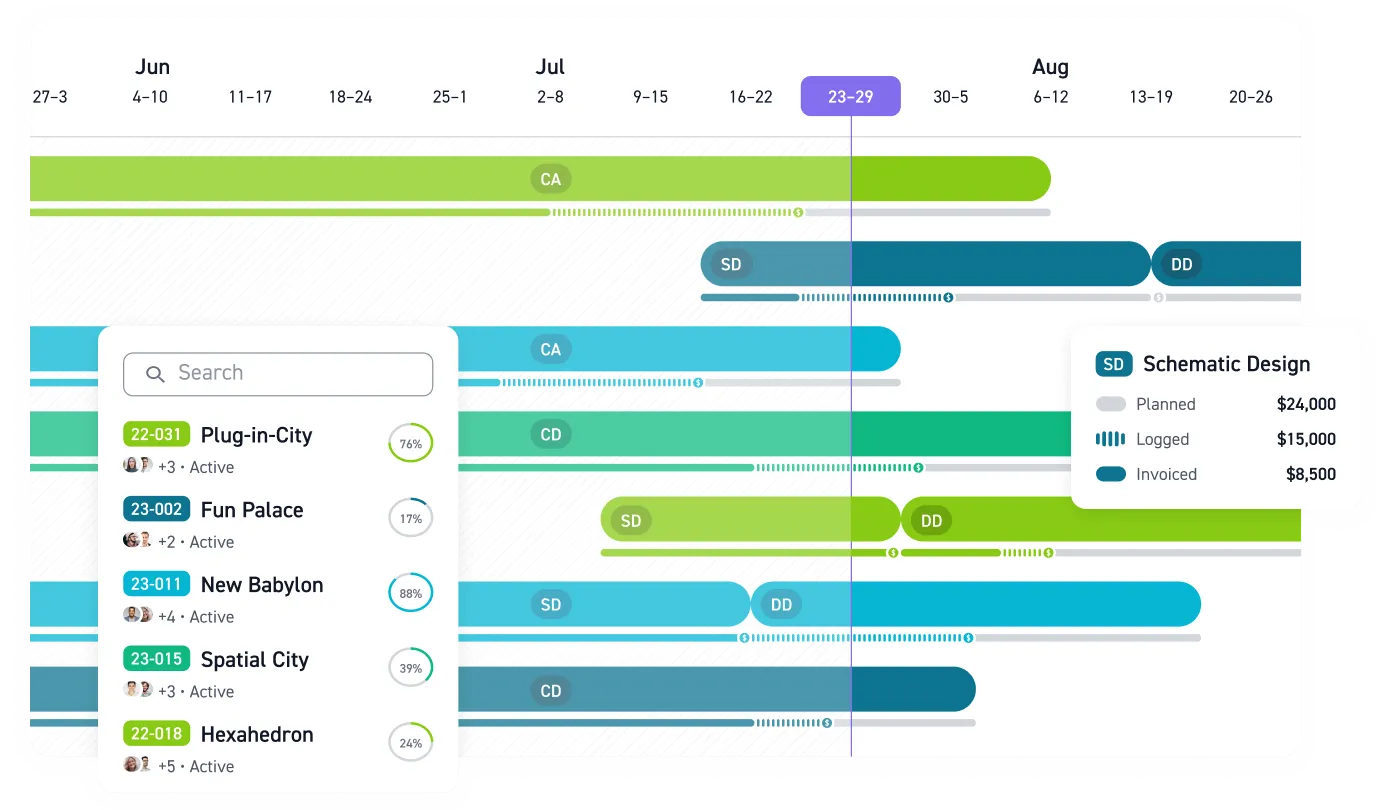
Monograph was built for exactly this scenario, giving A&E firms phase-based budget tracking, real-time project profitability data, and native QuickBooks Online integration so the numbers finance needs at month-end are already current.
Woodhull, a 25-person architecture firm in Maine, cut their billing time in half and reduced budget overages by 66% after switching to Monograph, directly translating to less month-end cleanup and fewer surprises at close. Firms using Monograph report faster billing cycles and fewer over-budget projects, which means less cleanup and fewer surprises when closing the books.
Every month without clean data is another month of decisions made in the dark. The goal goes beyond a faster close. You need financial data you can actually trust, every month, without the scramble. Book a demo with Monograph.
Frequently Asked Questions
How long should a month-end close take at an A&E firm?
Most A&E firms land in the six-to-ten business day range, given the complexity of project-based revenue recognition and WIP adjustments. Firms with real-time project tracking and integrated systems can close in five days or less. If you're consistently taking two weeks or more, your bottleneck is usually late timesheets or manual data gathering, not the accounting itself.
What's the most common mistake A&E firms make during month-end close?
Relying on stale estimated costs at completion. If project managers haven't updated their forecasts, your percentage-of-completion calculations are built on assumptions that no longer reflect reality. The fix is simple but requires discipline: require PMs to review and confirm their estimates before the close period begins, not after finance has already run the numbers.
Should we use a hard close or soft close approach?
It depends on your audit requirements and how much your financials vary month-to-month. A soft close, where you accept preliminary balances and reserve full reconciliation for quarter-end, saves time but requires confidence in your ongoing project tracking. Firms with volatile WIP or new contract types often benefit from monthly hard closes until their processes stabilize.
What if our project managers don't update their estimates on time?
This is the most common source of close delays. Set a hard deadline for estimate updates, ideally three days before month-end, and make it a non-negotiable part of the PM role. Some firms tie estimate updates to project billing releases: if the estimate isn't current, the invoice doesn't go out. That creates the right incentive without adding more administrative burden to finance.


.png)