
.png)
If you're running an engineering firm, you already know the tension: you need to bring in new work, but the work you already have consumes nearly every hour in the week. Senior managers at engineering firms dedicate only 13–25% of their time to marketing and business development. The rest goes to project delivery, operations, and firefighting.
That math doesn't work long-term. Building a reliable engineering lead generation engine means rethinking how your firm invests its time, trains its people, and manages its relationships, without hiring a full sales department.
Your Repeat Clients Are Essential, But They're Not a Growth Strategy
According to long-standing industry data, the average A/E firm derives roughly 75% of its revenue from repeat clients. That's a healthy foundation, but it can also become a vulnerability.
Relying on a few key clients for most of your revenue is like designing a structure with too few load paths: it works until one fails. Valuation guidance from leading AEC consultancies recommends that no single client exceed 4% of total revenue to avoid dangerous concentration.
Meanwhile, acquiring new clients costs six times more than securing repeat work, and 80% of profits typically come from just 20% of clients. The point here is to build a more deliberate system for both retention and new client pursuit, so your firm's future doesn't hinge on a handful of accounts.
Growth depends on winning new work, but the firms that grow sustainably do it by treating business development as a discipline, not an afterthought squeezed between project deadlines.
Train Your Engineers to Develop Business
Most engineering firms don't have large marketing teams. Across the industry, 55% of AEC firms rely primarily on seller-doers rather than dedicated BD staff. Yet fewer than half of firms provide business development training to those same seller-doers.
That's a significant gap. You wouldn't send an engineer to a job site without proper training on the tools; BD shouldn't be different. The firms that close this gap gain a real edge. Here's where to start:
- Formalize seller-doer training. The Seller-Doer Accelerator from ACEC is a 7-week program with five modules built specifically for engineering professionals learning business development.
- Invest in proposal skills. Proposal experts in the AEC space stress that winning proposals center on understanding the client's real concerns and making an emotional connection, not just checking boxes. Small firms should treat every proposal as a sales opportunity with real revenue potential.
- Improve your Go/No-Go process. According to SMPS Foundation research, the average AEC firm hit rate falls within the 37–44% range, with engineering firms averaging 44.2%. That means more than half the proposals most firms submit are losing efforts. A more rigorous qualification process (pursuing fewer, better-fit opportunities) improves win rates without increasing effort.
Spending on BD activities across the industry falls between 3.1–5.3% of net service revenues, with firms employing dedicated BD staff trending toward the higher end. Even if you're running a seller-doer model at the lower end, structured training turns that investment into measurable pipeline.
Use Professional Associations as Lead Infrastructure
You don't need to build every business development capability in-house. Professional associations provide training, peer benchmarking, networking, and credibility that would cost far more to develop independently.
The key is choosing the right associations for your firm's goals and engaging with intention:
- ACEC operates seven coalitions focused on specific practice areas, with first-year membership free for new firms. Their BD & Marketing Forum brings together engineering firm professionals for peer learning roundtables.
- ASCE's local chapters offer the most accessible, cost-effective networking for regional firms. The AEI Chapters program connects members with local learning opportunities and colleagues in architectural engineering.
- NSPE's Enterprise Membership provides firm-wide access to webinars, discounted courses, and leadership development, positioning your firm as one that invests in professional growth, which strengthens both recruiting and client confidence.
- SMPS offers industry research and publications developed with FMI Consulting that capture emerging marketing and BD trends, plus quarterly AI Insights Reports analyzing shifts across A&E marketing.
Local chapter engagement is where most firms should start. Committee leadership, technical presentations, chapter sponsorships, and sending both senior leaders and emerging professionals to events all build the kind of long-term trust that turns into project opportunities.
Turn Client Experience Into Your Lead Engine
Here's a stat worth paying attention to: 87% of A/E firms identify Client Experience as their most effective lead generation tool for the next three to five years. Not marketing campaigns. Not social media. The experience of working with your firm.
A well-known framework for client service identifies eight principles that drive repeat business and referrals. If your firm is like most, a few of these will hit close to home:
- Keep principals in front of clients regularly. As firms grow, principals become internally focused, and client relationships default to project managers. Maintaining principal engagement signals that the relationship lives at the firm level, not just the project level. This is consistently the most neglected practice we see across firms.
- Treat every client as a present client. The false distinction between "active" and "inactive" clients causes firms to neglect the very relationships that generate 73–75% of revenue. Every client you've ever served is a potential source of new work or a referral.
- Help clients formulate their next project. Position your firm as a strategic advisor, not an order-taker. The firms that stay close enough to see what's coming next rarely have to compete on price.
- Match your team to the client's style. Team continuity and communication compatibility signal respect for the relationship, and they're among the easiest things to get right.
The firms that turn CX into a lead gen asset connect three things: client data, project performance tracking, and BD activities. When those three live in one place, rather than scattered across spreadsheets, email, and memory, proactive relationship management becomes possible. That's the kind of operational visibility tools like Monograph are built to provide: connecting project client health so nothing falls through the cracks.
Free Up BD Time by Fixing Your Operations
The biggest barrier to engineering lead generation is time. When 52% of firms report that at least one in four projects go over budget, principals get pulled into recovery mode instead of building pipeline. Add the fact that 92% of firms report at least one open position, and the operational squeeze on BD time becomes severe.
Think of your BD pipeline the way you'd think about a project schedule. If you're not tracking it with the same rigor, it won't deliver on time. Yet across most firms, principal time gets consumed by operational drag that has nothing to do with winning new work:
- Chasing timesheets and assembling reports from disconnected systems eats hours every week that could go toward client conversations.
- Reconciling budgets manually pulls principals into administrative work instead of relationship building.
- Recovering over-budget projects forces senior leaders into firefighting mode, displacing the BD activities that prevent future revenue gaps.
- Filling open positions compounds the squeeze; someone has to cover the work while you're hiring.
The evidence for fixing this is clear. Most firms using PM software report efficiency improvements, but not all users experience gains. One documented case: Brunton Architects & Engineers, an 18-person firm, reduced budget overages by 25% and saved 25% of their time on administrative tasks after implementing a unified system. That freed their seller-doers to focus on relationship building instead of data entry.
The firms winning new work aren't necessarily spending more on business development. They're spending less time on operational chaos, which gives their principals room to build the relationships that drive growth.
Free Up Your Principals to Build Your Pipeline
The biggest obstacle to winning new engineering work is a lack of time. When your most experienced leaders are buried in budget reconciliation, timesheet chasing, and project recovery, they can't build the client relationships that secure your firm's future.
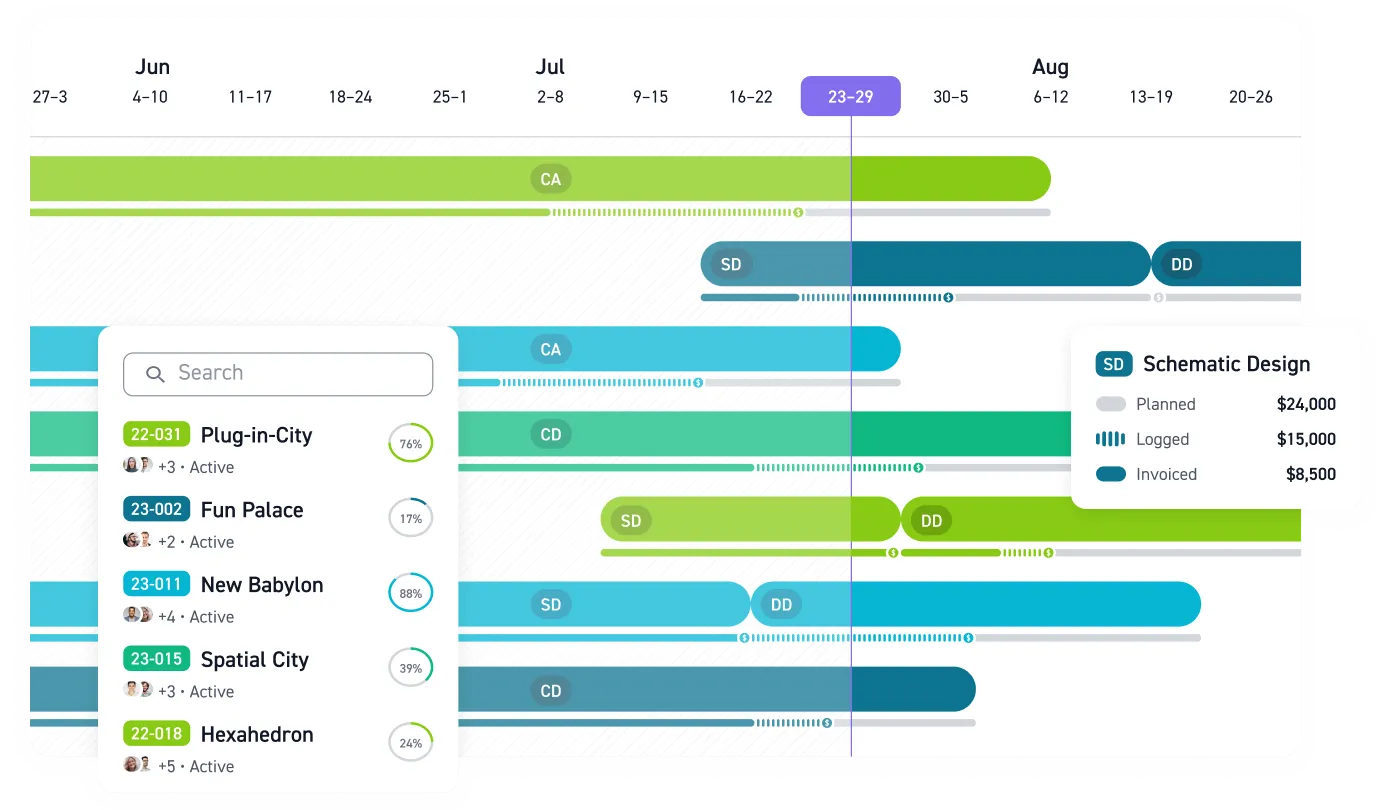
Monograph gives your firm the operational backbone to free up your seller-doers. By unifying project management, budgeting, and time tracking, Monograph eliminates the administrative drag that consumes principal-level time. Instead of fighting operational fires, your leaders can focus on client conversations and proactive business development.
Your next big project won't come from a spreadsheet. It will come from a relationship you have time to build. Creates time for growth.
Frequently Asked Questions
Our seller-doers are engineers, not salespeople. How can a tool help with relationship-building?
Good business development has nothing to do with turning engineers into slick salespeople. The goal is giving them back the time to be strategic advisors to clients.
The right system takes administrative work off their plate, like budget tracking, reporting, and visibility into which projects need attention, so their limited leadership hours go toward the conversations that actually grow the firm.
How does improving internal operations actually generate new leads?
It connects directly. When projects run over budget or behind schedule, senior leaders get pulled into firefighting mode, which kills time for business development.
Strong operations also improve client experience. On-budget, on-time delivery builds trust, and trust turns into referrals and repeat work, still the most reliable source of engineering leads.
We're a small firm. Isn't a platform like Monograph overkill for us?
It's usually the opposite. Small firms feel operational drag the most because every principal hour matters.
If you're running projects across spreadsheets, email, and disconnected tools, you're paying a "tax" in context switching and manual reconciliation. A unified system replaces that chaos with consistent project visibility, without needing a full-time admin layer to keep it all updated.

.png)