

Architecture firm billings have been below the expansion threshold for an extended period. When new work gets harder to win, healthy firms protect the revenue they already earned. Most principals know the feeling of finishing solid work and still wondering where the margin went. Usually, the answer is a set of gaps in tracking, billing, and scope control that show up across the life of a project.
The Core Metrics That Control Profitability
A common framework breaks it down: utilization tells you how many of your payroll dollars go toward billable client projects, and the net multiplier tells you how many dollars come back for each one spent. Watched together, a small set of metrics shows whether your architecture and engineering (A&E) firm is making money or just staying busy.
Here are the metrics that matter:
- Realization rate measures billed revenue divided by the value of billable work. Architecture firm medians are reported around 95%, and lower-performing firms leave meaningful revenue uncollected.
- Utilization rate measures billable hours divided by available hours. It is a common firm-wide metric, but target ranges depend on how available hours are defined.
- Net direct labor multiplier measures net revenue divided by direct labor cost. Annual benchmarks place the current median at 3.28. Even a multiplier that looks healthy can leave little room for error when overhead is high, as one recent case study demonstrates.
- Overhead rate measures indirect costs divided by direct labor cost. High-performing firms run 130–150%. Every reduction in overhead lowers the breakeven multiplier and improves profitability at the same billing rates.
These metrics work like a structural system. If one member is carrying too much load, the problem shows up somewhere else. Strong utilization will not save a project that was underpriced, and a high realization rate means little if the original fee was wrong.
Where Revenue Disappears
Revenue rarely disappears in one dramatic event. It builds through financial blind spots that chip away at margin long before anyone calls them a problem. In most firms, the leaks start in the contract and compound during delivery.
Scope creep on fixed-fee contracts is the most visible leak. By the time a team realizes a project has moved beyond the original agreement, the firm has often already delivered unbilled work. Many scope creep causes sit inside the firm itself, which means process and training matter as much as client management.
Incomplete time tracking is the quieter problem, and the one that compounds. When hours get rounded, delayed, or dumped into the wrong phase, project costs stop being trustworthy. Future fee proposals then get built on bad history, and the same underpricing keeps showing up across the portfolio.
Invoicing delays turn delivery issues into cash flow problems. Completing most of a project while delaying the final invoice cripples operations regardless of work quality. Many firms watch accounts receivable (AR) aging and ignore work-in-progress (WIP) aging, even though unbilled WIP still represents real financial exposure.
Fee Structures That Protect Margins
Small A&E firms carry a lot of risk on fixed-fee contracts. One underpriced project can wipe out profit from a strong period, which is why fee discipline matters long before the first invoice goes out.
The most reliable method for constructing fees cross-checks several calculations:
- Bottom-up: Work breakdown through phases, tasks, hours, and dollars, plus contingency hours
- Top-down: Based on comparable past projects or rule-of-thumb gross fee determinants
- Duration-based: Staff required multiplied by weeks required
When these methods converge on the same fee range, the fee is more likely to hold. When the numbers diverge, something in the assumptions needs revisiting before the contract is signed.
Value-based pricing creates another opportunity. Firms using standard billing rates across projects with differing professional complexity leave revenue on the table. Even on fixed-fee contracts where clients see one number, profitable firms charge time internally at billing rates to understand true project profitability. That is where margin visibility lives.
Cash Flow Starts at the Contract
A&E firms often wait too long to collect on invoices. A full backlog can still sit beside a weak bank balance when contract terms and billing habits make cash slow to move.
The fix lives in the contract stage. Once the project is underway, recovery options shrink. Specific contract-level vulnerabilities become collections problems that are hard to solve after signing:
- Billing only upon completion of large milestones instead of progress billing
- "You get paid when we get paid" pass-through clauses
- Open-ended retainage with no defined release trigger
- Contracts with no penalty for late payment
Those terms look routine during contract review, and each one slows cash once the project is underway.
During active projects, billing discipline has to stay simple. When a schematic package is delivered or a design-development milestone is reached, the invoice goes out right away. Month-end batching adds delay. On long-running projects, regular draws make invoices easier for clients to process and easier for your firm to collect.
The Financial Visibility Gap
Firms using integrated project management tools report stronger profitability than peers stuck on disconnected systems. Workbench reports significantly faster staffing, a faster billing process, and fewer unbilled fees.
When project managers can see current financial data, they stop managing from stale spreadsheets and incomplete timesheets. Real-time awareness of financial performance helps teams catch drift earlier, before it turns into write-offs.
That visibility matters most when teams can quickly spot warning signs like these:
- Planned revenue drifting away from logged time
- Phase-level budget problems before they become write-offs
- Slow billing cycles that leave fees unbilled
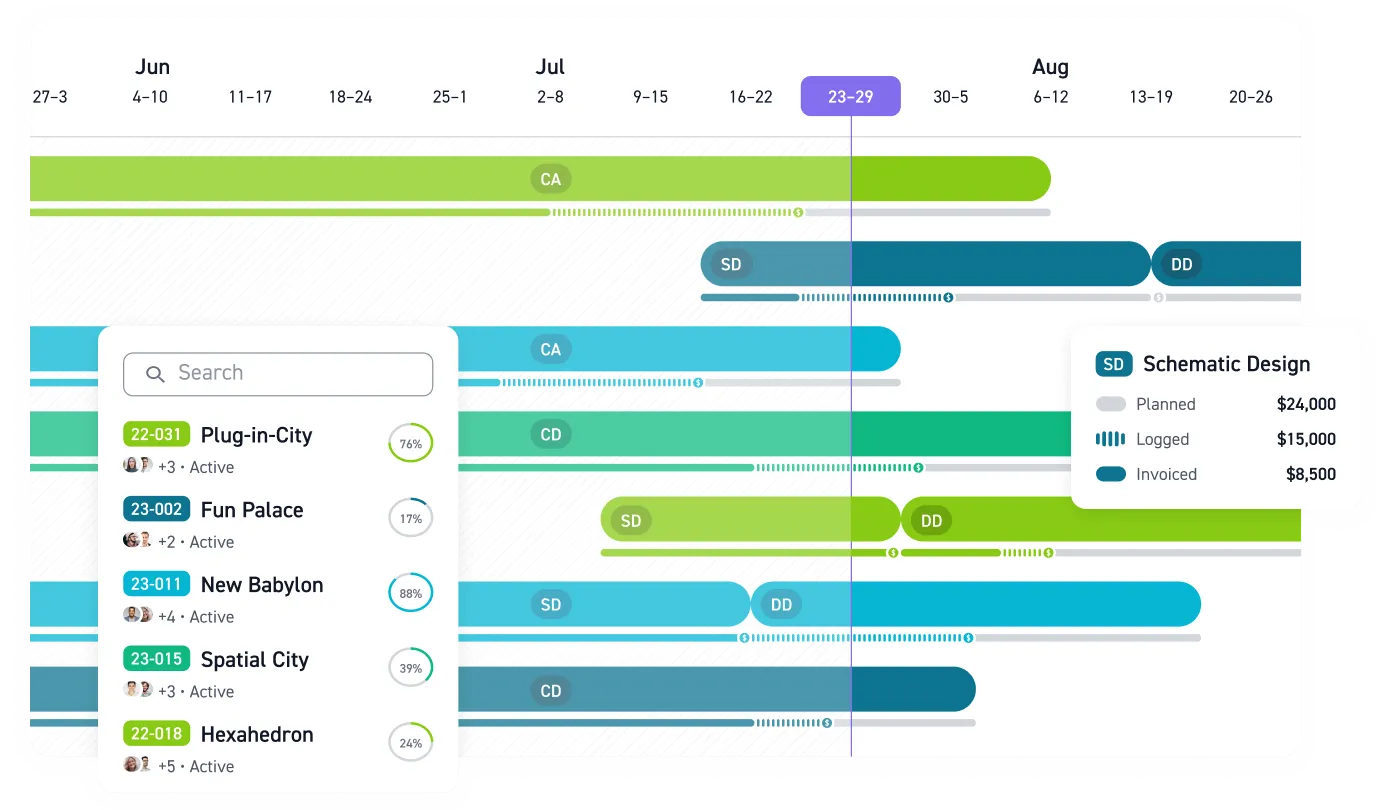
Monograph's MoneyGantt™ provides that visibility by tracking revenue from planned to logged to invoiced to paid in a single view. Monograph also delivers seamless accounting integration, which reduces the work of reconciling disconnected systems.
Your next project is already on the books. The contract terms, time tracking, invoicing speed, and regular metric reviews will decide how much of its revenue you actually keep.
See Where Revenue Leaks Before They Hit Your Margin
Scope creep, delayed invoicing, weak realization, and poor visibility rarely feel dramatic when they happen. Later, they show up as write-offs, stalled cash flow, and projects that stayed busy without staying profitable.
Monograph gives principals, project managers, and operations leaders one place to track planned, logged, invoiced, and paid revenue as work moves through the firm. With Monograph's MoneyGantt™ and connected financial visibility, teams can catch budget drift earlier, send invoices faster, and see which projects are protecting margin.
Revenue slips faster than most firms realize. Book a demo.
Frequently Asked Questions
How often should A&E firms review realization, utilization, multiplier, and overhead?
Review them consistently and together. Margin problems rarely show up in only one metric, and a single number can mislead if the others are not in view. A monthly cadence at the firm level, paired with project-level reviews at major milestones, gives leaders enough signal to correct course before write-offs accumulate.
What's the fastest way to improve cash flow without raising fees?
Speed up invoicing and tighten contract terms. When a deliverable goes out, the invoice should follow immediately. Move from milestone-only billing to progress billing where possible, and add late payment penalties to new contracts so receivables stop drifting past 60 days.
What should project managers do when a fixed-fee project starts overrunning?
Check whether the work has moved beyond the original agreement, confirm time is being tracked accurately, and compare current labor against the fee assumptions behind the contract. If scope has expanded, document it in writing and discuss a fee adjustment with the client before delivering the additional work.
Why does accurate time tracking matter if the client only sees a fixed fee?
Internal tracking is where margin visibility lives. Your firm still needs reliable time data to understand profitability, improve future fee proposals, and avoid systematic underpricing. Without it, the same loss patterns repeat across new projects, often without anyone noticing until year-end financials reveal the gap.
Can better financial visibility really change project profitability?
Yes. When project managers can see planned, logged, invoiced, and paid revenue in one view, budget problems surface earlier and invoicing can move faster, giving teams time to correct course before margin disappears. Firms that have shifted to integrated platforms commonly report fewer unbilled fees and tighter project margins within the first few quarters.