

You know that feeling when someone asks about a project's budget and you need three hours to piece together an answer from spreadsheets, emails, and a half-remembered conversation from last week. That's not project management. That's detective work.
For principals running A&E firms with 10, 20, or 40 people, the inability to see every project's status in one place creates a cascade of problems, from missed budget warnings to burned-out staff to proposals priced on gut feeling instead of data. Firm-wide project visibility is the structural system your entire business rests on.
The Hidden Cost of Flying Blind
Most A&E firm leaders know fragmented project information costs them time. What they don't realize is just how invisible that cost actually is.
Industry benchmark data found that senior managers dedicate 13-25% of their time to marketing and business development, though the actual number is almost certainly higher because many firms don't record senior managers' BD time separately from other overhead. And peer-reviewed research in the Architectural Engineering and Design Management journal confirms that ongoing fragmentation remains a core operational challenge in architecture firms, breaking design intention and workflow continuity across project phases.
The result? Principals making decisions on outdated information. Project managers compiling reports from disconnected sources. And teams spending time on coordination that should be spent on billable work.
What Tech-Forward Firms Already Know
An industry technology adoption report from the AIA states it plainly: an architecture firm's tech adoption has a direct impact on its profitability. Not a potential impact. A direct one.
The numbers back this up. The 2024 AIA firm survey shows that firm profitability as a share of net billings averaged 13.2% in 2023. Meanwhile, an analysis of 313 firms reveals that 67% of firms investing in integrated project visibility systems project profit rates of at least 20%, a 51% improvement over the industry median.
Here's what that looks like in practice:
- Process maturity: About 50% report "very mature" processes, compared to only 20% of tech-static firms. That's a 2.5x advantage in operational capability.
- Win rates: 17% hit 75-100% versus 9% of tech-static firms, an 89% improvement.
- Capture rates: 34% hit 50%+ compared to 21% of their peers.
- Billing efficiency: The average A&E firm bills only 81% of time, meaning 19% of available hours are lost to non-billable activities.
These aren't marginal gains. For example, after switching from BQE Core to Monograph to improve project visibility, Texas-based Able City reported 15% profit growth alongside a 4x efficiency gain in their operations. For a 20-person firm with $3-4 million in annual revenue, moving from 13.2% to 20%+ profitability represents $150,000-300,000 in additional annual profit. The visibility systems behind this shift typically cost $40,000-60,000 per year, paying for themselves within a few months.
The Metrics That Actually Matter
A&E firms need visibility into three categories that generic dashboards miss:
- Profitability metrics: The billing multiple is one of the most critical KPIs for A&E firms, the net revenue generated from every dollar of direct labor. Pair it with live project margins and overhead rate tracking for the full financial picture.
- Productivity metrics: Utilization rate confirms whether team members spend the right amount of time on billable projects, tracked by role, not just firm-wide averages.
- Cash flow metrics: Tracking revenue backlog, work-in-progress, and accounts receivable aging at project and firm levels is what leading A&E consultancies emphasize most. These numbers determine whether you can make payroll next month.
The takeaway from project KPI analysis in the industry is clear: firm-wide KPIs reveal overall business health, but project-level KPIs are what actually determine how profitable, efficient, and sustainable your work is.
From Utilization Guesswork to Real-Time Clarity
Utilization rate is the single metric that connects team workload to firm profitability. But without firm-wide project visibility, most leaders are guessing.
Data from 337 firms reveals a median utilization rate of 82.4%, with top-quartile performers reaching 95.2%. The target range for sustainable performance sits at 80-85% for billable staff (dropping to 60-65% firm-wide when all roles are included), while principals should target 75%+.
The key word is "sustainable." Pushing utilization to 100% burns people out. A resource allocation analysis recommends maintaining 10-15% buffer beyond target utilization to absorb scope changes and unexpected work. That buffer only works if you can actually see who has capacity and who's stretched thin, across every project, continuously.
Firms that gain this visibility see measurable improvements:
- 50% reduction in administrative time spent on resource planning
- 25% improvement in overall profit margins compared to spreadsheet-based planning
- Immediate identification of over- and under-utilized staff before problems escalate
- Ability to run monthly reviews of paused projects and reallocate idle hours to active work
Without a centralized view, those paused projects quietly consume budget while team members sit underutilized on stalled phases.
Managing Pipeline Volatility
A&E projects move through distinct phases, schematic design, design development, construction documents, construction administration, each demanding different resources. When projects pause mid-phase (which happens regularly, given that repeat clients constitute roughly 75% of A&E business and bring inherent pipeline instability), the ripple effects hit resource allocation, revenue forecasting, and cash flow simultaneously.
Consider a 15-person firm with three projects in construction documents when a client delays approval on the largest one. Suddenly two architects, a structural engineer, and a drafter have half-empty schedules, revenue projections for the quarter fall short, and the firm still owes consultants for work already completed on the stalled project. Without a live view of every project's status, that gap doesn't surface until payroll looks thin.
These compounding effects explain why 54% of high-performing A&E firms identify financial planning as a top process to modernize, and 40% of firms meeting or exceeding their goals plan to invest in PM software for better visibility into project status. Real-time project visibility turns these surprises into manageable transitions by letting firm leaders spot phase slowdowns early and shift resources before gaps widen.
Building Visibility Into Your Practice
Monograph was built to give A&E firm leaders instant visibility over every project and phase, budgets, staffing, timesheets, billing, and profit tracking in one place. Instead of copying data between Revit, Excel, and QuickBooks, you plan and organize your project's schedule, budget, and resources without opening a single spreadsheet.
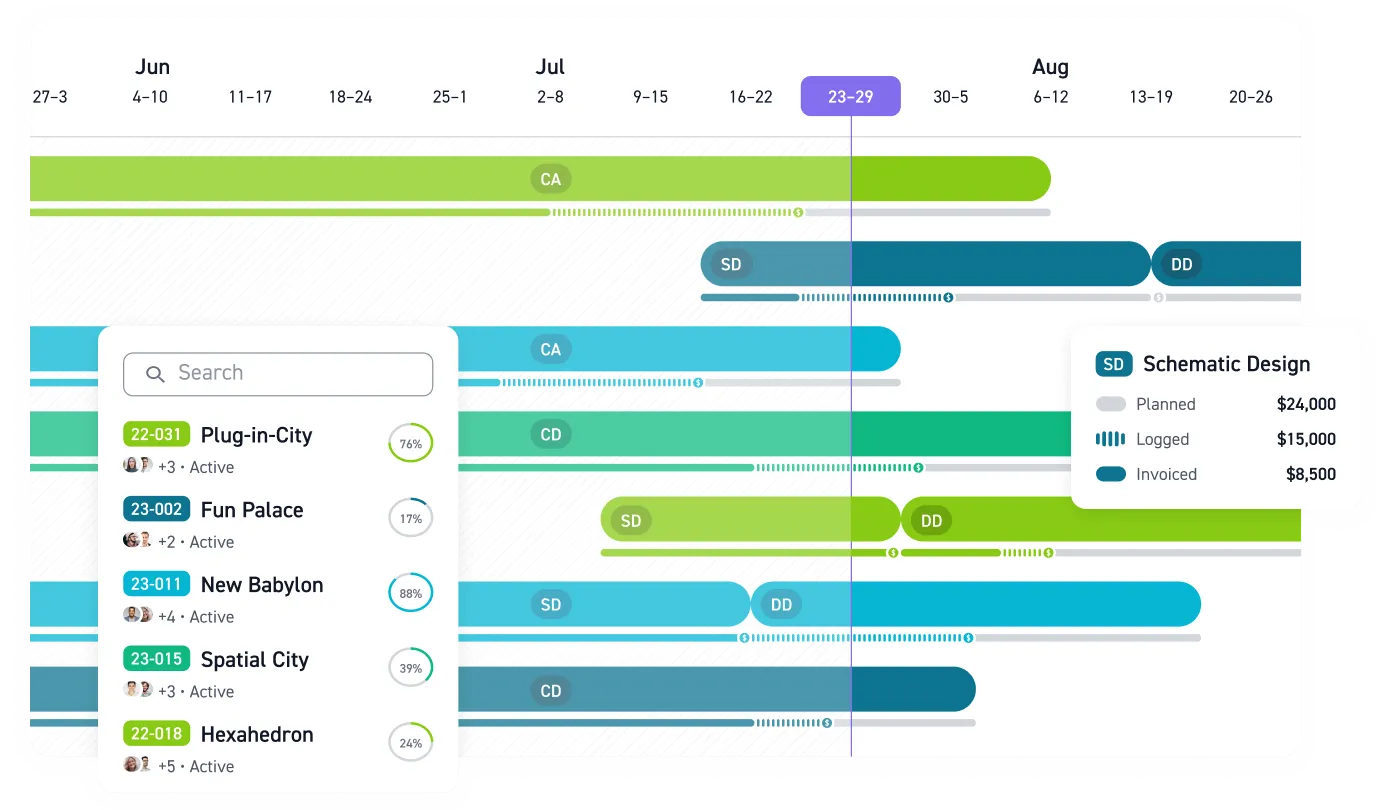
Monograph's MoneyGantt™ feature layers a project's planned fee across the schedule, then shows how dollars move from planned through logged, invoiced, and finally paid in one continuous bar. It's the kind of visual intelligence that turns a 30-minute status meeting into a 30-second glance.
Whether you're tracking design phases or engineering deliverables across three concurrent projects or thirty, firm-wide project visibility turns reactive firefighting into proactive management. And that's how you protect both your margins and your sanity.
Stop Guessing. Start Seeing Every Project in One Place
If you're still stitching together status updates from spreadsheets, inbox threads, and whatever your PM remembers from last Thursday, you're not just losing time. You're losing lead time. That's the window where you can still fix a budget, rebalance a team, or bill before cash gets tight.
The cost of inaction isn't theoretical. It shows up as projects that drift into the red without anyone noticing, utilization that looks fine until you realize one person is quietly carrying three deadlines, and invoices that go out late because the backup lives in five places.
If you want a practical next step, pick one moment that currently creates chaos, monthly project reviews, staffing meetings, or invoicing, and centralize the data behind it. When your budgets, schedules, time, and billing are connected, the "status meeting" turns back into what it should be: a quick decision, not a scavenger hunt.
The gap is widening. Close it. Book a demo.
Frequently Asked Questions
How long does it take to get firm-wide visibility across all projects?
Fast enough to matter, as long as you don't try to perfect everything on day one. Most firms get the biggest lift by starting with active projects and the handful of metrics they review every week (budget burn, staffing, and billing status). Once leaders can trust that view, standardizing how new projects get set up becomes much easier.
Will my team actually use another tool, or will it become one more place to update?
They'll use it if it reduces double-entry and answers questions they're already getting asked. Teams adopt visibility systems when time entry ties directly to budgets and billing, because it removes the "why are we doing this" friction. If the tool makes it easier to plan their week and defend their scope, it becomes part of the workflow instead of an extra chore.
How do we handle visibility for paused projects without cluttering dashboards?
Paused projects are exactly where visibility pays for itself. You want paused work to stay visible enough that you don't forget unbilled time, consultant costs, or outstanding receivables, while still keeping active work front and center. The goal is a clean separation between "active capacity drain" and "financial risk sitting on the shelf," so you can reassign people confidently and keep cash flow predictable.


.png)