

.png)

Firm management made easy

A scope of work document in architecture and engineering firms defines the specific range and extent of professional design services, technical deliverables, and documentation required for construction projects. Unlike generic business scopes, A&E scope documents operate within industry-standard contract frameworks and require professional judgment about appropriate technical detail and regulatory compliance.
For A&E project managers, scope documents serve dual purposes: accurate resource allocation and professional liability protection. Having a strong written contract is the most important risk management practice for A&E firms.
Essential Components of A&E Scope Templates
A complete scope of work template for A&E firms managing building design and construction projects should include several essential components grounded in industry-standard frameworks, though the exact number varies by project and organization.
The foundation starts with the AIA five-phase design framework, which defines services across five distinct phases: Schematic Design, Design Development, Construction Documents, Bidding or Negotiation, and Construction Administration.
Every A&E scope template should establish clear parameters for these essential components:
- Phase-based deliverable structure including drawings, specifications, and technical calculations for each project phase
- Consultant coordination protocols defining roles, responsibilities, and submission schedules for structural, MEP, and civil consultants
- BIM execution plan requirements establishing Level of Development (LOD) standards and information exchange protocols
- Professional liability insurance minimums ranging from $1M to $2M per occurrence depending on project complexity
These components work together to establish clear project boundaries that prevent scope creep while ensuring all technical requirements are addressed. The CSI MasterFormat organization provides the standard framework for organizing construction information into a logical and consistent format, using 50 divisions such as Division 03 Concrete or Division 09 Finishes to provide consistency across all project documentation.
Architecture vs Engineering Scope Structure Differences
Architecture firms and engineering firms structure scope documents with fundamentally different organizational approaches. Architectural scope follows a phase-based progression model where each phase builds upon previous work to increase specificity.
According to the AIA basic services guide, architectural deliverables emphasize spatial relationships, building envelope coordination, and drawing-centric documentation.
Engineering scope documents use a task-order and technical specification approach rather than pure phase progression. The ASCE contract documents show this through E-500 agreements that define specific tasks tied to measurable performance criteria and system integration requirements.
The terminology distinctions reflect different professional focuses:
- Architecture shows design intent documentation, aesthetic coordination, user experience considerations organized through drawing sets by architectural discipline
- Engineering shows technical performance specifications, structural calculations, building systems integration delivered through calculation packages and system diagrams
- Multi-discipline coordination requires explicit protocols for aligning engineering task schedules with architectural phase milestones
Understanding these differences helps project managers structure appropriate scope boundaries when coordinating between disciplines or managing consultant relationships.
Industry Standards and Legal Requirements
Professional organizations establish scope standards through coordinated frameworks that combine contractual requirements, ethical obligations, and legal protections. The AIA B101-2017 Standard Form provides industry-standard contractual structure requiring architects to perform services with standard of care.
The ASCE Code of Ethics specifies that engineers must protect and advance the health, safety, and welfare of the public above everything else. This ethical framework supersedes contractual scope limitations. This requirement directly impacts how scope boundaries are defined and what cannot be excluded from professional responsibility.
Effective scope documents must address clear scope boundaries that show what services are included and excluded. Risk management requirements are addressed within the broader professional services contract:
- Standard of care definitions establish professional responsibility within industry norms rather than perfection standards, consistent with AIA B101-2017 requirements that architects perform services consistent with established levels of professional skill and care
- Limitation of liability provisions protect firms from claims exceeding the scope of professional services and states what architects are and are not responsible for.
- Insurance verification requirements ensure all subconsultants carry appropriate professional liability coverage, with minimums of $2M coverage for architects and engineers
- Dispute resolution mechanisms provide alternatives to litigation for scope-related disagreements, as recommended in AIA construction contract practices for ensuring success and mitigating risks
These legal frameworks vary by state, but ACEC's model legislation provides templates that many jurisdictions have adopted for architect and engineer liability protection.
Real-World Scope Examples by Project Type
Different project types require distinct scope approaches based on complexity, funding source, and regulatory requirements. A review of government project documentation reveals consistent patterns that private sector firms can adapt.
Federal healthcare projects, for example, have specific quantified metrics. The Veterans Affairs clinical project specifies exact square footage commitments of 26,000 SF new construction and up to 13,700 SF renovation with building configuration details. This precision reduces client disputes and makes accurate cost estimating possible.
Municipal projects emphasize deliverables-based structures. They specify that consultants coordinate with the entire multidisciplinary team and monitor construction costs throughout the design process, providing cost estimates and recommended design alternatives to maintain the project budget. The scope requires specific document types including drawings, specifications, schedules, cost estimates, design calculations, meeting minutes and reports with detailed submission protocols. This approach works well for public accountability requirements.
Engineering-focused scopes address technical standards integration. The Wadsworth City engineering template, for example, requires site plans, design criteria, equipment lists, and general code compliance documentation. These technical deliverables help distinguish engineering scope from architectural documentation.
Small construction projects use value-threshold approaches. San Francisco's A105-2017 sample shows reduced documentation requirements for projects under $150,000 while maintaining quality control mechanisms. This helps firms right-size scope complexity with project value.
Implementation Best Practices for A&E Firms
Successfully implementing scope templates requires understanding both contractual requirements and operational workflows. Start with industry-standard frameworks rather than creating custom approaches. The AIA contract documents provide over 240 industry-trusted documents representing 135 years of professional consensus.
Project managers should structure scope around phase-based organization since this drives resource allocation, fee payment, and deliverable coordination. When scope decisions connect directly to phase budgets, any hours you assign need to instantly update fee burn and capacity views across all projects.
This integration makes a huge difference. Able City, a 29-person Texas architecture firm, achieved 15% profit growth and 4x efficiency gains by connecting scope decisions directly to phase budgets.
Key implementation approaches include:
- Phase budget alignment where scope definition drives resource capacity planning and financial tracking
- Consultant coordination protocols establishing clear boundaries between architectural design leadership and engineering technical responsibility
- Documentation standards using CSI MasterFormat for specifications and standard drawing conventions
- Quality control checkpoints embedding review and approval processes at each phase completion
- BIM Execution Plan (BEP) requirements defining Level of Development (LOD) standards, information exchange protocols, and roles and responsibilities matrices for model coordination
Effective scope management prevents the trap of spending more time hunting through spreadsheets than actually designing. When scope boundaries are clear and systematically tracked, teams can focus on technical excellence rather than administrative coordination.
Track Scope Changes Before They Destroy Your Margins
Most A&E firms discover scope creep weeks after it destroys project profitability. By the time you realize a project has blown past its phase budget, you're explaining to the principal why that hospital addition just became a break-even job.
Once you've drafted the perfect scope document, the real work begins: tracking changes as they happen across multiple projects, consultants, and phases.
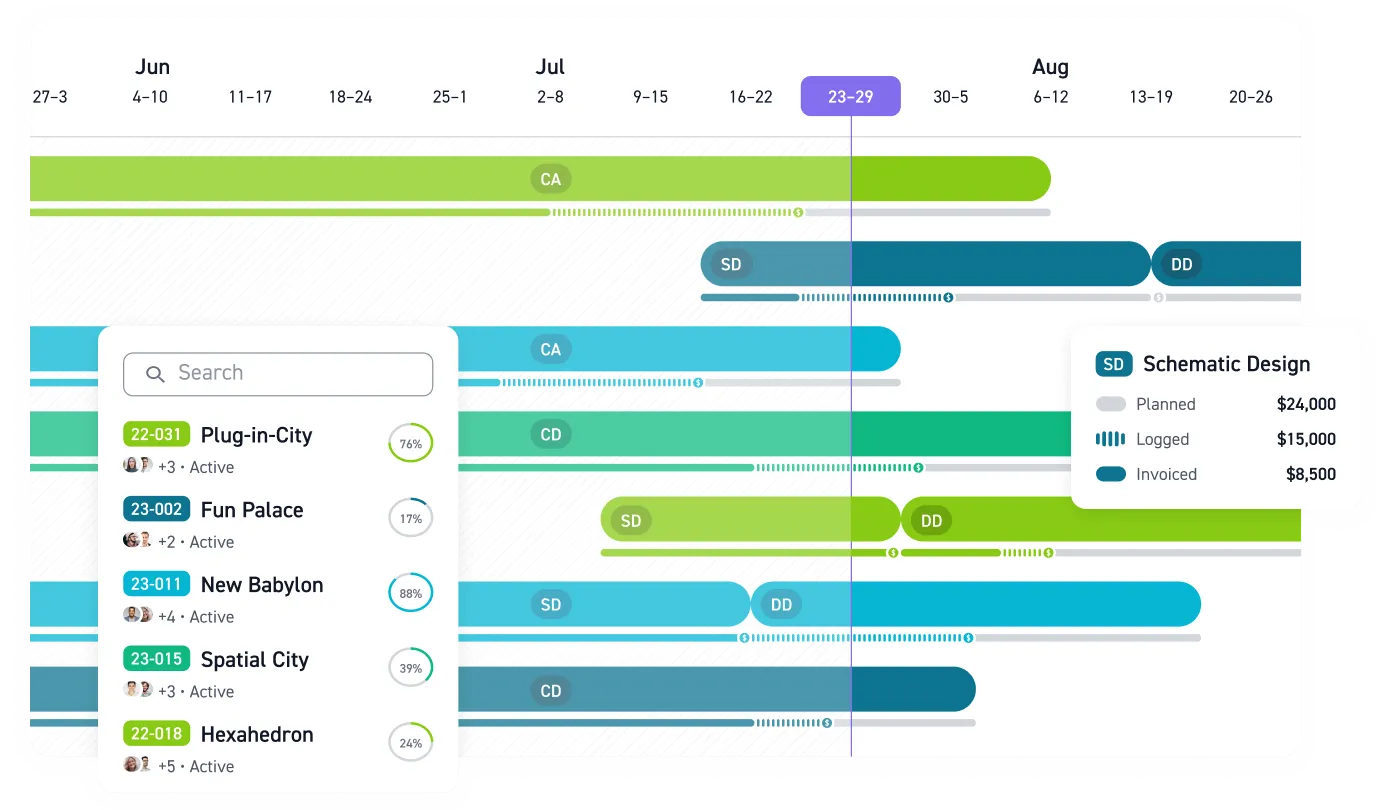
Monograph connects scope boundaries directly to real-time budget tracking. Monograph's signature MoneyGantt™ shows budget-to-cash progression at a glance. See which phases are planned, logged, invoiced, and paid without opening spreadsheets. Traditional scope tracking shows timelines. Monograph's MoneyGantt™ shows financial health. Get instant visual intelligence into project performance without mathematical complexity.
When a consultant submits extra hours or your team logs time beyond the defined scope, you see it immediately. Project managers get instant visibility into which phases are tracking against scope and which are heading toward trouble.
The platform handles what spreadsheets can't: connecting scope definitions to automated workflows that track time, monitor consultant billing, generate invoices, and flag budget overruns before they become losses. Your well-crafted scope document becomes actionable intelligence instead of a PDF gathering dust.
Scope creep is destroying your margins while you read this. Book a demo.
Frequently Asked Questions
Should we create custom scope templates or use industry-standard forms?
Start with industry-standard forms like AIA B101 or ASCE E-500, then customize for your firm's specific workflows. Creating fully custom templates from scratch opens liability gaps and misses 135 years of legal precedent built into standard documents. Use standard forms as the foundation, then add firm-specific language for your typical project phases, consultant coordination protocols, and deliverable standards. This approach protects you legally while reflecting how your firm actually works.
How do we handle scope changes mid-project without destroying profitability?
Document every scope change with a formal amendment before work begins. Track change orders against your original phase budgets in real-time so you know exactly how changes affect profitability as they happen. The firms that maintain margins during scope changes are the ones who can instantly see the budget impact and communicate it to clients before proceeding. Without real-time tracking, you're guessing whether that "small addition" just turned your profitable project into a break-even job.
What's the difference between architectural and engineering scope documents?
Architectural scopes follow phase-based progression from Schematic Design through Construction Administration with emphasis on spatial coordination and drawing-centric deliverables. Engineering scopes use task-order approaches with specific performance criteria and technical calculations tied to system integration requirements. When coordinating both, you need explicit protocols for aligning engineering task schedules with architectural phase milestones. Otherwise you'll spend more time managing consultant coordination than actually designing.
How detailed should our scope of work be for smaller projects?
Smaller projects need simpler scopes, but don't skip essential components. A $50,000 residential addition doesn't need the same deliverable detail as a $2M institutional project, but you still need clear phase definitions, consultant coordination protocols, and payment milestones. The key is right-sizing complexity to project value. Overcomplicating small project scopes wastes time, but under-defining them creates scope creep that destroys margins just as quickly.
Can good scope documentation really prevent scope creep?
Scope documentation prevents disputes about what was included. It doesn't prevent clients from requesting changes. The real value comes from connecting scope boundaries to real-time budget tracking. When you can instantly show a client exactly how their requested change affects timeline and budget, you transform scope creep from a silent profit killer into a transparent business conversation. Document scope clearly, then track it systematically.