
The question haunts every project manager in architecture and engineering: will artificial intelligence make our roles obsolete? If you're coordinating consultants, tracking budgets, and managing timelines while watching AI tools emerge across the industry, that concern is understandable. But here's what the data actually reveals about your future.
The reality is more nuanced than the headlines suggest. While AI will transform how project managers work, it won't eliminate the need for skilled professionals who can navigate complex A&E projects. But it is creating opportunities for PMs who understand how to use these tools strategically.
The Reality Check: Current AI Adoption in A&E
Despite the buzz around artificial intelligence, A&E firms are moving cautiously with implementation. Only 6% of architects regularly use AI in their practice, though 53% have experimented with the technology. That 47-percentage-point gap between experimentation and regular use tells the real story. Most firms are evaluating AI but struggling to move beyond pilot phases.
Engineering firms show similar patterns. A recent survey found 78% believe AI will positively impact their firm, representing a 15-point increase from 2024. Investment intentions remain strong, with another report showing over 75% of firms plan to invest in AI and automation tools within two years.
Clearly, there's a window opening for project managers who successfully implement AI tools while most firms are still figuring it out. Firms that crack the code on practical AI implementation during this period will build advantages before widespread adoption occurs.
Where AI Excels vs Where Humans Are Essential
Understanding which tasks AI can handle versus which require human expertise is crucial for positioning your role strategically. The boundaries are already more clear than you might expect.
AI can effectively automate or augment routine, data-intensive tasks that currently consume project managers' time. These include administrative and documentation work, construction scheduling and resource improvements, site documentation and progress tracking, risk identification and safety monitoring, and predictive analytics. These applications allow PMs to shift focus toward more strategic responsibilities requiring human expertise.
- Administrative workflows: Time tracking, data entry, reporting, and budget monitoring handle the mechanical coordination that consumes hours weekly.
- Construction scheduling improvements: AI-driven scheduling tools at leading construction organizations improve resource allocation and timeline accuracy.
- Site documentation: Robotics and sensors and cameras collect construction site data automatically. This helps PMs focus their efforts on more demanding strategic tasks.
- Risk monitoring: Pattern recognition provides early warning systems and safety compliance tracking. There are applications that demonstrate risk identification capabilities and ones that enhance safety monitoring.
These capabilities free up project managers to focus on higher-value activities where human expertise remains irreplaceable.
Professional engineering standards establish clear boundaries around human accountability. ASCE Policy Statement 573 mandates that civil engineers must maintain responsibility for project planning and designing. They must also maintain oversight of building operations and maintenance, regardless of AI capabilities. These requirements reflect professional liability obligations and ensure that accountability for construction oversight and public safety protection cannot be delegated to algorithms.
The tasks that define successful project management in A&E firms require distinctly human capabilities:
- Client relationships and expectation management: Building trust, negotiating scope changes, and managing stakeholder conflicts require human judgment.
- Multi-discipline design coordination: Balancing technical constraints, costs, aesthetics, and client priorities demands nuanced negotiation. This complex coordination spans architectural, structural, and MEP teams with competing interests.
- Professional engineering judgment: Making complex decisions under uncertainty requires capabilities beyond algorithms. Professional experience and contextual understanding cannot be automated.
- Crisis management: Responding to unexpected site conditions, design conflicts, or budget overruns requires adaptive expertise. These situations demand the adaptive expertise identified as essential project management competencies.
Tools That Augment Rather Than Replace
Smart A&E firms are implementing AI platforms that improve project manager effectiveness rather than attempting to replace human oversight. Several documented applications show how this augmentation works in practice.
Platforms like Monograph position themselves around intelligent business operations that complement rather than replace project managers. The platform's philosophy centers on combining design automation with strategic PM oversight. The most successful A&E firms combine design automation with intelligent business operations.
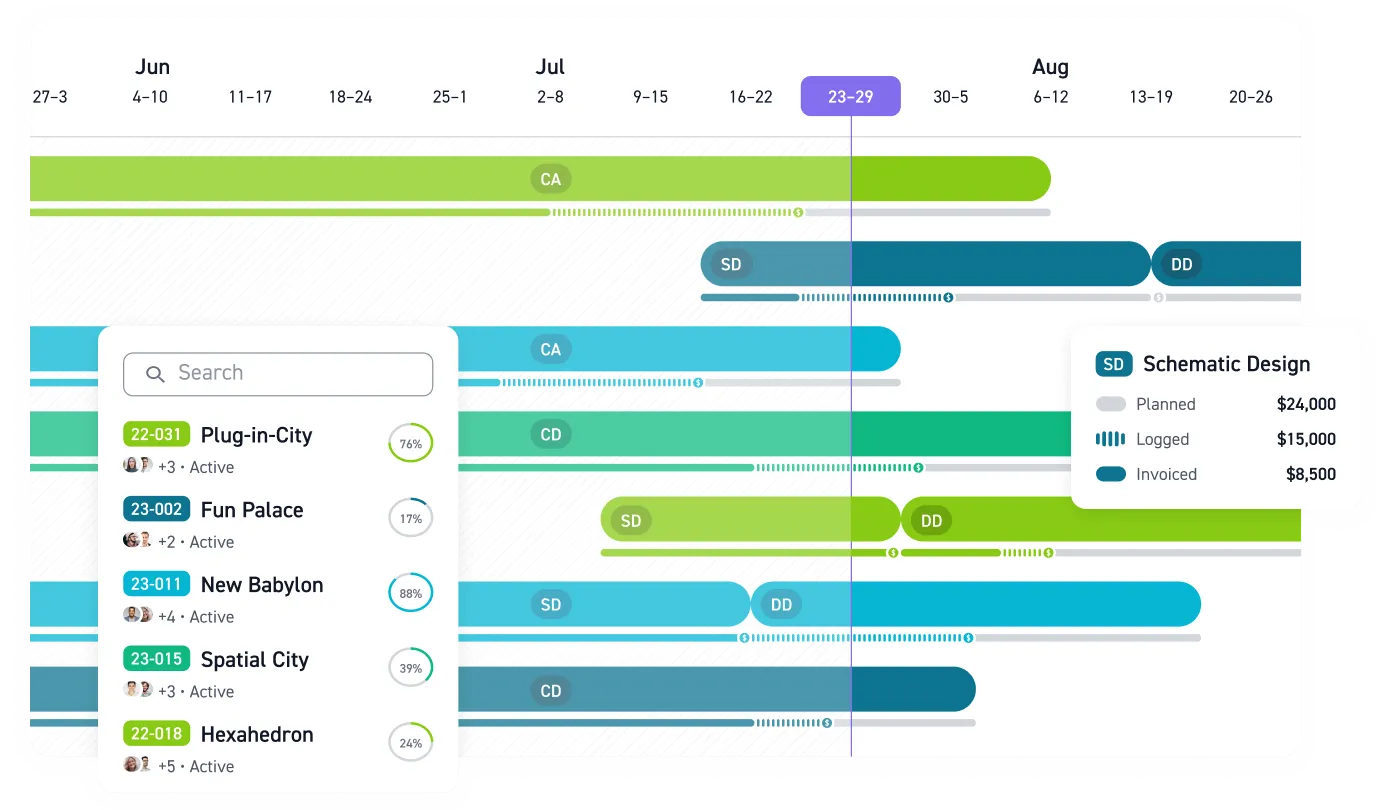
When AI helps teams complete design phases faster, Monograph automatically adjusts project forecasts, triggers billing workflows, and maintains visibility into profitability improvements. Monograph's signature MoneyGantt™ feature provides instant visual intelligence into project health. It combines traditional timelines with budget-to-cash progression without mathematical complexity. This surfaces intelligence that supports PM decision-making while keeping PMs informed and in control of strategic choices.
The results are tangible. Woodhull, a 25-person Maine architecture firm, achieved 66% time savings on admin tasks and 50% faster billing after implementing AI-augmented practice management. This demonstrates how automation frees PMs to focus on strategic work rather than replacing their roles.
The most effective implementations follow a pattern documented across A&E industry sources:
- AI handles: Data processing, pattern recognition, documentation, and routine coordination tasks that comprise approximately 80% of project management work
- Human project managers maintain: Decision-making authority, client relationships, professional responsibility, and strategic oversight
Professional engineers must retain responsibility for project planning, design decisions, and accountability for public safety regardless of AI capabilities. This division allows technical professionals to focus on what they do best. Solving complex problems, making strategic decisions, maintaining client relationships, and delivering quality projects.
Future-Proofing Your Role
The project managers who thrive in an AI-improved environment will be those who develop complementary skills that amplify rather than compete with artificial intelligence. Industry authorities including ZweigWhite, PSMJ Resources, and the AIA all emphasize core competencies that form the foundation where PMs maintain distinctive value.
So as AI handles routine coordination and administrative tasks, these are the fundamentally human skills that will differentiate valuable project managers:
- Advanced communication and stakeholder management
- Client relationship excellence
- Strategic decision-making and crisis management
- Financial acumen and business performance
- Leadership and team development
- Creative problem-solving
- AI integration awareness
Beyond these skills, future-focused project managers should also cultivate:
- Strategic financial acumen: Successful firms keep projects under budget. This positions PMs as business partners rather than just coordinators.
- Advanced stakeholder management: Complex negotiations and conflict resolution require nuanced human judgment. These interpersonal skills become more valuable as routine coordination becomes automated.
- Leadership and team development: PM leadership abilities and team collaboration skills are crucial. Building strong teams and developing talent cannot be delegated to systems.
- Creative problem-solving: Creativity is fundamental to A&E project management. Unique constraints and design challenges require human ingenuity.
The transformation is already underway, but it's creating opportunities for project managers who position themselves strategically. With minimal regular AI adoption across the industry and most firms still figuring it out, a window exists for early adopters. Rather than fearing replacement, embrace the tools that eliminate busywork.
As Gartner projects that 80% of project management tasks will be AI-driven by 2030, the future belongs to PMs who master that remaining 20%. Those who can lead teams, maintain professional responsibility for project outcomes, and navigate the complex decisions that define exceptional A&E delivery.
Master the Strategic 20% While AI Handles the Rest
Most firms struggle to move from experimenting with AI to using it regularly. That gap represents a key opportunity. While others debate AI adoption, early-mover project managers are building advantages that compound daily.
Monograph is the AI-powered practice management platform built specifically for A&E project managers who refuse to choose between strategic leadership and operational excellence. Our platform automatically handles the 80% of PM work that’s becoming AI-driven.
Monograph handles time tracking, budget monitoring, invoice generation, consultant coordination, and progress documentation. The platform learns from every project, surfaces insights before problems become crises, and keeps your entire team informed without requiring you to hunt through spreadsheets or chase updates. This lets you spend your time on client relationships, design coordination, professional judgment calls, and crisis management.
We’ve seen this over and over again in practice. Woodhull saved 66% of admin time and accelerated billing by 50%. Dynamic Engineering increased profit 25% with real-time project visibility. Both firms chose AI augmentation over manual coordination. Their project managers now focus on strategic work that actually requires human expertise.
The window is closing. Firms cracking AI implementation now will build operational advantages before widespread adoption occurs.
Your competitors aren't waiting. Neither should you. Book a demo with Monograph.
Frequently Asked Questions
Will AI-powered project management tools make my role obsolete?
No. AI won't replace project managers. It replaces the administrative burden that prevents you from doing actual project management. Think about your typical week. How much time do you spend chasing timesheet entries, updating budget spreadsheets, coordinating consultant billing, and hunting for project status information? That's the work AI handles.
The strategic decisions that define successful A&E projects require human judgment that can't be automated. Negotiating scope changes with clients, coordinating conflicting priorities across architectural and engineering teams, responding to unexpected site conditions, maintaining professional accountability for project outcomes. These require capabilities that cannot be reduced to algorithms.
ASCE Policy Statement 573 explicitly mandates that professional engineers maintain responsibility for project planning, design decisions, and public safety regardless of AI capabilities. AI gives you back the time to be the strategic project manager your firm needs.
When Monograph automatically flags budget risks, generates accurate forecasts, and coordinates consultant workflows, you're freed to focus on client relationships, design quality, and the complex judgment calls that actually require your expertise.
What AI capabilities should I look for in project management software?
Start with the capabilities that eliminate your biggest time sinks. The most valuable AI features for A&E project managers handle routine coordination and surface insights you'd never find manually.
Look for AI that automates project setup from contracts. Extracting phases, budgets, and staffing requirements without manual data entry saves hours. Budget intelligence that analyzes historical project data to recommend realistic phase allocations and identify where similar projects went over budget prevents costly mistakes.
Automated workflow orchestration assigns team members to projects, updates forecasts when phases complete, and triggers billing at the right milestones. Real-time budget alerts matter more than you think. AI that continuously monitors project spending against budgets and flags risks before they become crises gives you the proactive visibility manual tracking can't provide.
Intelligent timesheet management that auto-assigns staff to projects based on staffing plans eliminates the weekly chase for time entries. Integration is critical. AI that works across your existing systems delivers more value than standalone features.
Connecting project management to accounting, coordinating with consultant workflows, synchronizing time tracking with invoicing. 80% of project management work becoming AI-driven involves coordination across multiple systems. Pick tools that handle that complexity.
How do I convince firm leadership to invest in AI-powered practice management?
Start with the numbers leadership already worries about. Project profitability, cash flow, and utilization rates. Connect AI investment to measurable improvements in metrics they track.
Frame the business case around competitive positioning. Share the research showing firms struggle to move from experimenting with AI to using it regularly. Firms that implement AI successfully during this period build operational advantages before widespread adoption occurs. Ask whether your firm wants to lead that transformation or scramble to catch up later.
Highlight the labor constraint reality. A&E firms can't hire project managers fast enough, and training new PMs on complex multi-system workflows takes months. AI-powered practice management scales instantly without hiring delays. When Monograph handles project setup, budget tracking, and billing coordination automatically, your existing team manages more projects without working longer hours.
Provide concrete examples from firms similar to yours. Dynamic Engineering, a 10-person firm, increased profit 25% within six mo-nths by gaining real-time project visibility. Woodhull cut administrative time by 66% and accelerated billing by 50%. These aren't theoretical benefits. They're documented outcomes from A&E firms using AI-augmented practice management.
Finally, address the integration concern directly. The best AI tools work with existing systems rather than requiring wholesale replacement. QuickBooks synchronization, consultant collaboration workflows, and automated reporting eliminate the rip-and-replace risk that kills many technology initiatives.
Do I need technical skills to use AI project management tools?
No programming or technical expertise required. Today's AI-powered practice management platforms are designed for A&E professionals who manage projects, not developers who build software.
The best AI tools feel invisible. You upload a contract, and the system automatically extracts project phases, budgets, and staffing requirements. You approve a consultant invoice, and AI routes it through your approval workflow, updates project costs, and synchronizes with accounting. You check your dashboard, and AI surfaces budget risks and capacity constraints without requiring you to build reports or analyze spreadsheets.
Implementation matters more than technical skills. Look for platforms that provide expert setup support, handle integration configuration, and offer training specific to A&E workflows. The technology should adapt to how you work, not force you to change established processes.
What's the biggest immediate impact AI can have on my project management work?
Time. AI immediately gives you back hours every week that you're currently spending on administrative coordination.
Start by automating your biggest time sink. For most A&E project managers, that's either project budget tracking or billing coordination. Pick AI that handles that specific pain point, prove the time savings, then expand to additional workflows. The immediate impact comes from eliminating whatever administrative task currently prevents you from doing actual project management.


.png)