


Firm management made easy

You know that feeling when a promising lead comes in, your team scrambles to put together a proposal, and weeks later you hear nothing? Or worse, you find out another firm won the project? It happens more often than anyone likes to admit. We've all felt the frustration of investing hours in a proposal only to wonder where things went wrong. But here's what most A&E firm leaders get wrong about lead conversion: the problem usually isn't your proposals.
Architecture and engineering firms currently achieve win rates of 49-50%, a significant jump from historical averages of 37-44%. But that still means half the proposals you submit go nowhere. The question isn't whether you can write better proposals—it's whether you're pursuing the right opportunities in the first place.
Below 45%: When Pursuit Discipline Trumps Proposal Quality
If your win rate consistently falls below 45%, you have a pursuit approach problem, not a proposal quality problem. Firms achieving 45% or higher implement lead qualification before proposal submission. They aren’t writing better proposals, they are actually submitting fewer proposals but for better-fit opportunities.
The performance gap becomes stark when you look at technology adoption. PSMJ research reveals that 17% of tech-forward firms report win rates of 75-100%, compared to only 9% of tech-static firms. That’s nearly a 2x performance differential based largely on how consistently firms qualify and track opportunities.
Here's another metric worth tracking: capture rate. While win rate measures proposals submitted, capture rate tracks invitations to propose against all opportunities identified. Research shows 34% of tech-forward firms report capture rates higher than 50%, compared to only 21% of tech-static firms. Firms missing identified opportunities before reaching the proposal stage have a fundamental pursuit problem.
Qualification Before Pursuit
The biggest mistake A&E firms make isn't bad proposals. it's BD as an afterthought rather than a structured process. Every second spent on wrong pursuits is time not focused on opportunities that actually fit your firm.
Effective go/no-go decisions combine quantitative scoring with qualitative evaluation. Structured decision-making is essential to avoid wasting resources on low-probability pursuits. A practical framework should evaluate client relationship strength, project type fit, resource availability, win probability, long-term value, and fee potential.
The reason this matters comes down to resource constraints. Research shows that 41% of firms cite staff shortages as a cause of delays. With teams stretched thin, firms turn down projects and miss revenue opportunities.
The Four-Phase Conversion Framework
Converting leads into contracts requires disciplined progression through four distinct stages:
- Phase 1: Opportunity Qualification – Before investing proposal resources, evaluate the opportunity against your go/no-go criteria. Document client requirements, scope parameters, key stakeholders, and risk factors.
- Phase 2: Relationship Building –Research identifies four relationship-building fundamentals that separate high performers: differentiating beyond technical competence, leading with curiosity to understand client needs, crafting low-FUD (fear, uncertainty, doubt) approaches, and demonstrating understanding of client business drivers.
- Phase 3: Proposal Development – Confirm scope before writing begins. Unclear proposals cause teams to play catch-up later, eroding margins and client relationships.
- Phase 4: Contract Negotiation – Focus on realistic scopes, achievable budgets, and conditions for project success. The negotiation process establishes foundations for long-term client relationships.
Each phase builds on the previous, creating a foundation for consistent conversion success. Firms that master these fundamentals create lasting client partnerships rather than one-time transactions.
One metric deserves special attention: response speed. Conversion rates actually drop 8x after only five minutes following lead submission.
Proposal Approaches That Actually Win
With proposal win rates averaging 49-50% industry-wide, differentiation matters. Firms above 45% can focus on proposal refinement, while those below need to audit their pursuit approach first.
Start with explicit scope definition. Define project scope as accurately as possible, specifying what you will do and what you won't do.
Present fees within proper context. A/E fees represent a small percentage of construction costs and an even smaller percentage of lifecycle costs. Positioning fees as investment rather than expense changes the conversation.
The most successful proposals demonstrate three qualities:
- Business acumen beyond technical credentials: Show understanding of client business goals, not just technical requirements.
- Measurable past performance: Document specific outcomes from relevant projects rather than listing generic capabilities.
- Clear project execution approach: Demonstrate how you'll manage delivery through a structured plan.
Avoid the most common failure mode: undervaluing your marketing team. Marketing teams are often treated as support staff rather than partners, creating rushed, incoherent submissions.
Building Systems That Scale
Think of your lead conversion system like a building's structural system. Individual components matter, but the real strength comes from how they work together. The patterns across high-performing firms point to disciplined approaches rather than heroic individual efforts.
Implement a structured go/no-go matrix using quantitative scoring (0-5 scale) across six dimensions: client relationship strength, project type fit, fee potential, resource availability, win probability, and firm alignment. Establish a minimum threshold score (typically 18-24 out of 30 points) for automatic go decisions, with scores below threshold automatically declining and borderline scores requiring leadership review.
Track both win rate and capture rate. Document every go/no-go decision with scores and rationale, then review quarterly to compare assessments against actual outcomes. Firms that implement structured tracking systems see measurable improvements. Woodhull, a 25-person Maine architecture firm, reduced budget overages by 66% and cut administrative time by 66% after implementing systematic project tracking, freeing their team to focus on higher-value pursuit activities.
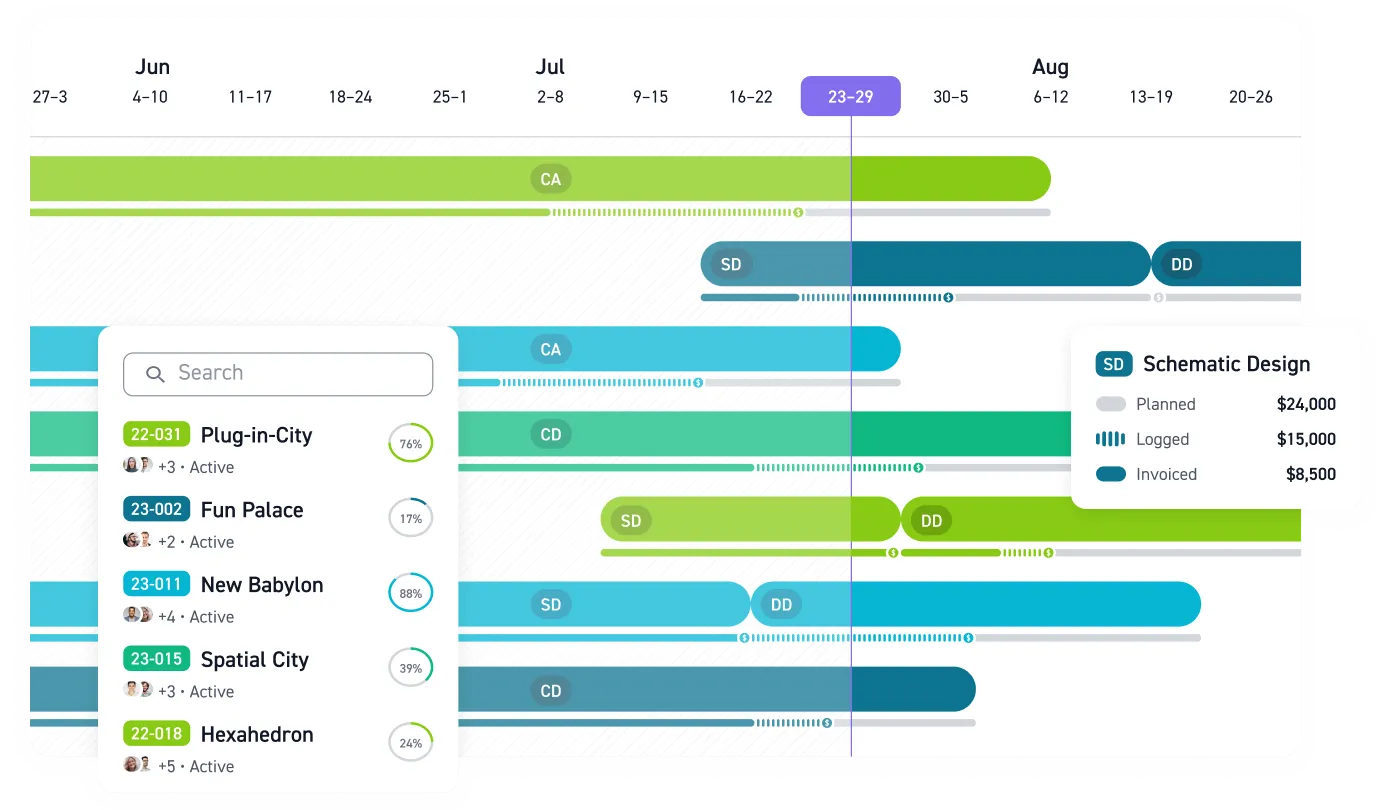
Monograph's CRM guidance suggests structuring your pipeline around actual project phases: initial inquiry, conceptual design, schematic design, design development, contract negotiation, rather than generic sales funnel stages.
Stop Losing Half Your Proposals
Your competitors are already implementing structured pursuit systems while you're still writing proposals for every opportunity that walks through the door. The firms winning at 75%+ aren't just better at proposals. They are, however, better at knowing which opportunities to pursue.
Monograph helps A&E firms track project performance, manage resources, and build the systems that turn good decisions into consistent wins. When you can see which project types deliver the best margins and which team configurations perform best, go/no-go decisions stop being gut calls.
Your next proposal could be the one that tips your win rate. Book a demo.
Frequently Asked Questions
What's a realistic win rate target for A&E firms?
Industry data shows average win rates of 49-50%, but tech-forward firms regularly achieve 75%+. If you're below 45%, focus on pursuit discipline before proposal quality. The goal isn't to win every proposal it's to only propose on opportunities you're positioned to win.
How do we implement a go/no-go framework without slowing down BD?
Start simple: score opportunities on six dimensions (client relationship, project fit, fee potential, resources, win probability, firm alignment) using a 0-5 scale. Set a threshold (typically 18-24 out of 30) for automatic pursuit. The discipline actually speeds up BD by eliminating wasted proposal effort.
Should we track capture rate or win rate?
Both. Win rate measures proposals submitted, but capture rate tracks invitations to propose against all opportunities identified. If your capture rate is low, you're missing opportunities before they reach proposal stage. If win rate is low, you're pursuing the wrong ones.
How quickly should we respond to new leads?
Research shows conversion rates drop 8x after just five minutes. Build systems for immediate response—even if it's just acknowledgment and scheduling a call. Speed signals competence and interest to potential clients.