


Firm management made easy

Most CRM systems are built for companies selling products to strangers through high-volume transactional acquisition. That's the opposite of how architecture and engineering firms operate. According to Monograph's research, A&E firms generate most revenue from repeat business with existing clients.
The problem isn't that your team resists technology. It's that generic sales tools don't match how A&E firms actually win and deliver work. We've watched firms try to force generic sales tools to work for years, and seen what actually succeeds.
Configure Your Pipeline Around Project Phases
Traditional CRM stages (Lead, Qualified, Proposal, Closed) don't reflect A&E reality. Your opportunities move through project delivery phases instead. Configure your CRM to track opportunities using these phases:
- Initial Inquiry
- Conceptual Design
- Schematic Design
- Design Development
- Construction Documents
- Negotiation
- Contract Execution
Assign probability weightings based on your firm's historical data. Most generic CRMs don't understand that a healthcare project at Schematic Design has different conversion odds than a commercial project at the same stage. Your historical data tells a more nuanced story. Use it to weight probabilities by project type, not just by generic stage.
By analyzing which stages historically convert to actual projects, you can improve forecasting accuracy and identify which phase transitions represent your strongest conversion opportunities. Research shows firms using proposal tracking improve win rates from 50% to 78%. This difference translates to millions in additional revenue for mid-sized firms without increasing business development activity.
Connect Your Systems or Watch Adoption Fail
Here's the uncomfortable truth: A&E firms struggle because their CRM lives in isolation from project management, time tracking, and financial systems.
When your CRM doesn't talk to your project management and accounting systems, every won project requires manual data recreation. Project managers start from scratch, hunting through email threads for client requirements documented during business development. You've seen this play out. The disconnect creates exactly the administrative burden that technical professionals resist. It's the same pattern across firms: good systems abandoned because they create more work than they save.
When an opportunity converts to a project, the system should automatically transfer:
- Client requirements, scope discussions and budget parameters
- Key stakeholder contacts with communication preferences
- Risk factors identified during pursuit
- Any proposal commitments
Your project team should start with complete context rather than rediscovering information.
Mid-sized firms see immediate impact from this integration. Woodhull, a 25-person architecture firm in Maine, reduced administrative time by 66% and cut budget overages by the same amount after switching from BQE Core to an integrated system that connected their CRM with project management and accounting.
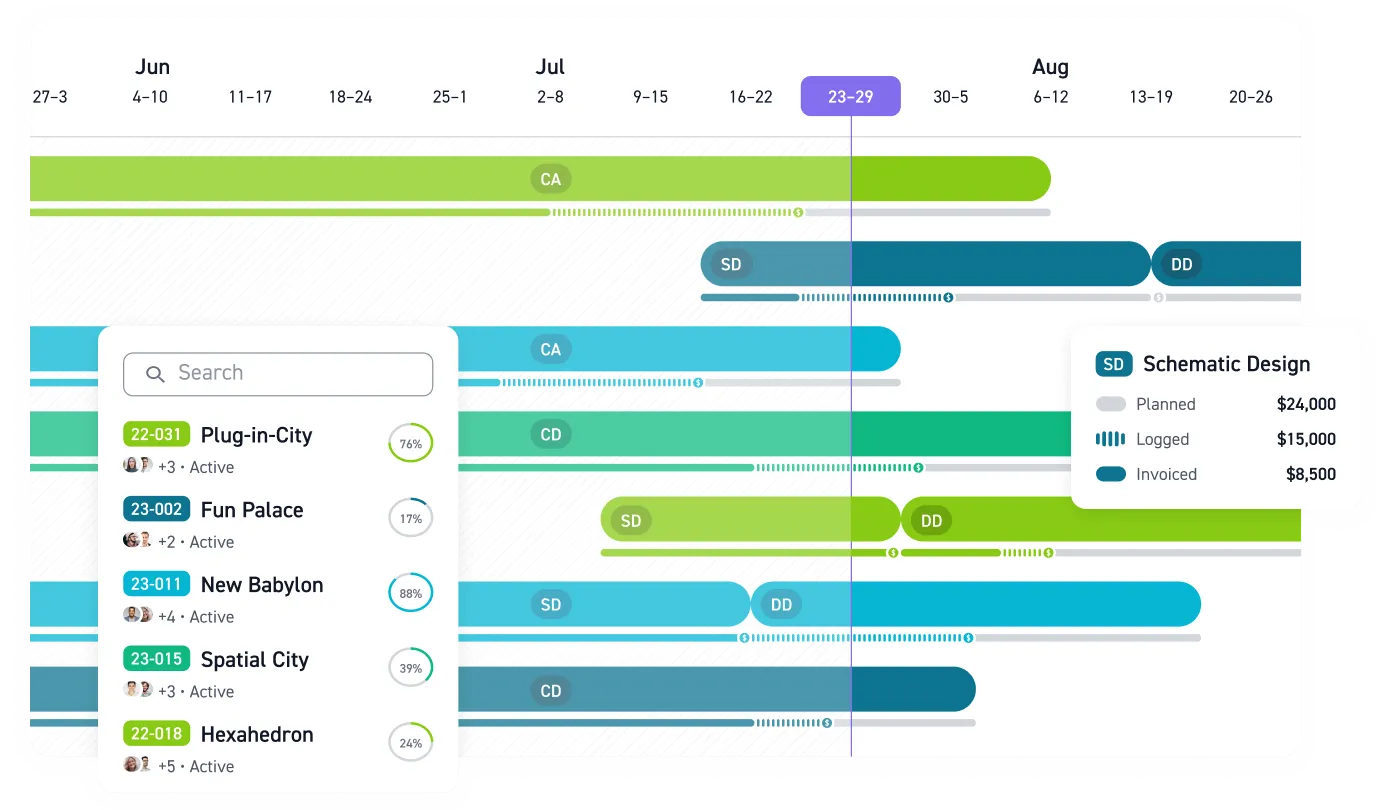
For small to mid-size firms without dedicated IT departments, look for systems with pre-built integrations to common A&E platforms. According to Monograph's research, firms benefit most from platforms that eliminate the gap between business development and project execution. Monograph's signature MoneyGantt™ transforms budget-to-cash progression into simple visual intelligence for firms using our platform. You can see planned, logged, invoiced, and paid status across all project phases without mathematical complexity.
This continuity matters especially for subconsultant relationships. Zweig Group's analysis notes that "subconsultants collaborate with diverse specialists to form the best possible team for successful project outcomes." Your CRM should track teaming partner capabilities, past collaboration performance, certifications, and current capacity.
Track What Actually Matters for Repeat Business
With most revenue coming from existing clients, your CRM strategy should prioritize relationship depth over lead generation volume. Structure your opportunity tracking with fields that help you analyze:
- Project manager performance: Which team members have the strongest client relationships?
- Market sector patterns: Are you winning healthcare projects at higher rates than commercial?
- Client type variations: How do win rates differ between repeat clients and new pursuits?
- Procurement method impact: What's your success rate on negotiated projects versus competitive bids?
This granular segmentation reveals where your firm actually excels. When you can see that Sarah's client retention rate outperforms the firm average by 40%, you know whom to assign to your most valuable relationships. When you notice that your negotiated project win rate doubles your competitive bid rate, you can make smarter decisions about which pursuits deserve your limited BD time. You might discover you're spending significant BD resources pursuing project types where you rarely win, while underinvesting in markets where your win rate is exceptional.
Make Proposals Work Harder for Your Firm
A&E firms invest significant time developing detailed proposals, yet many lack basic systems for capturing and using this institutional knowledge. Best practices says you should steer away from generic proposal content like "Our firm is more like a family" that fails to differentiate.
Set up structured proposal workflows:
- Go/no-go frameworks with weighted scoring for client relationship strength, project fit, resource availability, and competitive position
- Searchable content libraries of project descriptions, staff qualifications, and technical approaches tagged by project type
- Post-award analysis documenting why clients selected winners, whether you won or lost
According to research, A&E firms can improve win rates from 50% to 78% by tracking proposals systematically.
Nurture Relationships Systematically
Long-term relationship management requires more than good intentions. Industry research confirms that systematic nurturing processes drive repeat business in sectors where relationship depth determines success.
Set up automated workflow reminders, not impersonal automated emails. Consider these relationship touchpoints:
- Quarterly check-ins triggered by project completion date plus 90 and 180 days
- Project anniversary communications with photos and impact stories
- Industry news sharing based on documented client interests
- Milestone participation tracking groundbreakings, ribbon cuttings, and certifications
These touchpoints maintain relationship warmth between projects.
Start Where You'll See Results Fastest
Don't try to set up everything at once. Many A&E firms lack basic systems for tracking utilization and profitability, a phased approach makes sense:
- Months 1-3: Basic opportunity tracking with win/loss analysis and client contact database
- Months 4-6: Proposal management workflows and project management integration
- Months 7-9: Relationship nurturing automation and content libraries
- Months 10-12: Advanced analytics and subconsultant tracking
Close the Gap Between Business Development and Project Execution
You're tracking opportunities through your pipeline, logging client conversations, documenting proposal commitments. Then you win the project, and everything stops. All that context vanishes into email threads while your project team starts from scratch.
That gap is where CRM adoption dies. When business development and project execution live in separate systems, you're guaranteeing the manual recreation that makes your technical team resist CRM in the first place. They're not resisting technology. They're resisting tools that create administrative burden instead of eliminating it.
The firms seeing real results from CRM don't treat it as a standalone system. They connect relationship management directly to project delivery. Client requirements flow automatically into project setup. Budget discussions become phase budgets. Stakeholder contacts appear in project dashboards. Proposal commitments turn into deliverable tracking.
13,000+ architects and engineers across 1,800+ firms use Monograph. When an opportunity converts to a project, the context moves with it. Your project managers start with complete information instead of hunting through disconnected systems. Your principals see how relationships translate into profitable work. Your team finally has the clarity they need to make smarter decisions across both business development and project delivery.
Your competitors are already connecting their systems. Close the gap. Book a demo with Monograph.
Frequently Asked Questions
What if 85% of our revenue comes from repeat clients? Do we even need CRM?
That's exactly why you need CRM, just not the kind built for high-volume sales prospecting. When most of your revenue comes from existing relationships, your CRM should track relationship health, not lead generation funnels.
Track which project managers maintain the strongest client relationships. Document communication preferences and decision-making patterns. Set up regular check-ins triggered by project completion dates. Monitor which clients are ready for new work based on their project cycles.
The firms that lose repeat business aren't getting beat on technical competence. They're losing because someone else stayed in touch while you were heads-down on the current project.
How do we configure CRM stages around AIA phases instead of generic sales stages?
Stop trying to force your workflow into Lead, Qualified, Proposal, Closed stages. Configure your CRM pipeline to match actual project phases: Initial Inquiry, Conceptual Design, Schematic Design, Design Development, Construction Documents, Negotiation, Contract Execution.
Assign probability weightings based on your historical conversion data, not generic sales benchmarks. Your data shows that healthcare projects at Schematic Design convert differently than commercial projects at the same stage. Weight your pipeline forecasts accordingly.
This phase-based approach gives you accurate revenue forecasting and helps identify where opportunities actually stall in your pursuit process.
Can CRM really improve win rates from 50% to 78% just by tracking proposals better?
Yes, but not because the software is magic. Better proposal tracking forces you to answer hard questions: Why are we pursuing this? What's our competitive advantage? Do we have the right team available? What did we learn from similar pursuits?
Set up go/no-go frameworks with weighted scoring for client relationships, project fit, resource availability, and competitive position. Build searchable content libraries so you're not recreating project descriptions from scratch. Document post-award feedback whether you win or lose.
The win rate improvement comes from pursuing fewer projects more strategically and learning from every outcome. CRM just makes that regular instead of ad hoc.
What if our team already resists the tools we have? Why would CRM be different?
Your team resists tools that create administrative burden without delivering value. When CRM lives in isolation from project management, every won opportunity requires manual data entry into multiple systems. That's not resistance. That's rational behavior.
Connect your CRM to project management so opportunity data flows automatically into project setup. Client requirements become project briefs. Budget discussions turn into phase budgets. Stakeholder contacts appear in project dashboards.
Your technical professionals will use systems that eliminate busywork and provide context they need. They'll resist systems that force them to hunt through three platforms to answer basic questions about client requirements.
How do we track subconsultant relationships without creating more administrative work?
Track what matters for teaming decisions: capabilities by project type, past collaboration performance, current certifications, and capacity availability. Structure this data so it's searchable when you're building pursuit teams.
Set up fields that answer the questions you actually ask during proposal development: Who did we work with on similar healthcare projects? Which structural engineers have availability in Q3? What MEP firms have experience with LEED Platinum?
The key is making subconsultant data useful for pursuit decisions, not just documenting relationships after the fact. If your CRM can't help you build better teams faster, you're tracking the wrong information.