
Eighty-five percent of A&E firms believe AI is critically important to the industry's future. Regular use remains at roughly six percent. That adoption gap shows where the industry stands right now: firm leaders know AI matters, but most have not figured out what it looks like in practice.
For principals and owners running 5-to-50-person firms on fixed-fee contracts, AI project management software will change how A&E firms operate. If you are spending more time hunting through spreadsheets than reviewing project performance, something is already broken. You can adopt AI with a clear plan now, or deal with the scramble later.
What AI Project Management Software Actually Means in A&E
AI project management software for architects and engineers supports forecasting, staffing, documentation, and billing in ways generic task tools often do not. Across the AEC industry, adoption guidance organizes the opportunity around three practical questions: why to adopt AI, what makes it difficult, and how to move forward. That framing is useful because it keeps the discussion grounded in firm-level decisions rather than abstract technology trends. The same research identifies how AI capabilities are showing up in three functional areas worth understanding before you start evaluating tools:
- Machine learning: Cost estimation models trained on historical project data, predictive scheduling that identifies delays before they hit, and pattern recognition across your project portfolio
- Task automation: Handling repetitive work like report generation, spec management, document processing, and invoice assembly
- Agentic AI: Systems that manage multi-step business processes, like submittal reviews or RFI tracking, without requiring human intervention at each step
The broader shift in the industry is away from general-purpose language models and toward specialized AEC tools built for construction sequencing, building codes, and engineering workflows. Purpose-built systems are increasingly designed to manage multi-step business tasks across operations, including finance and human resources.
This distinction matters. Generic tool gaps often show up around design phases, consultant coordination, and the financial dynamics of a fixed-fee contract. A&E-specific AI is built closer to that reality.
The Capabilities That Actually Move the Needle
For a firm managing 5 to 15 concurrent projects with a lean team, several capabilities stand out as immediately useful.
Predictive budget forecasting tracks burn rate variance, cost performance, and estimate-at-completion projections in real time. Instead of discovering a phase went over budget after the fact, these systems can help teams track budget performance and support earlier project discussions. Forecasting research highlights how AI can improve forecasting and help flag likely delays and cost overruns earlier.
Intelligent resource allocation is where firms with limited staff often see the fastest returns. AI analyzes staff availability, skill matching, deadline constraints, and real-time workload across projects and phases simultaneously. AEC industry data indicates that AI can help firms improve resource allocation and use historical data to support forecasting and planning. Cross-industry conversations with A&E firm leaders, consistently identify AI-driven resource assignment based on availability and skills as one of the highest-value early applications.
If you have ever tried to rebalance staff across ten active projects on a Friday afternoon, you already know the problem. One person is overloaded, another has hidden capacity, and the answer is buried across timesheets, schedules, and budget sheets. That is exactly the kind of coordination work AI can help clean up when the underlying project data is connected.
Administrative overhead reduction frees up hours every week. High-value automation applications for A&E firms include email organization, meeting documentation, field reporting, and legal discovery. A PSMJ webinar on AI in practice documents how these applications free teams to focus on design and client delivery. When project managers spend less time assembling status reports and more time managing actual project risk, the improvement compounds across every engagement.
Billing automation directly addresses cash flow. A&E firms typically wait an average of 71 days to collect on invoices while managing billing rates across dozens of position levels. AI-assisted invoicing generates bills directly from tracked time and can automate parts of the billing and collections workflow.
Why Most Firms Haven't Made the Jump Yet
AEC professionals consistently report several barriers to adoption. Survey data from a broad cross-industry study identifies the top three:
- Security concerns around how client data is stored and used
- Cost and complexity of implementation, especially for smaller firms
- Regulatory uncertainty about liability and professional standards
Beyond tool-level hesitation, there is a structural challenge. Engineers proficient in traditional software often lack the data analysis skills needed to interpret machine learning outputs. That skills gap affects change management across people, processes, and organizational culture in ways a software purchase alone will not solve.
That said, momentum is building. Among AEC professionals already using AI, the majority plan to expand their use significantly, suggesting the industry is approaching a tipping point.
Why A&E-Specific Tools Matter More Than Generic Ones
Mid-size A&E firms face a specific operational paradox. They sit in the middle ground between the informal financial management that works at very small firms and the dedicated administrative staffing that larger practices can afford. This is where purpose-built AI project management software can have direct impact.
A 2026 engineering PM study shows that larger engineering teams are significantly less satisfied with their project management tools than small teams, with large teams scoring -27 and small teams scoring +25 on a satisfaction index after excluding neutral responses. The complaints are consistent: tools are difficult to use, they do not connect with other software, and training is inadequate. As firms scale, those failure modes compound, especially when disconnected systems turn spreadsheets into a liability rather than an asset.
A unified A&E system works best when project data, staffing, billing, and accounting stay connected. The principle is reinforced across the industry: effective AI strategy depends on strong data governance, and integrated data is the prerequisite for any AI capability to produce reliable results. Design data in BIM, financials in QuickBooks, and project updates in spreadsheets do not power intelligent models while they live in silos.
This is where platforms like Monograph fit. Built for A&E firms, Monograph brings project planning, resource allocation, time tracking, budgeting, invoicing, and profitability analysis into one system. Its QuickBooks integration links project workflows and accounting, letting QuickBooks manage the general ledger while Monograph supports A&E-specific budgeting, staffing, and profitability workflows.
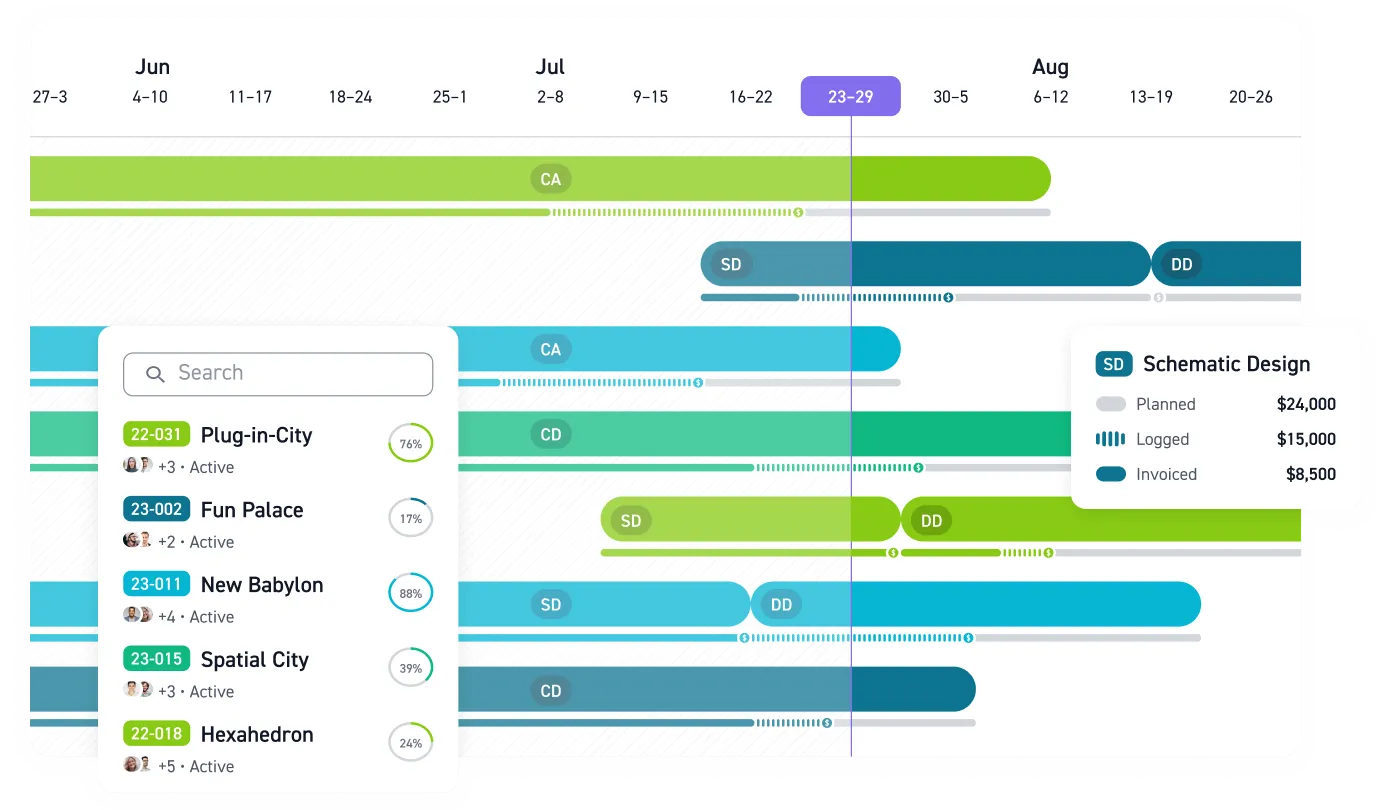
A&E firms do not need another dashboard that only reports problems after the damage is done. They need a system that helps teams see project health while there is still time to act. Monograph supports fixed-fee, hourly, and hybrid contracts, tracks consultant costs, and gives teams visibility into project planning and resource allocation. It also gives teams a visual view through Monograph's MoneyGantt™, showing budget-to-cash progression across planned, logged, invoiced, and paid work so financial issues are easier to spot early.
Over 13,000 architects and engineers across 1,800+ firms use Monograph to work smarter, faster. In practice, that translates into measurable operational gains: Workbench, a 30-person California firm, reported 8x faster staffing, 4x faster billing, and 75% less unbilled fees after moving from BQE Core to Monograph.
How to Start Without Overcommitting
Practical guidance for smaller A&E firms emphasizes low-risk entry points: building awareness, identifying high-impact use cases, launching limited pilot projects, and evaluating existing tools before committing to new ones. The same guidance points to three approaches that reduce friction during early adoption:
- Target bottlenecks first. Identify the one or two workflows where your team loses the most hours each week. Billing cycles, staffing coordination, and project status reporting are the most common starting points in A&E firms.
- Track leading and lagging indicators. Establish a baseline before you start, then monitor both the process metric you want to improve and the downstream outcome it affects, such as billing cycle time and days sales outstanding.
- Consider group purchasing. Industry associations and peer networks often negotiate tool access at reduced rates, which lowers the cost of piloting new technology without a long-term commitment.
Firms achieve stronger AI results when they treat adoption as a workflow decision, not a software purchase. Industry survey data puts it plainly: the biggest barriers to AEC technology adoption are complexity, culture, and connection between teams and systems, not cost alone. Responsible adoption guidance for AEC firms recommends starting with one or two measurable use cases, building momentum through early wins, and keeping people in the loop while AI handles the repetitive work.
Before implementing any tool, establish a baseline. Document the current state of the workflow you want to improve, then track your progress against that starting point to evaluate what the tool actually delivers.
Start With One Workflow, Not a Firmwide Overhaul
You do not need to automate your entire practice at once. Start with one workflow that creates friction every week: staffing, budget tracking, meeting documentation, invoicing, or project reporting. Choose the process where your team is losing the most time, establish your baselines, and run a limited pilot so you can evaluate what actually improves.
For principals, operations leaders, and project managers, the practical next step is simple. Pick one use case, track the right leading and lagging indicators, and make sure your data is connected well enough for the tool to be useful. If your firm is already feeling the limits of spreadsheets and disconnected systems, it may also be time to evaluate whether an A&E-specific platform can support project planning, resource allocation, budgeting, invoicing, and profitability in one place.
Platforms like Monograph are built around those workflows, including project planning, resource allocation, budgeting, invoicing, consultant cost tracking, and real-time financial visibility through Monograph's MoneyGantt™. That view shows budget-to-cash progression across planned, logged, invoiced, and paid work, making small financial problems easier to catch before they become expensive ones.
Start now. Firms that move first with clear metrics, a solid data foundation, and a focused pilot will be in a much stronger position than firms still trying to piece answers together from disconnected tools later. See how Monograph works for A&E firms like yours.
FAQ
What is AI project management software for architects and engineers?
In this context, it means software that uses machine learning, automation, and agentic AI to support A&E-specific workflows such as forecasting, documentation, billing, and resource planning rather than generic task management alone.
Why is AI adoption still low in A&E firms?
Security concerns, cost and complexity, regulatory uncertainty, a skills gap in data analysis, and the reality that adoption is a change management challenge, not just a software purchase, all contribute to the slow pace of adoption across the industry.
Which AI capabilities matter most for small and mid-size A&E firms?
The most immediately practical capabilities are predictive budget forecasting, intelligent resource allocation, administrative automation, and billing automation. Each of these addresses a high-friction, high-cost process that most A&E teams are managing manually today.
Why do A&E-specific tools matter more than generic project management platforms?
A&E firms operate around design phases, consultant coordination, fixed-fee contracts, and project-based financial management. Generic tools often miss that context, while purpose-built systems are designed around it.
How should a firm start adopting AI project management software?
Start with narrow, measurable use cases, pilot carefully, track baseline metrics, and make sure your data and workflows are ready before expecting AI to produce meaningful results.