



Firm management made easy

You're juggling scope creep, fee pressure, and clients who want yesterday's deadline. Now everyone says AI should fix it. But how do you actually add AI to your proposal workflow without breaking what already works?
Only 27% of A&E professionals currently use AI in their operations, yet 78% plan to invest within two years. That gap represents both risk and opportunity.
The Foundation of Effective Engineering Proposals
Before diving into AI tools, it's worth grounding ourselves in what makes engineering proposals work. Without a clear scope foundation, no amount of technology will save your proposal.
You've likely developed these components through hard-won experience over many projects. The challenge isn't knowing what matters. It's executing consistently under deadline pressure while managing multiple pursuits.
Effective engineering proposals require four core components that AI can improve but never replace:
- Scope of services definition: Zweig Group emphasizes that proposals need a very clear and appropriate scope of services as the foundation
- Work breakdown structure: PMI establishes that a WBS describes the sum of work required, serves as a communications tool best reduced to writing, and should be useful to all project participants
- Fee structure and pricing: PSMJ Resources recommends breaking fees down by project area type through detailed checklists, which supports fee negotiations and demonstrates the full scope of work required
- Schedule and timeline: ASCE establishes that schedules require task durations, sequences, network diagrams, and cash flow plans aligned with milestones
These four components form the backbone of every successful proposal. When AI tools improve this foundation rather than bypass it, firms see measurable improvements in win rates and project profitability.
Where AI Fits Into Your Proposal Process
A well-documented example of AI transforming proposal work comes from Bechtel, which ENR ranked #9 on its 2025 Top 500 Design Firms list. Their implementation compressed proposal timelines from days into minutes by using AI as an assistant.
While Bechtel compressed proposal timelines from days into minutes, smaller firms see comparable transformations. Dynamic Engineering, a 10-person Florida engineering firm, achieved 25% profit growth and 2x efficiency gains by implementing AI-powered practice management that automated budget tracking and proposal development workflows, allowing their team to focus on high-value technical work rather than manual spreadsheet management.
What does this mean for your firm? The productivity gains are real, but they require the right foundation and realistic expectations about what AI can and can't do. MIT Sloan research documents nearly 40% productivity gains for skilled workers using generative AI. Yet firms lack adoption plans despite this evidence. The infrastructure is expanding. IT spending is up 51% over two years. But deployment lags significantly.
AIA research shows 84% of architects are optimistic about AI automating manual tasks, while 62% are optimistic about AI providing answers based on historical firm knowledge. That second capability directly supports project scoping by helping firms quickly reference similar past projects and apply lessons learned to new proposals. Early movers who execute this step by step will gain competitive advantage before AI becomes table stakes.
A 7-Step Framework for AI-Powered Project Planning
Engineering leaders recommend a compliance-first approach centered on professional oversight and phased implementation. NSPE guidance emphasizes that engineers in responsible charge must exercise oversight and professional judgment over AI-assisted work, particularly where public safety or licensure is involved. This isn't optional. It's a professional and legal requirement that shapes how any implementation framework must function.
Step 1: Audit your data infrastructure. Before purchasing any AI tools, document where your project data lives. Most A&E firms face a fundamental challenge where data lives in six different places, preventing effective AI deployment.
Step 2: Define professional oversight requirements. Establish protocols where licensed professionals verify all AI-generated recommendations before use. Define clear boundaries between AI assistance and human decision-making authority.
Step 3: Develop a tailored roadmap. Larger organizations follow more adoption and scaling best practices for AI deployment than smaller organizations. But smaller firms have advantages in faster decision-making and simpler technology ecosystems. Your roadmap should account for your specific project types, team size, and resource constraints.
Step 4: Start with a controlled pilot. Test AI capabilities on specific project types before broader deployment. This controlled approach allows teams to build confidence through demonstrated results and identify implementation challenges before firm-wide rollouts.
Step 5: Train your team. Most architecture and engineering firms can't flip a switch and "go AI." Teams need time to understand what works and build trust in AI-assisted processes.
Step 6: Monitor continuously. Track professional liability exposure, client trust, and quality assurance throughout implementation.
Step 7: Scale what works. Firms that establish these practices from day one report higher team adoption rates and fewer professional liability concerns. But even the best framework fails without the right data foundation.
Building the Right Foundation First
Here's the uncomfortable reality: your data infrastructure likely isn't ready for AI. Research from sa.global on AI adoption in architecture and engineering firms shows many firms still rely on paper in their project workflows, making it impossible to capture the consistent, real-time data that AI requires.
Four barriers must be addressed before AI tools provide value:
- Paper-based workflows that can't capture digital data
- Fragmented systems with data scattered across platforms
- Inconsistent data formats between projects and teams
- Missing historical benchmarks for AI to learn from
Firms may need 6-12 months of digitizing work before AI tools provide value. The sooner A&E firms establish the right technology foundation, the sooner AI transitions from promise to measurable results.
Cultural readiness matters equally. Zweig Group's analysis found that firms at the frontier of change thrive by pairing AI adoption with a culture of agility, data trust, and teams built to adapt at scale.
Leadership commitment determines success or failure. Revizto's analysis identifies leadership commitment as the single most critical factor for technological adoption success in A&E firms. Principals must not only approve investments but actively use the tools, reference AI-generated insights in planning discussions, and hold teams accountable for data quality.
Making It Work for Your Firm
Generic project management tools lack critical A&E capabilities: phase-based billing aligned with contract structures, earned value calculations, and direct time-to-budget connection. Monograph's research shows platforms like monday.com and Microsoft Project require extensive customization for A&E workflows. Microsoft Project requires manual overhead to build cost codes, update budgets, and export time data before invoicing is even possible.
After working with 13,000+ architects and engineers across 1,800+ firms, Monograph addresses this by consolidating project management features into a single system designed specifically for A&E workflows. Real-time dashboards eliminate the delays that come from navigating between multiple tools or spreadsheets. Phase-based tracking aligns with how engineering contracts actually work.
The impact of consolidated AI-powered platforms is measurable. Woodhull, a 25-person architecture firm in Maine, saved 66% of time on administrative tasks and achieved 50% faster billing after implementing integrated practice management, allowing their team to redirect time from manual budget tracking to high-value proposal work and client development.
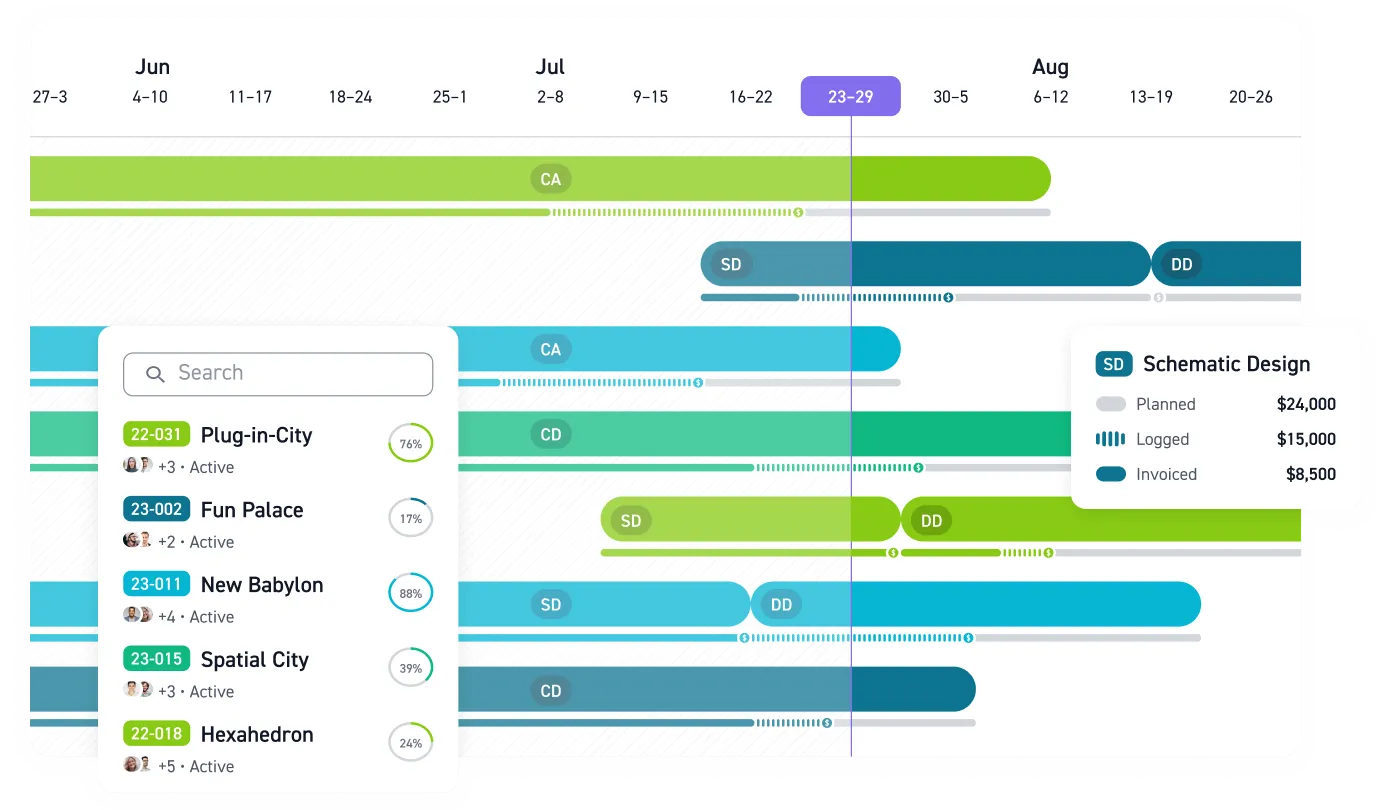
Monograph's MoneyGantt™ shows burn rate in real time. The difference between reacting to budget problems and seeing them develop in time to correct course. AI-powered tools can combine data from multiple sources for real-time schedule adjustments rather than relying on static Gantt charts. Predictive capabilities provide early warning systems for potential schedule impacts, moving you from reactive firefighting to proactive management.
The future of engineering project planning isn't about AI replacing professional judgment. It's about AI handling routine data analysis and pattern recognition so you can focus on the client relationships, creative problem-solving, and technical decisions that require human expertise.
Start With What You Can Control
You can't control when AI becomes table stakes in your market. You can control whether your firm is ready when that moment arrives.
Before evaluating any AI tools, assess your data foundation. Where does your project information live today? Can you quickly pull historical budgets, timesheets, and project outcomes from the last two years? If that takes more than a few minutes, your data infrastructure isn't ready for AI, no matter how advanced the tool.
For Project Managers: Start by documenting which projects have consistent data and which don't. Identify one project type where you have reliable historical information, then pilot AI-assisted planning there first.
For Operations Leaders: Audit your current systems. How many platforms do you use to manage projects from proposal through closeout? Each disconnected system creates a barrier to AI adoption. Consider consolidating before adding AI capabilities.
For Principals and Owners: The firms winning more profitable work aren't waiting for perfect AI solutions. They're building the data foundation today that lets them leverage AI tomorrow. That means choosing platforms designed for A&E workflows, not generic business tools retrofitted with AI features.
The 7-step framework above works, but only if your data is ready. Focus there first, and the AI capabilities will follow naturally.
The window is closing. Book a consultation to assess your AI readiness.
Frequently Asked Questions
How do I know if my firm's data is ready for AI?
Run this simple test: can you pull accurate budget and timesheet data for your last five similar projects in under 10 minutes? If not, your data infrastructure needs work before AI will help. Most firms discover their project information lives across spreadsheets, email threads, and disconnected systems. AI needs consistent, accessible historical data to generate useful recommendations. Start by consolidating project data into one system built for A&E workflows, then let that clean dataset train your AI tools.
What if my team resists AI-powered project management?
Team resistance usually signals legitimate concerns, not technophobia. Engineers and architects resist tools that ignore how they actually work or add administrative burden. The solution isn't forcing adoption. It's choosing AI that fits existing workflows. Start with a controlled pilot on one project type where you can demonstrate tangible wins: faster proposal development, more accurate budgets, or reduced administrative time. When teams see AI handling tedious tasks instead of creating new ones, resistance drops fast.
How long before we see ROI from AI implementation?
Timeline depends entirely on your data foundation. Firms with consolidated project data in A&E-specific platforms see productivity gains within weeks. Firms starting with spreadsheet chaos face 6-12 months of data cleanup first. The MIT Sloan research showing 40% productivity gains reflects teams working from clean datasets, not firms piecing together information from six different systems. Focus on data consolidation first, then measure AI impact on specific workflows like proposal development or budget tracking.