
Most architecture firms run on relationships that span years. A school district contact can become a repeat client much later. A teaming partner on a healthcare project can resurface for a future federal RFP. The problem is where all that relationship history lives: scattered across email inboxes, personal contacts, and spreadsheets that only one person knows how to read.
More than 12,000 architects and engineers across 1,500+ firms use Monograph, and one pattern shows up consistently: firms buy CRMs but do not always use them. Survey data indicates 77% currently use a CRM or marketing information system. Industry data suggests nearly 47% of A&E firms cite poor adoption of business development tools as a significant challenge. For principals and project managers at small-to-midsize firms, the real question is which CRM your team will actually open every day.
Why Generic CRMs Break Down for Architecture Firms
Generic CRMs are built around short sales cycles, single contacts, and deal-close metrics. Architecture firms work differently. Pursuits stretch across long timelines, proposals involve teams of subconsultants, and repeat client relationships drive a large share of revenue.
A purpose-built A&E CRM covers workflows that generic tools often miss:
- Pursuit tracking tied to project types and procurement methods rather than simple lead-to-deal funnels.
- Go/no-go decision frameworks that score relationship strength, win probability, and team capacity before resources are committed.
- Teaming partner databases that track subconsultant disciplines, past teaming history, and conflicts across active pursuits.
- Past performance repositories linking completed project descriptions, metrics, and client references to proposal assembly workflows.
These are usually the first workflows to break when a firm tries to force A&E business development into a generic sales tool.
A 2025 industry analysis shows many firms default to automatic pursuit decisions instead of structured go/no-go evaluation, which pulls limited resources into low-probability pursuits. Industry guidance has also flagged sales and marketing as often-missed opportunities for architecture firm leaders to adopt better technology. The spreadsheet approach leaves firms exposed.
A&E-Specific CRM Platforms
Most firms choose between three paths: purpose-built A&E platforms, general-purpose CRMs adapted for A&E use, and all-in-one practice management systems with embedded pipeline tools.
Deltek Vantagepoint is the most established A&E-specific option. Its CRM connects directly to project planning and resource planning, so pursuit information flows directly into the project record when work moves forward.
Unanet CRM by Cosential brings 20+ years of A&E-specific depth. It handles teaming partner tracking, multi-office management, and contact segmentation across project types.
TrebleHook takes an A&E-specific approach built on Salesforce. For firms that already want Salesforce, it adds A&E workflows without starting from scratch.
BQE CORE Architect combines time tracking, invoicing, accounting, project management, and CRM in one cloud platform.
General-Purpose CRMs in A&E Practice
HubSpot has gained traction at smaller firms. Industry coverage has cited its free plans as one reason for adoption among business developers, marketers, and seller-doers. In one A&E practitioner discussion, HubSpot's free tier was described as capable enough for standalone CRM use at a small firm. The tradeoff is setup. HubSpot has no native concept of project types, teaming partners, or SF330 forms.
Microsoft Dynamics 365, configured for AEC pursuit management, can serve firms that already live inside the Microsoft stack.
Salesforce offers maximum configurability but demands more IT investment. Many A&E firms use it with an A&E-specific layer like TrebleHook rather than building from scratch.
Where Practice Management Meets Pipeline
For smaller firms, pipeline management inside the system where projects, budgets, and time already live can work better than a standalone CRM.
Monograph's Pipeline module connects leads, proposals, and forecasts to the same platform where project managers track time, budgets, and invoicing. It pairs pipeline and revenue forecasting with practice management in one place.
Capabilities include:
- Proposal-to-project continuity: Fee structures from proposals become project budgets, and scope agreements inform phase planning.
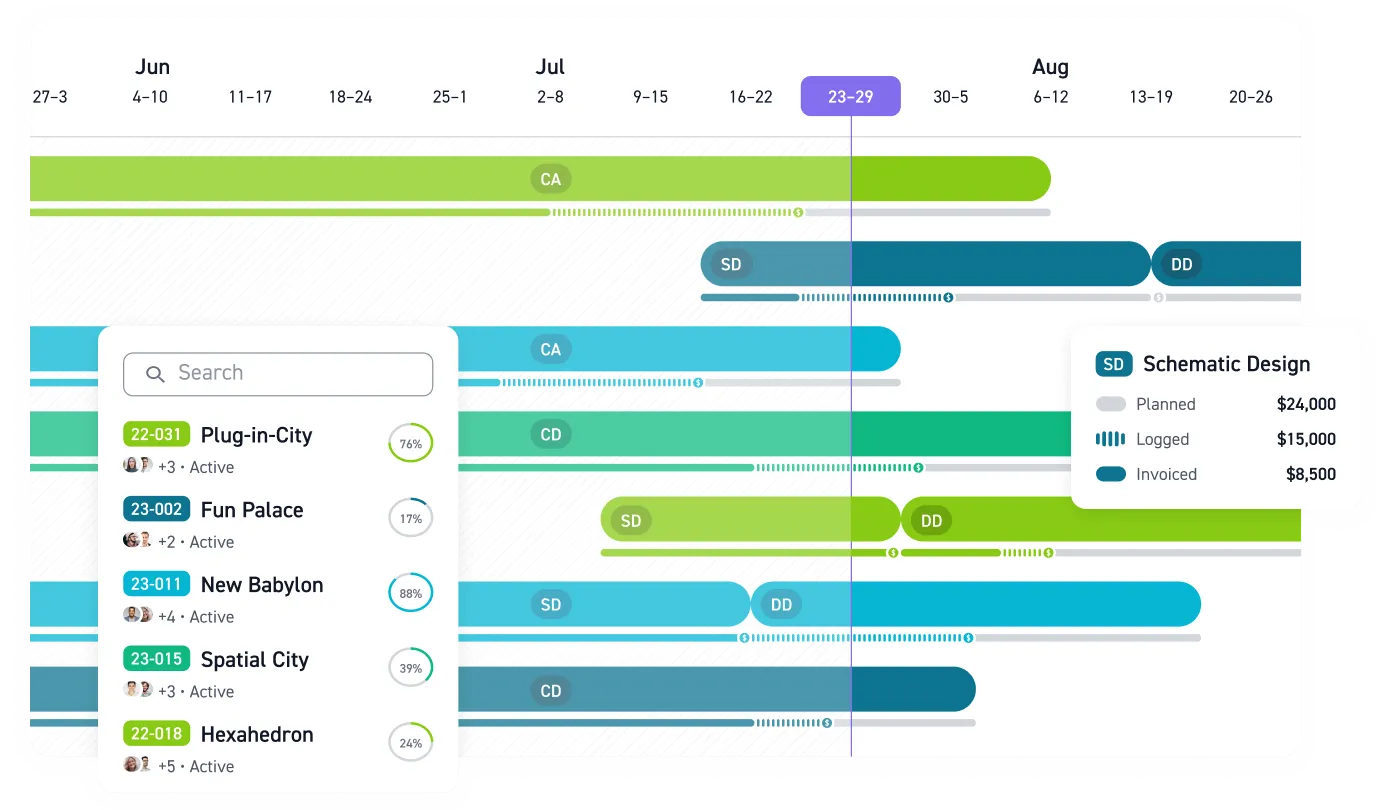
- Financial visibility through Monograph's MoneyGantt™: A visual cross-section of scope, schedule, and cash across every project, without pulling data from disconnected sources.
- Capacity-aware forecasting: Adding a new opportunity shows the capacity impact by role and month.
That matters when firm leaders want pursuit visibility without creating another disconnected workflow for the team.
For firms evaluating whether practice management software can cover enough CRM ground, Cascadia Architects reported 50% time saved on admin, 2x faster billing, and 25% less budget overage after switching from Mosaic. That visibility is why some firms manage pipeline and delivery in one system instead of maintaining a separate CRM.
For firms with complex pursuit portfolios, government work, or large teaming partner networks, Monograph is best paired with a dedicated A&E CRM. For firms tracking a manageable number of active pursuits alongside daily project delivery, Pipeline may remove the need for a separate system.
Choosing the Right CRM for Your Firm
In many A&E firms, principals and project managers are the ones updating client relationships between design reviews, not a dedicated sales team. Any CRM that demands heavy manual data entry after every client interaction will collect dust.
Three questions should drive your evaluation:
- Will your seller-doers actually use it? A CRM that's too complex for a principal to update on their phone after a client lunch will fail regardless of its feature depth.
- Does it connect to your project management and accounting stack? Poor CRM usability and data-management burdens can undermine adoption.
- Does it support structured go/no-go decisions? For many architecture firms, this is the highest-value CRM feature.
If a platform fails on those basics, the rest of the feature list will not matter.
Start with basic opportunity tracking, then expand to proposal workflows and analytics over time. That approach lowers adoption risk.
Getting your team to use a CRM consistently matters more than picking the most powerful platform. Start with practice management that fits how your firm actually works today, and build from there.
Build a Pipeline Your Team Will Actually Use
CRM data only helps if your team uses it. When pursuits, budgets, and staffing live in separate systems, opportunities slip through the cracks and principals end up managing relationships from memory.
Monograph helps A&E firms connect pipeline visibility with the project, financial, and staffing data they already need to run the business. For smaller firms, that means fewer handoffs, clearer forecasts, and a better way to decide which opportunities are worth pursuing.
Start with clarity. Book a demo.
Frequently Asked Questions
Do small architecture firms really need a dedicated CRM?
Not always. If your firm is managing a limited number of active pursuits alongside daily project delivery, pipeline management inside your practice management system may be enough. If you are juggling more complex pursuit portfolios, government work, or large teaming partner networks, a dedicated A&E CRM makes more sense.
What's the difference between a CRM and practice management software?
A CRM tracks relationships, pursuits, and business development activity. Practice management software covers the work that follows, including projects, budgets, time, and invoicing. Some smaller firms want pipeline visibility in the same place they already manage delivery, which is where the two categories start to overlap.
When should an architecture firm choose an A&E-specific CRM over HubSpot or Salesforce?
Choose an A&E-specific CRM when your firm needs more than a contact database and deal pipeline. The difference shows up in go/no-go decisions, teaming partner tracking, project-type-based pursuits, and proposal assembly support. Generic CRMs can work for early-stage firms, but most growing practices outgrow them once federal or institutional pursuits enter the mix.
Can principals and project managers realistically keep CRM data updated?
Yes, but only if the system fits how they already work. Adoption breaks down when updates feel like extra admin work after every meeting. Start simple, make it easy to update on mobile, and connect it to the rest of your project and financial workflow so the data has somewhere useful to go.