



Firm management made easy

A&E firms take a long time to get paid. PSMJ data puts the average collection period at 62 days, with top-performing firms collecting in about 52 days. At that pace, monthly billing can leave cash tied up in unpaid work before the next billing cycle even starts.
One contributor to that lag is how long it takes to build the invoice: pulling hours from timesheets, calculating percent complete by phase, reconciling the structural sub's bill, then re-entering everything into QuickBooks. A&E invoicing software exists to compress that cycle. Most of it, though, wasn't built for how engineering work is actually billed.
Why Generic Invoicing Tools Break Down
Engineering revenue is tied to multi-phase projects, percent-complete billing, and subconsultant coordination. Standard small-business invoicing handles none of these. QuickBooks captures costs at project totals. It cannot tell you whether construction documents are running over budget while schematic design came in profitable, or bill a fixed fee partway through one phase while billing hourly on the next.
The mismatch compounds because most firms run several fee structures at once:
- Hourly and T&M, itemized by staff category and rate. 93% of firms use hourly rates as a fee method, and 92% use stipulated sum.
- Fixed fee billed by percent complete, with a separate budget and burn rate per phase.
- Percentage of construction cost, where fees track the owner's budget and adjust as scope evolves.
- Cost-plus with reimbursables, which needs separate line items for actual costs and the fee on top.
- Consultant pass-throughs, where structural, MEP, or civil invoices flow through the prime's bill, usually with markup.
Generic tools handle a subset of this work. The rest ends up in spreadsheets running parallel to the accounting system.
Fixed-fee work adds an accounting obligation on top. Under ASC 606, revenue is recognized as progress is made, typically measured by hours or resources expended. A firm billing fixed fees needs percent-complete tracking whether or not any client asks for it.
The Platforms Built for A&E Billing
Six platforms handle A&E billing, and the right one depends on firm size and how much federal compliance you carry:
- Monograph fits small-to-mid A&E firms. Its invoice builder bills phase by phase, showing previously billed, current percent complete, and amount due against each phase budget.
- BQE CORE targets mid-sized firms with project-oriented invoicing, batch invoicing, and optional built-in accounting.
- Deltek Ajera suits firms needing deep project accounting. It auto-applies bill rates, completion percentages, and consultant costs as projects move between phases.
- Deltek Vantagepoint serves larger firms with heavy federal or multi-entity compliance. Expect costs of $50K to $500K+ in the first year.
- Unanet ERP AE has DCAA-ready audit trails for federally funded work, plus AR automation with digital payments and collections visibility.
- BigTime offers bidirectional QuickBooks sync covering both Online and Desktop, with DCAA-compliant billing.
Firms doing DOT or federally funded work face federal billing requirements that point toward Unanet or BigTime. Most small-firm platforms, Monograph included, do not document that compliance.
Keep QuickBooks. Add a Phase-Aware Layer Above It.
Many small and midsize firms already keep their books in QuickBooks Online. Monograph operates as a QuickBooks layer, handling phase budgeting, staff utilization, time tracking, and invoicing while QuickBooks manages core accounting. Monograph connects with QuickBooks Online to sync client contacts and consultant vendors, export invoices, mark payments, and import real costs for profit forecasting. Monograph is used by 13,000+ architects and engineers across 1,800+ firms.
Time entries flow into draft invoices with phase billing data, expenses, and approved consultant bills, reducing duplicate entry. Consultant fees can be tracked, reviewed, and attached to client invoices, which keeps consultant costs tied to the billing workflow instead of someone's memory.
It also changes month-end close. Automated data flow removes manual matching across disconnected systems, so a lean finance team spends the close analyzing numbers instead of matching entries by hand.
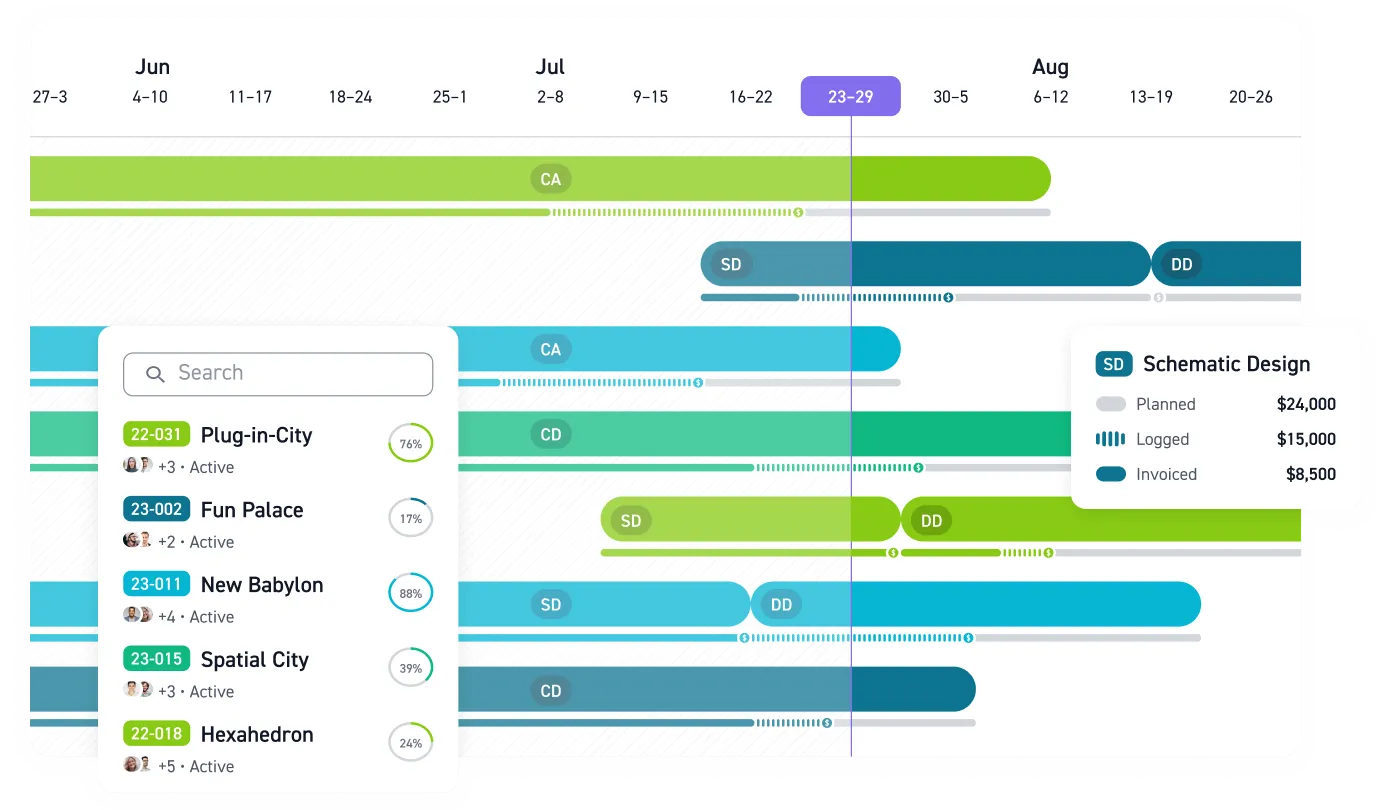
Monograph's signature MoneyGantt™ feature overlays budget-to-cash progression on the project timeline, showing percent complete against percent spent by phase. When spending outruns progress, you catch it before the invoice goes out.
How to Run the Evaluation
Before you demo anything, define what your firm needs:
- Map your contract mix. A firm running mostly fixed-fee work needs percent-complete billing built in; a mostly hourly firm can get by with less.
- Audit your integration requirements. If a vendor points to integrations instead of built-in billing tools, expect manual work.
- Model total cost of ownership. License fees are only part of year-one cost once rollout, data preparation, and training land.
- Run trials with real client invoices. Sample data hides edge cases: retainers, markup rules, paused projects.
- Involve billable staff early. Software adoption determines whether the tool will actually get used.
Check references from firms your size. Ask what went sideways and what they wish they had known before signing.
Workbench, a California firm, switched from BQE Core to Monograph and reported 8x faster staffing, a 4x faster billing process, and 75% less unbilled fees.
Get Invoices Out Before Cash Flow Gets Tight
Engineering invoices get messy because the work is messy. Phases move at different speeds, consultants bill on their own schedules, and fixed-fee progress rarely matches a monthly accounting cycle. If your team rebuilds every invoice from timesheets, spreadsheets, and QuickBooks exports, the delay is already costing you.
Monograph gives A&E firms a phase-aware layer for budgeting, time tracking, consultant costs, invoicing, and QuickBooks sync. Project managers see where work stands, operations leaders build invoices without re-keying data, and principals get clearer cash flow without replacing their accounting system.
Billing delays compound fast. Fix the workflow before another invoice waits 62 days to turn into cash. Book a demo.
Frequently Asked Questions
Is QuickBooks enough for an engineering firm?
QuickBooks is usually enough for core accounting, but it is not built to manage phase-level budgets, percent-complete billing, or consultant pass-throughs. Many small and midsize firms keep QuickBooks and add a practice management layer above it so project data becomes invoice-ready without duplicate entry.
When should an engineering firm choose ERP software instead of a lighter invoicing platform?
Start with compliance and complexity. If you carry DCAA, FAR Part 31, multi-entity, or heavy federal reporting requirements, ERP tools like Unanet, BigTime, or Deltek Vantagepoint may be necessary. If your main problem is billing fixed-fee phases, tracking consultant costs, and syncing with QuickBooks, a lighter A&E-specific platform is usually a better fit.
Do fixed-fee engineering projects need percent-complete invoicing?
Yes. Fixed-fee work still needs progress tracking because revenue, budget burn, and client billing rarely move at the same speed. Percent-complete billing shows whether each phase is earning its fee or quietly absorbing margin.
What should we test during an invoicing software demo?
Use a real recent invoice. Include the awkward parts: mixed hourly and fixed-fee phases, consultant bills, reimbursables, markups, retainers, and paused work. Your actual billing edge cases show whether the tool fits your firm.