

If you're spending more time copying data between spreadsheets, QuickBooks, and email threads than managing projects, the tools you're using probably weren't built for how A&E firms actually work.
Generic project management software tracks tasks. A&E firms need to track fees by phase, bill different rates for principals and interns on the same project, pass through consultant costs with markup, and see whether a phase is burning through its budget before it's too late to course-correct. QuickBooks doesn't natively track amounts billed and owed by project phase without manual workarounds or add-ons, and that gap is where projects can quietly lose money.
The Features That Actually Matter
A&E-specific project management and billing software needs capabilities that generic tools usually lack.
Your software must handle:
- Phase-based budgeting and billing. Every A&E project runs through schematic design, design development, construction documents, and construction administration phases, each with independent fee allocations. Software that can't budget and invoice at the phase level forces manual workarounds for every billing cycle.
- Multi-rate billing across roles. A 2025 industry benchmark tracks billing rates for 33 distinct employee levels in AEC firms. Your software needs to apply different rates for each role on a project and carry those through to invoices automatically.
- Consultant cost tracking and pass-through. Industry benchmarks on AEC fee structures, billing rates, and billing practices consistently flag consultant cost tracking as a top billing concern. Tracking those costs by phase, applying markup, and flowing them into client invoices is a daily reality for A&E firms.
- Real-time budget burn visibility. Scope creep goes unbilled because firms recognize budget overruns after work is delivered. Phase-level burn monitoring catches problems while there's still time to act.
These capabilities should be table stakes for any tool you evaluate in this category.
AIA G702/G703 billing format support matters if you do construction administration. Resource planning tied to both phase schedules and fee budgets matters for everyone. A resource plan showing allocated hours means little if you can't see whether those hours fit within the phase fee.
How the Market Breaks Down
The A&E project management and billing software market generally falls into a few categories:
- Full Practice Management ERPs, which replace your accounting software entirely.
- A&E-Specific PM and Billing Platforms, which layer project accounting on top of existing tools like QuickBooks Online.
- General-Purpose Time Tracking, which captures hours but lacks A&E billing and budgeting features.
Your firm size and how you run accounting today will narrow which approach fits best.
Full Practice Management ERPs
These platforms include built-in accounting, so your firm stops juggling separate systems.
BQE CORE is presented as an end-to-end firm management platform created by architects and engineers. It offers phase-based budgeting, resource management, CRM, and embedded payroll. BQE CORE also documents AIA G702/G703 billing support, including Schedule of Values details for G703 continuation sheets.
Deltek Ajera and Deltek Vantagepoint sit at different points in the Deltek lineup. According to a G2 market segment comparison, Ajera reviews skew toward small-business users, while Vantagepoint reviews skew toward mid-market firms. Deltek positions Vantagepoint as a platform that supports the full project lifecycle with CRM and analytics capabilities.
Unanet AE, previously known as Clearview InFocus, is built for architecture, engineering, and construction firms. It surfaces consultant and vendor obligations through payment management features.
A&E-Specific PM and Billing Platforms
These tools are designed for A&E firms that want A&E-specific capabilities connected to accounting software like QuickBooks Online.
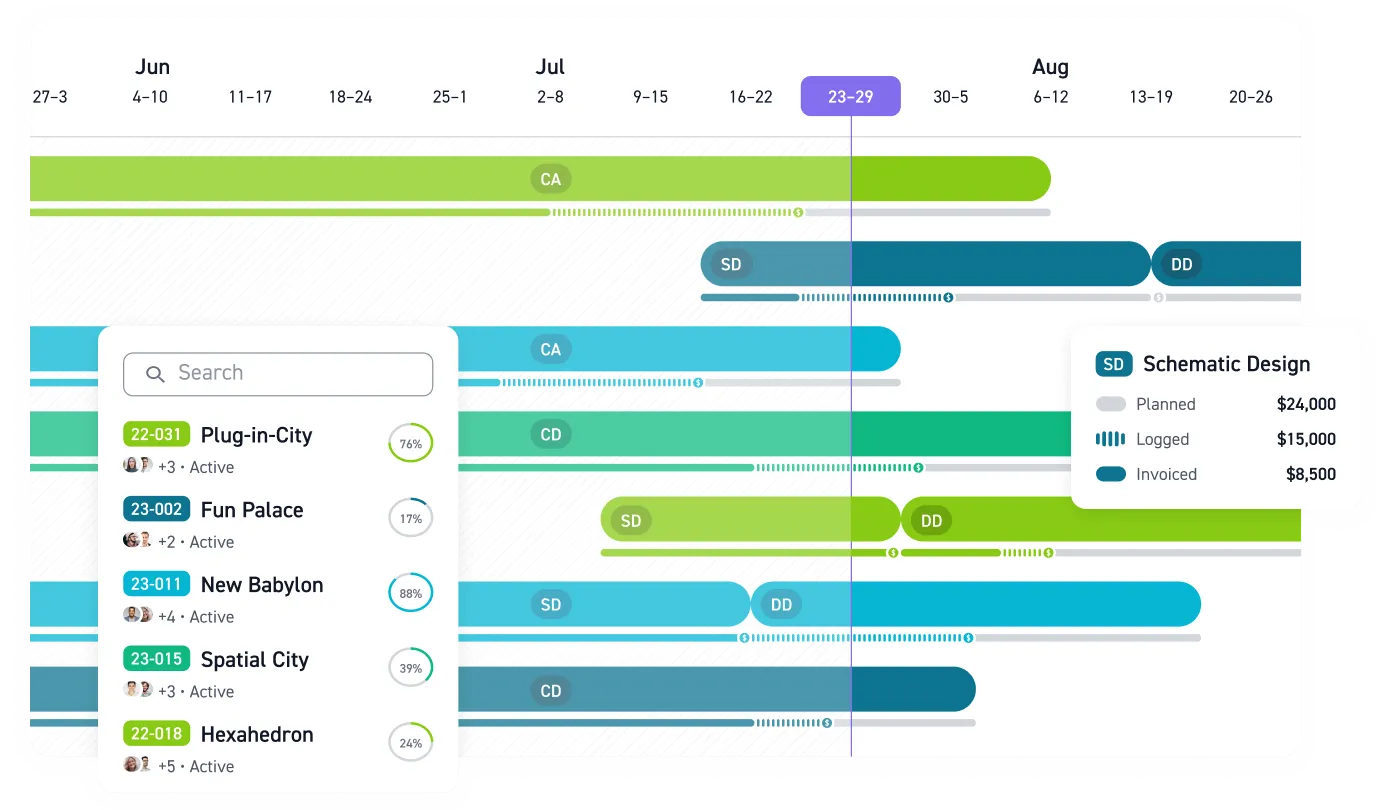
Monograph is built exclusively for architecture and engineering firms, covering project management by phase, budget tracking, time tracking, and invoicing in a single workspace. Monograph's MoneyGantt™ displays scope, schedule, and cash in a single visual. It shows whether individual phases are burning hours too fast or drifting past fee. Approved time flows directly into draft invoices that sync to QuickBooks Online.
Factor AE covers planning, tracking, billing, and reporting, and its public materials emphasize subconsultant management features such as contract, budget, invoice, and pay-when-paid workflow tracking. BaseBuilders is billing and project management software built for architecture and engineering firms, with materials that discuss subconsultant liability inside billing workflows. For time tracking only, Harvest offers broader time-tracking software. Firms evaluating it should verify phase-based budgeting and subconsultant management directly before choosing it for A&E billing workflows.
Why This Choice Has Real Financial Stakes
The gap between target and actual staff chargeability widened to 4.0%, up from 2.9% the prior year. Firms often collect payment 54 days after invoicing on average, and only 23% of project fee arrives by the end of schematic design. These problems compound when your tools can't surface them until after a phase closes.
Firms that are more advanced in their use of technology may report stronger profit expectations over the next 12 months.
Monograph built its platform specifically to surface financial visibility for A&E firms. Workbench reported 75% less unbilled fees after moving to Monograph from a combination of BQE Core, Excel, and Smartsheets. As a counterpoint, INC Architecture & Design reported saving dozens of hours each month after implementing BQE CORE.
Picking the Right Tool for Your Firm
Your accounting setup, team size, and construction administration work will narrow your options fast.
Consider these specifics:
- Do you want to replace QuickBooks or keep it? ERPs like BQE CORE and Unanet include built-in accounting. Platforms like Monograph and Factor AE layer A&E-specific capabilities on top of QBO.
- How large is your team? Smaller firms may not need enterprise ERP features like full CRM suites.
- Do you do construction administration? If so, verify G702/G703 support directly with any platform you're evaluating. In the public materials cited here, BQE CORE explicitly documents this capability.
Those three questions usually do more sorting than a feature checklist.
Increasing profitability remains a top concern for architecture firms. The right project management software gives you visibility into where your fees are going, which projects are profitable, and where money is slipping away. That visibility supports project accounting decisions across the firm.
Stop Managing Projects Across Spreadsheets and Guesswork
If your team still pieces together budgets, billing, and staffing across spreadsheets, QuickBooks, and email, you're making project decisions with delayed information. The longer that continues, the harder it gets to catch phase overruns before they turn into lost profit.
Profit leaks fast. See what it looks like when the numbers are finally clear. Book a demo.
Frequently Asked Questions
Do small A&E firms really need A&E-specific project management and billing software?
Often, yes. Smaller firms can skip a full ERP and still need phase-based budgeting, multi-rate billing, consultant cost tracking, and real-time budget burn visibility.
Should we replace QuickBooks or keep it?
That depends on how you run accounting today. ERPs like BQE CORE and Unanet include built-in accounting, while platforms like Monograph and Factor AE layer A&E-specific capabilities on top of QuickBooks Online.
What should we verify first if we bill by project phase?
Start with phase-level budgeting and invoicing. If the system cannot budget and invoice at the phase level, your team will end up relying on manual workarounds every billing cycle. From there, confirm multi-rate billing across roles and make sure you can see whether a phase is burning through its fee before it closes.
What matters most if we also manage consultants and construction administration?
You need consultant cost tracking by phase, pass-through billing support, and clear visibility into consultant obligations. If you handle construction administration, verify G702/G703 support directly with any platform you're evaluating.
What's the difference between a full ERP and an A&E-specific PM and billing platform?
A full ERP replaces your accounting software and consolidates more of the business in one system. An A&E-specific PM and billing platform is often a better fit for firms that want phase-based budgeting, invoicing, and staffing visibility while keeping QuickBooks Online in place.