

A recent industry sentiment study found that 51% of engineering firms are turning down work because of staffing shortages, and 26% are passing on profitable projects for the same reason. Meanwhile, the latest architecture billings index closed December 2025 at 48.5, still below the 50 threshold that signals growth. Firm backlogs remain strong at an average of 6.3 months, yet staff can look fully allocated on paper while phases stall waiting on approvals or permits. If you run projects at a small-to-mid-size firm, you know the gap. Spreadsheets cannot close it.
The right workload management tool gives you a clear view of who is busy, what is stalled, and what can actually move. This guide compares several platforms against the A&E-specific criteria below.
What Makes a Workload Management Tool Work for A&E
Before comparing platforms, it helps to define what separates a useful tool from an expensive distraction. Think of practice operations like structural load analysis. You need to know the forces on each member before you can say the system works. Tool selection works best inside a firm assessment roadmap that covers people, processes, tools, and culture together. Consistent workflows have to support staffing decisions. Resource allocation also becomes a growth breakpoint for firms that can no longer forecast staffing by instinct.
These gaps usually show up first:
- Phase-based resource loading. SD, DD, CD, and CA carry different staffing intensity and fee pressure. A flat project timeline misses that.
- Role-based utilization tracking. Principals, project managers, and staff architects do not carry the same billable targets. Industry research treats utilization as a benchmark metric alongside operating profit and overhead rate.
- Capacity forecasting tied to pipeline. Staffing decisions happen before projects ramp up, so accurate backlog data matters.
- Person-centric workload views. Most A&E staff work across several projects at once. A project-by-project view hides total load.
Only 45% of firms report utilization rates above 70%. That gap shows up directly in profit. Median EBITDA margin on net service revenue hit 19.2% in the latest financial benchmarking data, nearly doubling over the past decade. Firms hitting those numbers can see where hours are going.
Workload Management Tools Worth Evaluating
1. Monograph
Best for: Small-to-mid-size A&E firms
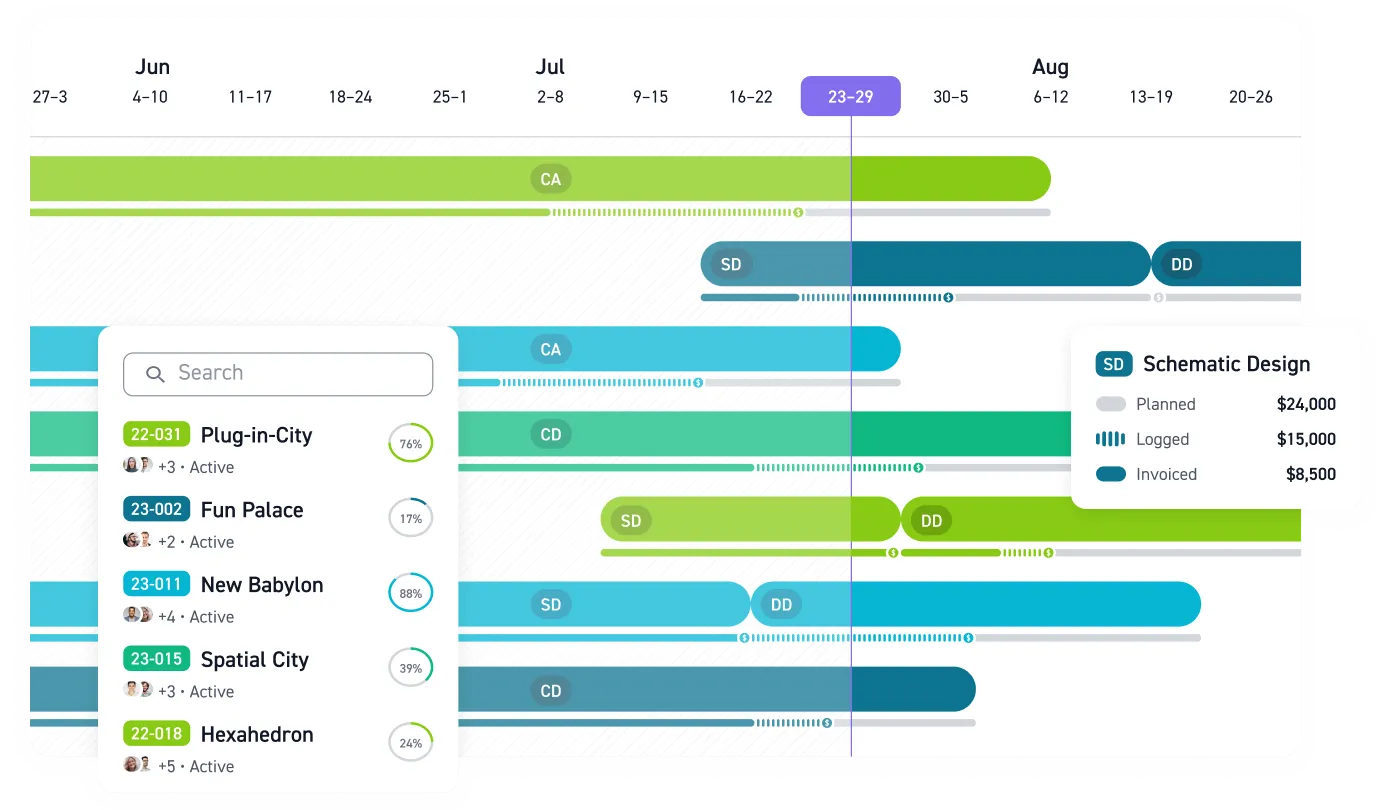
Monograph is built exclusively for architecture and engineering firms, serving 13,000+ architects and engineers across firms. Its product decisions reflect how A&E firms actually operate. The platform uses A&E-native phase terminology such as SD, DD, CD, and CA throughout the interface, so less gets lost in translation. That fit shows up in practice. After Workbench switched from BQE Core, the firm cut unbilled fees by 75%, sped up billing 4x, and made staffing decisions 8x faster.
Monograph's workload management features include:
- Monograph's MoneyGantt™ combines timeline and fee burn in one view, with planned, logged, invoiced, and paid hours shown visually so overruns surface early.
- Capacity heatmaps show over-allocated team members in real time so you can shift hours before burnout or missed deadlines.
- Pipeline forecasting connects leads, proposals, and forecasts so you can model capacity before signing a contract, with deeper guidance on forecasting workflows for new projects.
- Capacity forecasts and a QuickBooks integration give forward visibility across active and pipeline projects.
Together, those features give smaller A&E firms a clearer picture of workload by person, phase, and project. They also show why firms outgrowing spreadsheets usually need one system that connects staffing, fees, and pipeline.
2. BQE CORE
Best for: Firms that want accounting, billing, and resource planning in one system Pricing: Custom pricing
Founded by an architect and an engineer, BQE CORE covers accounting, billing, resource planning, and recent product updates. Its Allocation & Forecasting screen pairs task information with resource planning and scheduling features. Phased projects and a Zapier connector round out recent updates.
3. Total Synergy
Best for: Small-to-mid A&E teams
A cloud-based platform designed for AEC firms. Total Synergy handles stage-based project delivery and invoicing, revenue forecasting, and utilization tracking. It connects with both QuickBooks Online and Xero.
4. Mosaic
Best for: Mid-sized firms
Mosaic focuses on AI-powered resource planning, analyzing project requirements, team skills, and availability to suggest staffing configurations. Verified reviews on Software Advice are available for Mosaic.
5. BigTime
Best for: Small-to-mid firms that want room to grow
BigTime offers capacity-based and skills-based workload assignment, predictive planning, and project lifecycle management from proposal to billing. It is a professional services tool with named A&E verticals rather than an AEC-purpose-built platform.
6. Factor AE
Best for: A&E firms focused on financial forecasting and pipeline alignment.
Factor AE connects opportunity tracking to pipeline, workload, and revenue alignment. The emphasis is on proactive capacity management so firms can forecast whether they can deliver a project before committing to it. It is reviewed under business performance management for A&E firms.
7. Deltek Vantagepoint
Best for: Large firms with complex, multi-entity needs
Deltek serves large design firms at scale. Vantagepoint offers color-coded over- and under-capacity views, an employee availability dashpart, and enhanced Gantt scheduling. The feature set is deep, but the implementation burden makes it a harder fit for smaller firms.
8. Unanet AE ERP
Best for: Mid-to-large A&E firms, especially those with government or federal work
Unanet combines project management, accounting, resource planning, and CRM. Its CRM module adds business development workflows with go/no-go support, giving firms another option when they need mid-market ERP depth.
Matching the Right Tool to Your Firm Size
The A&E software market segments sharply by firm size, and using a tool built for a very different scale creates friction fast. A small architecture studio does not need enterprise ERP depth. A larger engineering firm usually needs more than a lightweight scheduling app.
A 2025 industry survey indicates that only 27% of AEC firms currently use AI in their operations. Firms that adopt AI project tools while competitors still copy project data between Revit, Excel, and QuickBooks will have an advantage in resource utilization, margin, and capacity planning.
Stop Guessing at Capacity
When your team's workload lives across spreadsheets, inboxes, and half-updated schedules, staffing decisions turn into guesswork. That guesswork shows up in overloaded strong performers, missed utilization targets, and work your firm could have delivered profitably.
Monograph helps A&E firms see workload by person, phase, and project in one place. With capacity forecasting, phase-based planning, pipeline forecasting, and Monograph's MoneyGantt™, your team can spot staffing conflicts early and make better decisions before a project slips.
Your backlog is already there. Get clear on the capacity to deliver it.Book a demo..
Frequently Asked Questions
How do I know whether a workload management tool is actually built for A&E? Look for phase-based planning that mirrors how A&E firms structure projects, with native support for SD, DD, CD, and CA rather than generic milestones. The tool should also offer role-based utilization tracking that recognizes principals, project managers, and staff architects carry different billable targets. Capacity forecasting tied directly to your pipeline matters too, since staffing decisions usually need to happen before a project is even signed. Finally, person-centric workload views are essential, because most A&E staff work across several projects at once and a project-by-project view will hide their real total load. Tools built for generic professional services or construction-only workflows typically miss at least two of these capabilities.
Which workload management tools make the most sense for smaller A&E firms? Monograph, Total Synergy, and BQE CORE are typically the strongest fits for firms with five to fifty employees. Monograph is built exclusively for architecture and engineering practices and is designed around the way smaller firms actually operate, with phase-based budgets, capacity forecasting, and a tight QuickBooks Online integration. Total Synergy works well for studios that want stage-based delivery and Xero compatibility. BQE CORE is a fit when accounting, billing, and resource planning need to live in one system. Larger enterprise platforms like Deltek Vantagepoint or Unanet AE ERP usually carry too much implementation overhead for small firms to justify.
Why do spreadsheets break down for workload management in A&E firms? Spreadsheets cannot show real capacity in real time, which is the entire point of workload management. Staff often appear fully allocated on paper while projects sit paused waiting on permits, approvals, or client decisions, and a static sheet has no way to surface that. Spreadsheets also struggle with phase-specific loading, since SD and CD pull on different team members at different intensities. Tracking individual load across concurrent projects is nearly impossible when each project lives in its own tab. Once a firm has more than a handful of active projects, manual updates fall behind reality fast, and staffing decisions start running on stale data.
Do larger A&E firms need different workload management tools than smaller firms? Yes. The A&E software market segments sharply by firm size, and using a platform built for the wrong scale creates friction in both directions. Smaller studios that adopt enterprise ERP often find themselves paying for modules they will never use and absorbing six-month implementations they cannot afford. Larger multi-entity firms with government or federal work, on the other hand, usually outgrow lightweight scheduling apps quickly because they need depth in compliance reporting, multi-company accounting, and complex resource planning. Platforms like Deltek Vantagepoint and Unanet AE ERP are purpose-built for that scale, while Monograph and Total Synergy are tuned for firms that need clarity and speed without ERP complexity.