


Firm management made easy

You're managing five concurrent projects, tracking time entries across your team, chasing consultant updates, and preparing budget reports. All before your 10 a.m. client call. If this sounds familiar, you're not alone. Project managers at architecture and engineering firms juggle multiple time-consuming administrative tasks, from billing and time tracking to project coordination, that can consume significant portions of their workday. Firms implementing AI have seen dramatic improvements. One major firm transformed project tracking tasks that previously consumed days into minutes of activity.
The good news: AI-powered project management tools are changing this equation. The better news: with AEC professionals currently using AI in operations (27%), firms that adopt now gain a meaningful competitive edge.
Why AI Matters for A&E Project Management Now
The AEC industry faces challenges including inflation, labor shortages, and tightened margins that strain project delivery. Spreadsheet-based tracking becomes outdated the moment you close the file. Manual billing processes delay cash flow. Status updates across multiple projects consume hours that should go toward high-value oversight.
AI handles the repetitive work that bogs you down. Research on AI implementation demonstrates what's possible. AI tools cut days to minutes for project tracking tasks. That's not a marginal improvement. It's a fundamental shift in how project managers spend their time.
Key AI Capabilities Worth Evaluating
When evaluating AI project tools for architecture and engineering firms, prioritize these capabilities:
- Administrative automation: Invoice generation, timesheet processing, and report creation that eliminates manual data entry. AIA research found that 84% of firm leaders expressed optimism about automating manual tasks.
- Automated error detection: AI that catches specification conflicts and drawing errors before they become costly change orders. This is particularly valuable for EPC projects where design and construction overlap.
- Real-time budget tracking: Dynamic visibility into project financial health across phases, consultants, and disciplines. This replaces the "budgets as a guessing game" approach.
- Predictive analytics: Forward-looking insights that help project leaders move from real-time to ahead-of-time data. This helps you take corrective action before negative trends materialize.
Here's what matters: successful AI implementation treats these tools as assistants that augment professional expertise, not replacements for judgment. Licensed professionals retain final approval. AI handles the time-consuming groundwork.
Top AI Tools for A&E Firms
BQE CORE was designed by an architect and an engineer specifically for A&E firms. It consolidates project management, accounting, time tracking, billing, and resource management with real-time performance analytics. Best for small to mid-sized firms seeking an integrated approach without complexity designed for firms with 50+ employees.
Deltek Vantagepoint offers automation for large A&E firms across the entire project lifecycle. The platform's AI-enhanced predictive capabilities serve firms with complex operational requirements, though it may exceed the needs of firms under 50 employees.
Unanet ERP AE focuses on predictive analytics and AI-powered content generation for proposals, addressing the 75% of firms planning to use AI in business development within a year. Best for mid-to-large A&E firms integrating business development automation with project financial management.
Procore improves field management, including submittals, RFIs, daily logs, punch lists, and change orders. Built with contractors in mind, it delivers maximum value during construction administration, with limited design-phase functionality.
Newforma bridges the gap when your contractors use different systems, serving A&E firms needing project information management integration across design and construction administration phases.
Projectworks connects time tracking, expense tracking, resource management, invoicing, and financial reporting in one live system. Firms prioritizing real-time financial visibility across project components benefit most.
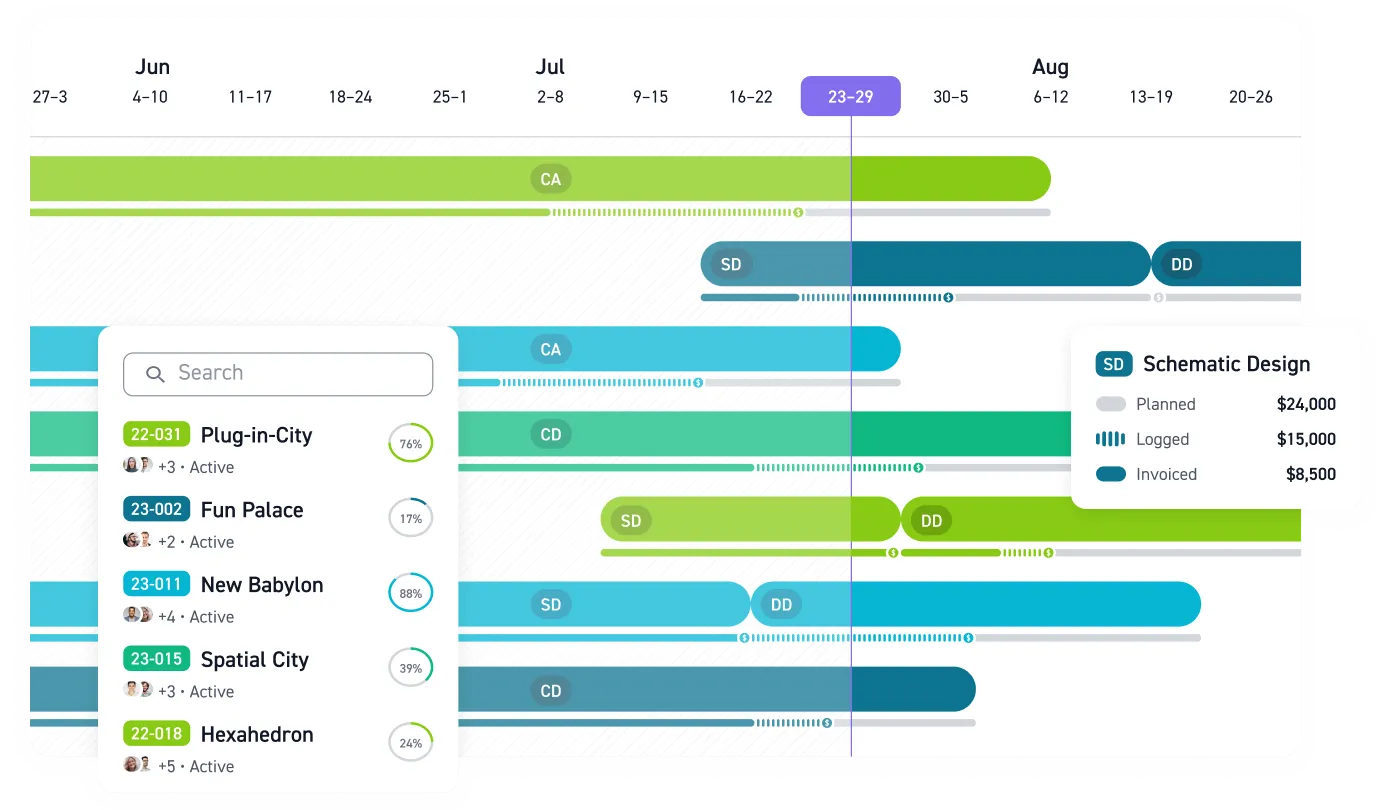
Monograph serves 16,000+ architects and engineers across 1,800+ firms with a platform built specifically for small to mid-size firms. Built for A&E, it consolidates project tracking, budget monitoring, time management, invoicing, and financial reporting into a single interface, with reporting features designed "in the language of A&E leaders." Monograph's signature MoneyGantt™ provides visual budget tracking that shows project financial health at a glance, connecting time, phases, and profitability in one view. With pricing starting at $60/month per user and on-demand training and onboarding support, it's accessible for US-based firms with 5+ employees. Customer results include 50% faster billing at Woodhull, 25% profit growth and 50% efficiency gains at Brooks + Scarpa Architects, and 25% profit growth with 2x efficiency gains at Dynamic Engineering.
Implementation Realities for Smaller Firms
Successful implementation requires addressing several factors:
- Digital foundation first: With 72% of firms still using paper for some building phases, project data must exist in accessible digital form for AI-powered budget tracking to deliver value.
- Professional oversight protocols: Licensed professionals must retain final approval authority for AI outputs. This is critical for firms where principals maintain direct project involvement and liability exposure.
- Improvement over reinvention: Research found that almost 100% of respondents cited improving operational efficiency as a primary driver for AI adoption. Start by simplifying existing workflows, not attempting full transformation.
- Firm-size alignment: Tools designed for 5+ employee firms deliver faster ROI than platforms requiring extensive configuration.
Stop Letting Admin Work Steal Your Project Leadership Time
We've worked with 1,800+ A&E firms making this exact transition from spreadsheet chaos to AI-powered clarity. Here's what actually works when you're ready to stop drowning in administrative tasks.
If you're a principal concerned about competitive positioning, focus on real-time project profitability visibility. You already know which projects eat up time without generating profit. The question is having systems that catch problems before they destroy your margins. Monograph's AI-powered project setup analyzes your historical data to recommend realistic budgets and best team assignments before you commit to new work.
If you're an operations leader drowning in billing cycles, prioritize invoice automation that actually understands A&E workflows. Monthly invoicing that takes two weeks to process isn't a workflow, it's a cash flow crisis waiting to happen. Monograph automates the entire cycle from timesheet processing to invoice generation to payment collection, with firms reporting 2x faster billing and getting paid in half the time.
If you're a project manager tracking too many systems, start with consolidated project visibility. You shouldn't need five platforms and twelve email threads to answer "Is this project on track?" Monograph's signature MoneyGantt™ shows you which phases and projects are off-track in seconds by combining traditional timelines with budget-to-cash progression. See what's planned, logged, invoiced, and paid without opening a single spreadsheet.
That's why we built Monograph as architects who were tired of choosing between good work and good business. Our AI-powered platform handles project setup, prevents budget overruns, and automates billing while you focus on actual project leadership. Upload your contracts and proposals. The system automatically extracts phases, budgets, and staffing requirements. Machine learning analyzes your timesheet history to recommend realistic allocations. Get alerts when projects hit budget thresholds, not after they've already blown past them.
Book a demo and see how AI eliminates the administrative chaos that's keeping you from leading projects instead of managing spreadsheets.
Frequently Asked Questions
What's the real time to get operational with AI project management tools in A&E firms?
Time to get operational varies significantly by firm size and tool complexity. For purpose-built A&E platforms like Monograph, expect 2-4 weeks to get fully operational with basic workflows running in the first week. Platforms designed for firms with 50+ employees typically require 3-6 months with dedicated IT support.
The key is choosing software that understands A&E workflows from day one. You shouldn't need months of configuration to handle phase-based projects or consultant coordination. That's the whole point of industry-specific tools.
Start with your highest-pain process (usually billing or budget tracking) on 2-3 representative projects before firm-wide rollout. Measure actual time savings against your baseline to build internal buy-in.
Will AI tools integrate with our existing QuickBooks and project workflows?
Most modern AI project management platforms offer QuickBooks integration, but the depth varies considerably. Look for two-way sync that eliminates double-entry. Your time entries should flow automatically into invoices, and payments should sync back to update project profitability in real-time.
Monograph's QuickBooks Online integration handles invoice syncing, client contact management, vendor coordination, and real cost data importing for accurate profit forecasting. The integration maintains your existing accounting structure while adding project-level visibility that QuickBooks alone can't provide.
The integration question isn't just technical. It's about workflow preservation. Your team shouldn't need to abandon established processes to gain AI capabilities. The right platform works with your existing tools, not against them.
How do we maintain professional oversight and liability protection with AI automation?
AI in A&E practice should function as a project coordinator, not a licensed professional. The technology handles time-consuming groundwork, including extracting contract data, flagging budget risks, and processing timesheets, while licensed professionals retain final approval authority for all deliverables.
Set up approval workflows where AI recommendations require human review before execution. For example, AI can analyze your historical data to recommend phase budgets, but your project managers validate those recommendations against project-specific factors before committing resources.
Document your oversight protocols clearly. When AI flags a budget overrun or specification conflict, your records should show who reviewed the alert and what decision was made. This creates the audit trail that protects your firm while still capturing AI's efficiency benefits.
What's the actual ROI time for smaller A&E firms implementing AI project management?
Small to mid-size firms (5+ employees) using purpose-built tools typically see measurable returns within 60-90 days. The first month focuses on implementation and team adoption. Months two and three reveal time savings as billing cycles compress and budget visibility improves.
Common first-year outcomes: 2x faster invoicing (reducing billing cycles from two weeks to one week), 25-50% reduction in administrative time for project managers, and 20-40% improvement in budget accuracy through real-time tracking. Firms using Monograph report adding 21% more revenue on average in their first year through improved efficiency and cash flow.
The faster ROI comes from targeting your highest-pain process first. If billing delays are your biggest cash flow issue, start there and measure days-to-payment improvement. If budget overruns are killing profitability, focus on real-time tracking and measure variance reduction.
Can AI handle our specific A&E workflows like phase-based projects and consultant coordination?
Generic project management tools struggle with A&E workflows because they weren't built for phase-based fee structures, multi-rate billing, or consultant coordination across multiple firms. Purpose-built platforms like Monograph understand these workflows natively.
Phase-based project structure mirrors your actual workflow from schematic design through construction administration. Multi-rate billing handles principals, project managers, and junior staff at different rates without spreadsheet gymnastics. Consultant coordination tracks external team contributions and bills without forcing consultants to adopt your internal systems.
The workflow compatibility question reveals whether the platform was built by people who have actually managed A&E projects. If the demo requires extensive customization to handle basic phase budgeting or consultant billing, that's a red flag. The right tool should think like you do: phases, hours, consultants, and deliverables.