



Firm management made easy

Most architecture and engineering firms start budgeting backwards. They take a fee number, divide it across phases, and hope the math works out. When it doesn't, project managers scramble to explain why a project that looked profitable on paper turned into a write-off. Sound familiar? This happens more often than firms want to admit.
Bottom-up budgeting flips this approach. Instead of forcing projects into predetermined fee structures, you build budgets from the ground up using individual tasks, specific deliverables, and actual labor hours. For Finance Managers and CFOs at A&E firms, this approach transforms budgeting from educated guessing into forecasting based on real numbers.
The Economics Behind Every Hour
The foundation of effective bottom-up budgeting is understanding what each hour of labor generates in billable revenue for your firm. This is where the Direct Labor Multiplier (DLM) becomes essential. The DLM converts direct labor costs into billable rates by capturing overhead recovery and profit margin, ensuring that task-level hour estimates translate into project budgets that achieve profitability targets.
With an industry-standard billing multiple of 3.20, there’s a breakeven multiple of 2.73. That 173.3% overhead rate includes everything from employee benefits (39.7%) to occupancy costs (16.1%) to IT infrastructure (9.2%).
Here's what this looks like in practice: an engineer with a $50/hour direct labor cost generates a $160/hour billable rate using the industry-standard multiplier. The breakeven rate (covering overhead without profit) lands at $136.50/hour. That $23.50 gap represents your contribution margin (gross profit) per hour before all indirect costs and final profit are determined.
Finance Managers should establish firm-specific DLM calculations for each staff position and update them quarterly based on actual overhead rates. Able City, a 29-person Texas architecture firm, achieved 15% profit growth by accurately tracking their position-specific multipliers and maintaining quarterly DLM updates across all staff levels. Without accurate multipliers (calculated as billable hourly rate divided by hourly salary), even the most detailed task estimates produce unreliable budgets.
Building From Tasks to Totals
Bottom-up budgeting follows a clear hierarchy. Individual tasks roll into discipline activities, which combine into project phases, which sum to the total project budget. The process requires project managers to estimate hours for specific deliverables rather than working backward from fee targets.
Industry-standard phase allocations provide budgeting and verification benchmarks. According to fee structure benchmarks, traditional allocations break down as follows:
- Schematic Design: 15% of total professional services fee
- Design Development: 20% of total fee
- Construction Documents: 40% of total fee
- Bidding/Negotiation: 5% of total fee
- Construction Administration: 20% of total fee
These percentages serve as reconciliation targets. If your bottom-up estimate for Construction Documents comes in at 60% of total project hours, something needs investigation. Either the scope is more complex than typical, or the estimate needs refinement.
Current industry billing practices insights show 23% of the total project fee allocated to Schematic Design and 25% to Design Development, indicating the industry is allocating more resources to early-phase work than traditional benchmarks suggest.
Seven Steps to Build Your Budget
The implementation process requires coordination between project managers, technical leads, and finance. Each role contributes specific expertise to the final budget. The framework moves through these stages:
- Establish Direct Labor Economics: Calculate DLM for all staff positions using current salary data and overhead rates. The DLM converts hours to billable rates by multiplying hourly salary by the position-specific multiplier (range: 2.80–3.54 depending on firm size and discipline).
- Define scope and phase structure: Organize the project around standard phases aligned with contract deliverables and industry-standard fee allocations.
- Decompose into tasks: Break each phase into specific deliverables with assigned labor categories (Principal, Project Manager, Project Architect/Engineer, Designer, Drafter).
- Estimate hours at task level: Technical leads estimate effort based on scope complexity and historical experience. Apply the 10% rule for project management time across all projects.
- Calculate costs using DLM: Convert hours to dollars using the position-specific DLM, ensuring each task budget includes direct labor, overhead recovery, and profit margin.
- Validate against benchmarks: Compare phase totals to industry-standard allocations and reconcile bottom-up detail against top-down percentage targets.
- Integrate with financial systems: Load the baseline budget into your project accounting platform for real-time monitoring and living forecasts.
One critical detail often overlooked: Experts recommend designating 10% of every project budget specifically for project management activities. Technical staff naturally estimate design and engineering hours. However, they consistently underestimate the coordination, client communication, and administrative time required for successful project delivery.
The Case for Hybrid Budgeting
Pure bottom-up budgeting has a weakness. Project managers focused on task-level details may not fully account for firm-wide strategic objectives and market constraints. Pure top-down budgeting has the opposite problem. Leadership sets targets without the operational visibility needed to understand whether project scopes are actually achievable within those budgets.
Successful firms employ a hybrid approach: top-down forecasting establishes strategic goals from market trends, and bottom-up forecasting drives tactical planning and operational decisions based on project specifics. Professional engineering organizations reinforce this standard. ACEC-BC's budget guidelines provide construction cost-based fee schedules as starting benchmarks while emphasizing that adequacy must be determined through detailed scope analysis.
Where Implementation Gets Complicated
A&E firms face specific challenges that generic budgeting advice ignores. If you've wrestled with these, you're not alone.
Project-based accounting creates aggregation complexity. Unlike manufacturing where costs follow standardized products, A&E budgets must aggregate from estimates prepared by multiple project managers with varying experience levels. For AEC firms, project-based accounting is a critical element, their financial health is directly linked to their current projects.
Cash flow timing creates pressure on bottom-up cost projections when immediate labor and consultant costs precede revenue recognition tied to deliverable milestones.
Indirect expense allocation trips up even experienced estimators. Indirect expenses are everything else. Marketing, administrative staff, benefits, and facilities all add up. At A&E firms, labor represents up to 75% of total operating costs.
Engineering firms face particular challenges with bottom-up estimation. Dynamic Engineering, a 10-person Florida firm, achieved 2x efficiency gains and 25% profit growth by combining detailed task-level estimates with firm-wide profitability targets, moving from disconnected Excel spreadsheets to integrated budgeting systems.
The solution involves standardized templates with predetermined allocation approaches, automated reconciliation checks, and continuous refinement based on actual performance data.
Making Budgets Live
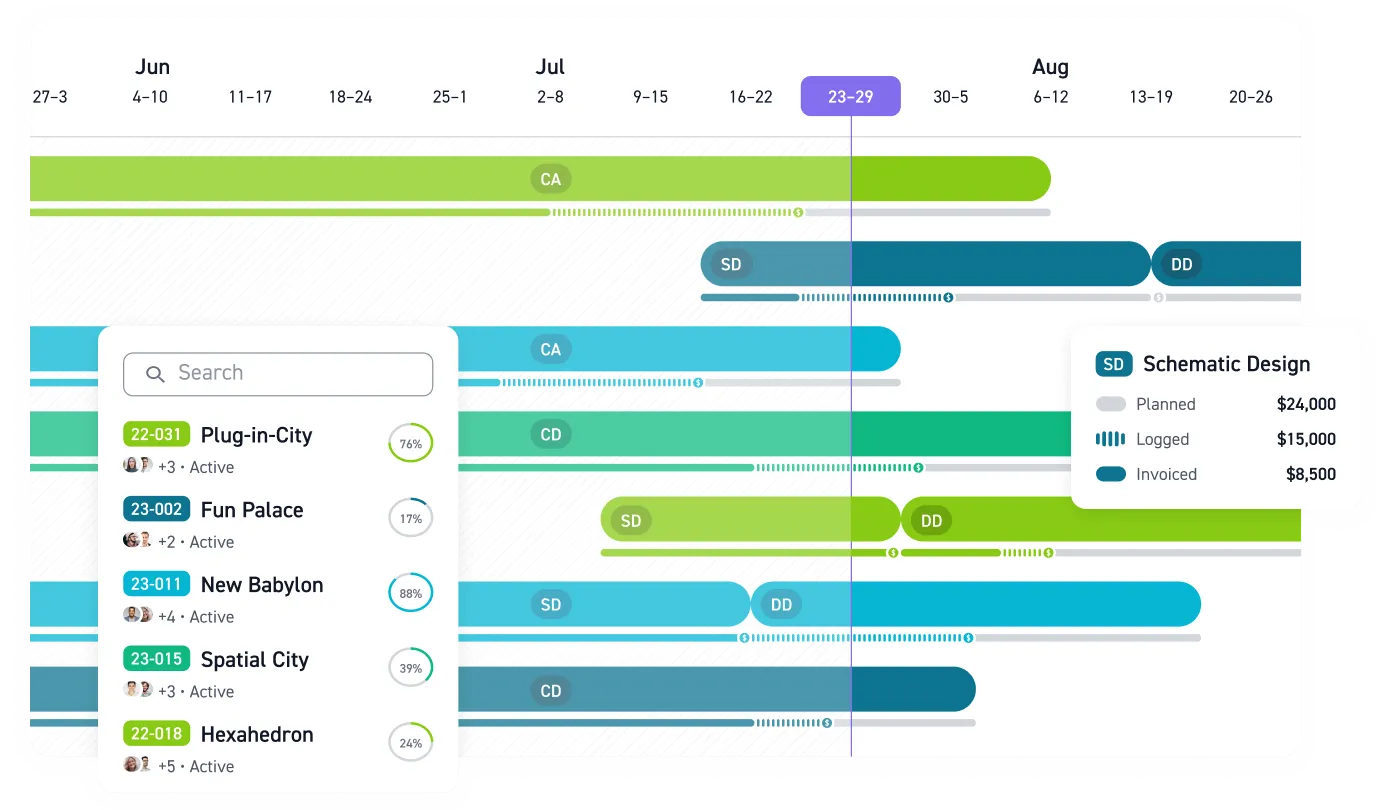
The baseline budget shows where we hope to finish. A living forecast shows where the project is actually heading as hours, expenses, and scope shift week by week. Monograph's MoneyGantt™ makes variance tracking visual and immediate by syncing actual hours from project teams in real-time, helping address problems before they become write-offs.
Bottom-up budgeting isn't about achieving perfect estimates. It's about building budgets from real project requirements, validating them against industry benchmarks, and maintaining visibility as execution unfolds. For Finance Managers at A&E firms, this approach transforms project profitability from a hopeful outcome into a managed result.
Turn Bottom-Up Budgets Into Living Intelligence
You've built your budget from tasks to totals. You've validated against industry benchmarks. You've reconciled bottom-up detail with top-down targets. Now the real challenge begins: keeping that budget accurate as reality unfolds.
Most firms watch their carefully constructed bottom-up budgets become outdated the moment project work begins. Hours shift between phases. Consultant costs exceed estimates. Scope changes ripple through deliverables. By the time you spot the variance, the project has already bled margin.
Over 13,000 architects and engineers across 1,800+ firms use Monograph to transform static bottom-up budgets into living project intelligence. Our Project Planner builds detailed phase budgets with staff and consultant assignments that automatically sync to weekly timesheets. Monograph's MoneyGantt™ overlays your budget against actual logged hours and invoiced fees, showing exactly which phases are trending over budget before they spiral out of control.
When your structural engineer logs hours to Construction Documents, Monograph instantly updates budget vs. actual tracking, flags variance alerts, and adjusts your forecast. When consultants submit invoices, the system reconciles against budgeted fees and updates project profitability in real-time. You built the budget task by task. Now watch it perform phase by phase.
Finance Managers get the reconciliation tools they need: phase-based profitability analysis, consultant cost tracking against estimates, utilization monitoring by role and project, and automated variance alerts when budgets hit critical thresholds. Project Managers get early warning systems: visual budget health on Monograph's MoneyGantt™, real-time phase burn rates, capacity forecasts showing upcoming constraints, and staffing rebalancing recommendations based on actual performance.
Your bottom-up estimates become the foundation for intelligent budget management. Your hybrid approach (task-level detail validated against strategic targets) finally works the way it should. Your quarterly DLM updates flow automatically into budget forecasts. Your phase allocations adapt as project realities emerge.
Your competitors are already managing budgets with real-time intelligence. Close the gap. Book your demo.
Frequently Asked Questions
How long does it take to implement bottom-up budgeting at an A&E firm?
The technical setup takes 2-4 weeks: establish your DLM calculations, build phase templates, and document estimation standards. The cultural shift takes longer. Expect 3-6 months before project managers consistently estimate at the task level rather than working backward from fee targets. Start with one project type where you have solid historical data, prove the approach works, then expand to other project categories. Firms using integrated platforms like Monograph cut implementation time in half because position-specific rates, phase templates, and benchmark reconciliation happen automatically rather than through manual spreadsheet management.
What if our projects are too unique for industry benchmarks?
Industry benchmarks aren't constraints. They're diagnostic tools. If your bottom-up Construction Documents estimate hits 60% of total fees versus the 40% benchmark, that variance tells you something valuable. Either your project genuinely requires more documentation effort (hospital projects with complex MEP coordination, for example), or your task-level estimates need refinement. Unique projects still follow predictable patterns at the task level: site analysis hours, code research time, consultant coordination effort. Build your estimates from these specific tasks, then use benchmark variance as a quality check that forces you to justify (and document) why this project differs from typical work.
Can we use bottom-up budgeting without expensive software?
Yes, but it's painful. You can build bottom-up budgets in spreadsheets. Many firms do. The problem isn't creating the initial estimate. The real challenge is maintaining accuracy as projects execute. When your Project Architect logs 8 hours to Schematic Design, someone needs to manually update the budget tracker, recalculate phase burn rates, adjust forecasts, and check variance thresholds. When your consultant submits an invoice, someone needs to reconcile against budgeted fees and update project profitability. Multiply that across 10-30 active projects and you'll spend more time maintaining spreadsheets than analyzing performance. Purpose-built platforms eliminate the manual reconciliation burden. Your bottom-up estimates automatically become living forecasts that update with every timesheet entry and invoice.
How do we handle bottom-up budgets when clients expect percentage-based fees?
Use both approaches in sequence. Build your internal budget bottom-up from task-level estimates. This tells you what the project actually costs to deliver. Then reconcile against the client's percentage-based fee expectation. If your bottom-up estimate shows $180K in costs but the percentage formula yields a $150K fee, you have three options: negotiate scope reduction, accept lower margin (if strategic), or decline the project. The bottom-up detail gives you the information needed to have that conversation intelligently. Many firms present clients with phase-based fee structures (15% Schematic Design, 20% Design Development) that feel like percentages but are actually built from detailed task estimates underneath. The client sees familiar percentage allocations; you maintain task-level cost visibility.
What's the biggest mistake firms make when switching to bottom-up budgeting?
Estimating design and engineering hours while forgetting project management overhead. Technical staff naturally focus on deliverable production (drawing sets, calculation packages, specifications). However, they consistently underestimate coordination time. Client communication, consultant management, internal reviews, scope clarification, and schedule coordination easily consume 10-15% of total project hours. The 10% rule exists because firms repeatedly learn this lesson the hard way: that "profitable" project built from bottom-up task estimates still lost money because nobody budgeted for the Project Manager's weekly coordination calls, the Principal's client meetings, or the administrative time processing consultant invoices. Build project management as a distinct line item in every phase, not an afterthought when budgets go sideways.