
Most architecture and engineering firm principals keep client histories in their heads. Project managers piece together relationship context from scattered email threads, and when a key person leaves, years of client knowledge walk out the door with them.
The gap comes from firm structure and staffing constraints. 75% of architecture firms have fewer than 10 employees, so many operate without dedicated business development, marketing, or IT staff. Principals are seller-doers: they win work over lunch, manage delivery in the afternoon, and track client relationships in notebooks or spreadsheets that nobody else can access. Meanwhile, 70% of AECO firms still rely on disconnected tools for project and client information.
With average profit margins sitting at 13.2% of net billings, there is very little room for revenue leakage from missed follow-ups, lost repeat-client opportunities, or pursuits that fall through the cracks.
What A&E Firms Actually Need from Client Database Software
Generic CRM tools built for commercial sales teams do not map to how architecture and engineering firms win work. A&E procurement follows qualifications-based selection, multi-phase submissions, and public agency timelines with no equivalent in a standard sales funnel.
The following capabilities separate A&E-specific tools from generic alternatives:
- Bidirectional project-client linkage. Every client record should surface associated projects, and every project record should surface the relevant contacts and history. Without this connection, project managers start engagements without the client history built during the pursuit phase.
- Go/no-go decision support with pursuit tracking. A structured pipeline should evaluate relationship strength, win probability, and team capacity before the firm commits resources.
- Past performance repository. A searchable database of completed project descriptions, staff qualifications, and client references helps teams assemble proposals under deadline pressure.
- Connected project and financial data. When CRM, project management, and accounting share connected data, firms do less rework, make fewer errors, and make decisions faster.
A system that requires heavy manual entry after every client interaction will fail at a seller-doer firm. Automatic email and calendar logging, mobile access, and low-friction updates usually determine whether the tool gets used.
Top Client Database Software for A&E Firms
The right tool depends on firm size, pursuit complexity, and the systems already running the business.
For Smaller Firms
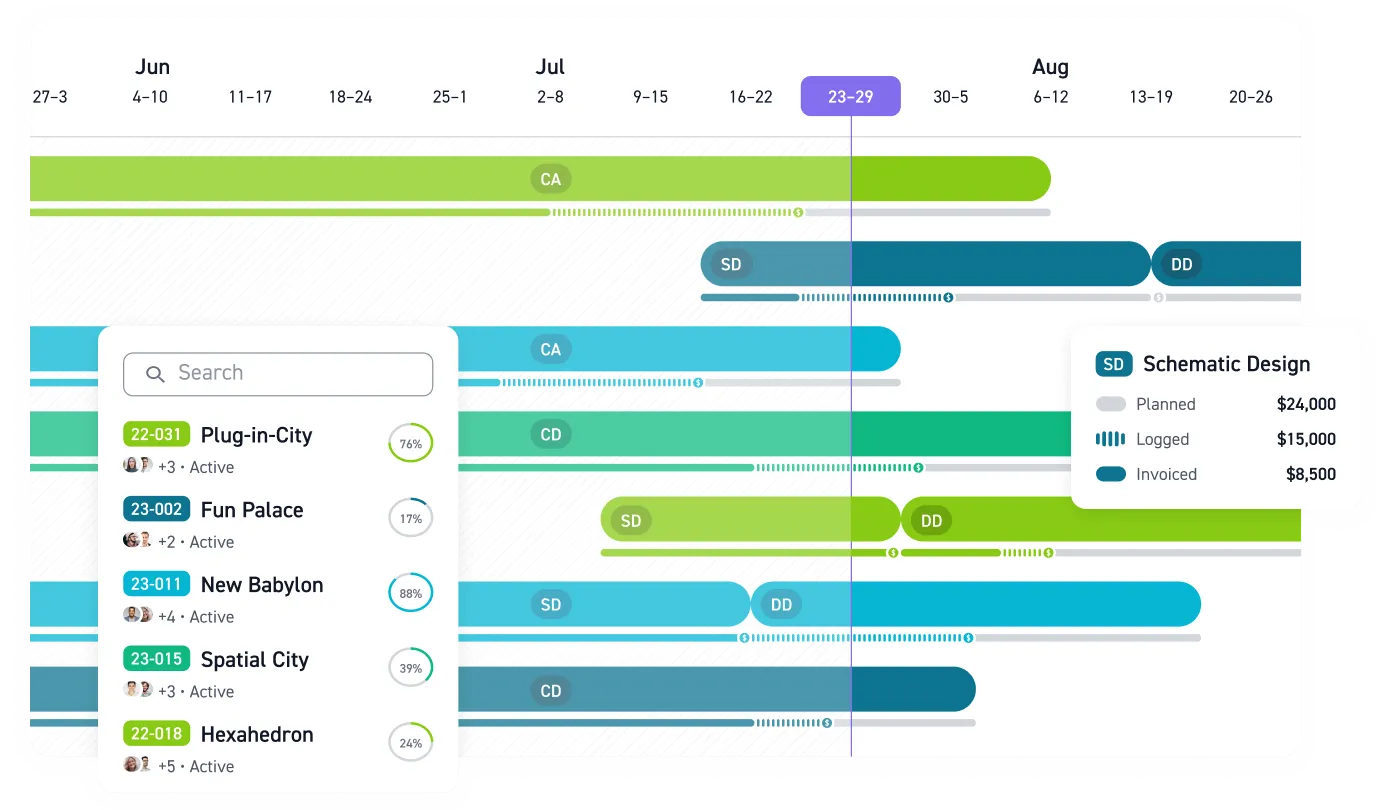
Monograph is a firm management platform built for architecture and engineering practices, covering phase-based project tracking, resource management, time tracking, invoicing, and reporting. Its Pipeline feature handles lead, proposal, and revenue forecasting in the same system where project delivery happens. It adds pursuit tracking, go/no-go decision support, and lead-to-project conversion, and it connects directly to QuickBooks Online. Woodhull, a 25-person Maine firm, reported 66% admin time savings, 50% faster billing, and 66% less budget overage after moving from BQE Core.
For firms with complex pursuit portfolios, government work, or large teaming partner networks, Pipeline may work better alongside a dedicated AEC CRM. For firms tracking a manageable number of pursuits alongside delivery, it may remove the need for a separate system used mainly for opportunity tracking and revenue forecasting.
HubSpot CRM has gained traction with smaller firms because of its free plan tiers. Practitioners in online community forums have recommended it for small practices. The tradeoff is that it has no native concept of project types, teaming partners, or SF330 forms, so many firms outgrow it once pursuits become more complex.
For Firms That Need Accounting and Project Management Together
BQE CORE combines time tracking, invoicing, accounting, project management, and CRM in one cloud platform.
Deltek Ajera brings project management and accounting together. Firms evaluating Ajera should factor accounting changes into the decision because it is positioned differently from tools that connect back to QuickBooks.
For Larger and Multi-Office Firms
Deltek Vantagepoint CRM is a long-established AEC-specific option for firms managing complex pursuit pipelines across offices.
Unanet CRM offers A&E-focused capabilities including teaming partner tracking and mobile and Outlook access.
TrebleHook is built on Salesforce and covers project pursuits from lead through contract award.
aec360 CRM by HSO runs on Microsoft Dynamics 365 and provides go/no-go automation and proposal process management through award.
One of the most important differences across these tools is how they relate to your accounting system:
- Monograph and BQE CORE connect with QuickBooks, so firms can keep their current accounting setup.
- Deltek Ajera uses its own general ledger, so firms moving from QuickBooks typically face an accounting migration.
- Deltek Vantagepoint, Unanet, TrebleHook, and aec360 sit within broader CRM or ERP ecosystems.
That accounting decision usually narrows the field faster than a feature comparison does.
The BD-to-Delivery Handoff Problem
A recurring problem shows up when a pursuit becomes an active project: client context disappears. In too many AEC firms, BD stays siloed from delivery. Firms that solve this problem either keep BD and project delivery in the same platform or connect their CRM and project management tools directly.
Against profitability this thin, missed context is expensive.
How to Choose the Right Tool
Mismatches in either direction are costly. Enterprise software can be too heavy for a small studio. Lightweight tools can leave major gaps once pursuit volume, teaming relationships, and proposal requirements grow.
Before evaluating features, answer three structural questions:
- Are you augmenting QuickBooks or replacing it? Monograph and BQE CORE connect with QuickBooks. Deltek Ajera replaces it with a built-in general ledger.
- How complex is your pursuit pipeline? A firm juggling a modest pipeline alongside delivery needs something different from a firm managing large numbers of opportunities across offices with teaming partners and SF330 requirements.
- Who will maintain the data? If principals are the primary relationship managers, the tool has to support quick updates from the field. A system that depends on administrative enforcement usually fails in firms without dedicated operations staff.
Start with one team. Show improvement. Then expand. This approach is more sustainable in small-firm environments than a top-down rollout that tries to change everything at once.
Connect Client Context to Project Delivery
If you are a principal, project manager, or operations leader, the next step is to decide where client context should live in your firm. For some teams, that means one platform where pursuit tracking and project delivery already sit together. For others, it means a dedicated AEC CRM connected cleanly to project management and accounting.
The best choice is the one your team will actually maintain. If your firm runs on seller-doer behavior, low-friction data entry, mobile access, and visible project-client linkage matter more than a long feature list. If QuickBooks is staying in place, that decision should narrow the field quickly.
Client context disappears fast. Book a demo.
Frequently Asked Questions
Do small A&E firms really need client database software?
Small firms feel the pain fastest because so much client knowledge sits with one or two principals. Even a lightweight system should capture contacts, project history, and next steps in a place the team can access.
What is the difference between a generic CRM and A&E-specific client database software?
Generic CRM tools are built around commercial sales pipelines. A&E firms need tools that reflect qualifications-based selection, pursuit stages, past performance, project-client linkage, and the handoff from business development to delivery.
Should we replace QuickBooks when we upgrade our client and project systems?
Not always. Monograph and BQE CORE let firms keep their existing QuickBooks setup, while Deltek Ajera typically changes the accounting environment more substantially.
How do we avoid creating one more tool nobody updates?
Choose the system around actual behavior inside your firm. If principals and project managers are the main relationship owners, the tool has to work with quick updates, low-friction entry, and connected data that carries forward into project delivery. Start with one team, prove the workflow, and expand from there instead of forcing a firm-wide change all at once.