

An average of 80% of work at A&E firms comes from existing clients. That makes managing client relationships one of the most important business development activities at architecture firms. Yet only 48% of firms have formal BD processes.
The gap between firms that manage client relationships systematically and those still relying on memory and email threads keeps growing. If you're a principal or PM spending too much time digging through Outlook before a client meeting, your system is slowing you down.
Why Generic CRMs Fail Architecture Firms
Standard CRM tools are built around transactional sales models. Architecture firms sell finished projects. Pursuits can stretch over long periods, and the people delivering the work are often the same people winning it.
89% of A&E firms rely on seller-doers for business development, and 42% of seller-doers report spending more time on BD than they used to. When the tool doesn't fit that workflow, technical professionals stop using it. The system turns into administrative overhead, and client knowledge stays trapped in inboxes and individual memory.
Three gaps show up fast when generic CRMs are forced onto A&E work. Standard deal stages don't match go/no-go decisions, teaming, RFQ responses, and interviews. Relationship tracking falls short when BD depends on repeat clients, referral networks, and long-term contact history. Proposal work gets harder because resumes, project histories, certifications, and past performance data usually live across too many places for a generic CRM to organize well.
47% of A&E firms cite poor adoption of BD tools as a significant challenge. That usually means the software is asking architects and engineers to work like sales teams instead of A&E teams.
What to Look for in a CRM for Architects
The right system should reflect how your firm actually wins and delivers work. Focus on a few core areas:
- Pipeline and pursuit management. Your CRM should support stages like Identified, Go/No-Go, Teaming, Proposal, Interview, and Award. It also needs structured go/no-go support and win/loss documentation.
- Contact management for repeat clients. You're tracking multi-year relationships across multiple people at each client organization.
- Integration with project management and accounting. If pursuit data disappears when work is won, your team ends up re-entering the same information later.
- Proposal content libraries. These should pull staff resumes, certifications, project sheets, and past performance data into one library.
- Reporting and analytics. Pipeline forecasting should connect BD reporting with staffing and delivery planning.
A CRM that covers these areas will support A&E practice instead of forcing your team into a sales process built for another industry.
Purpose-Built vs. General-Purpose
The main decision is whether to adapt a general-purpose CRM or choose a tool built around A&E workflows.
General-purpose platforms like HubSpot and Salesforce are contact-centric and deal-centric by default. A&E firms usually need a project-centric model where opportunities, teams, and timelines revolve around projects. Adapting a general-purpose tool often means more customization and more work to connect business development with delivery.
For firms just starting to formalize BD, a free HubSpot tier may be enough to create basic pipeline visibility. For firms that need pursuit tracking tied more closely to project delivery, purpose-built A&E tools are usually the more practical choice.
A&E-native options for many firms include:
- Unanet CRM, formerly Cosential: A standalone AEC CRM with opportunity management, proposal automation, and integrations to accounting and PM systems.
- BQE CORE: Practice management software with CRM, project management, time tracking, and billing in one platform.
- Deltek Vantagepoint: An ERP platform with a CRM module, typically better suited to firms with more implementation capacity.
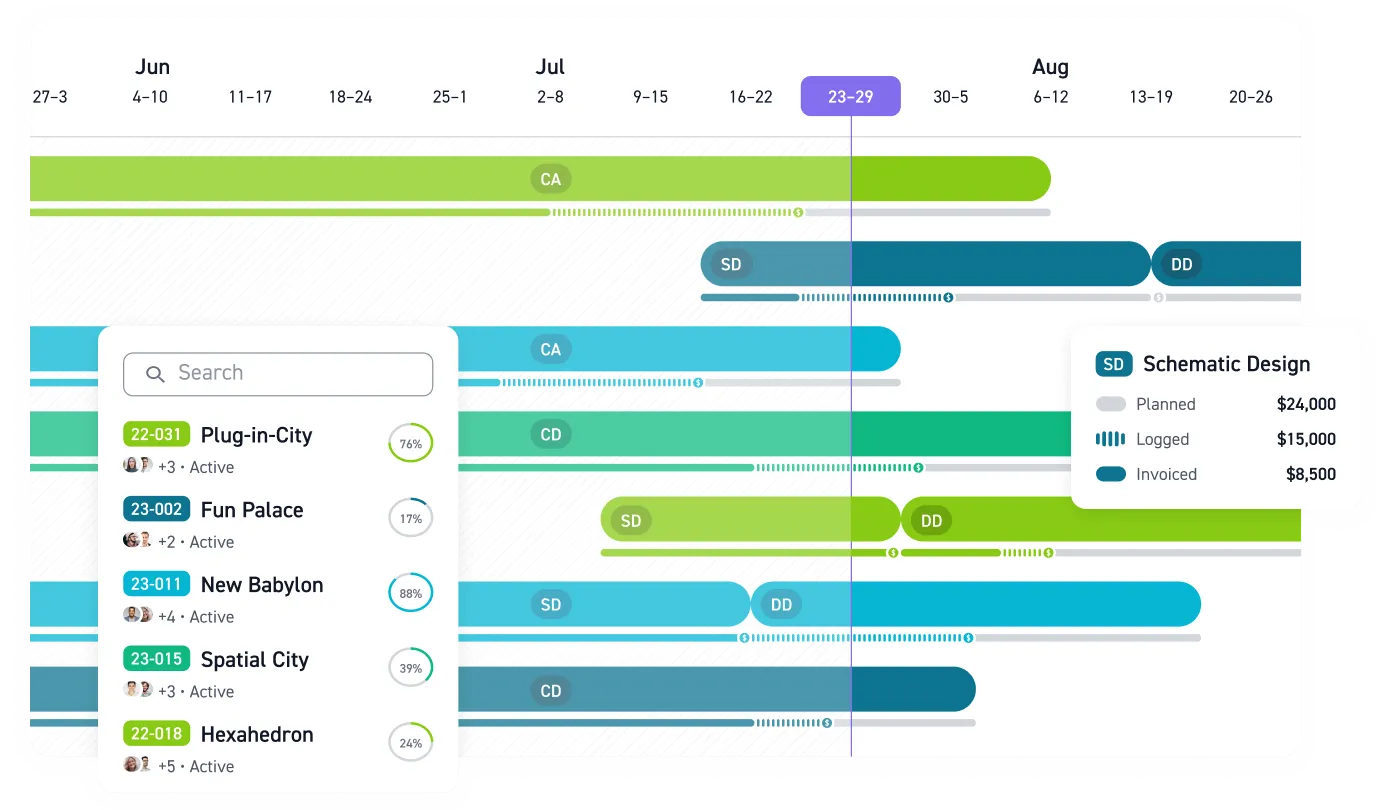
- Lead and forecast visibility: Monograph's lead, proposal, and revenue forecasting module for A&E firms. It supports go/no-go decisions, proposal tracking, and forecast visibility inside the Monograph platform, alongside project managers who track time, budgets, and invoicing. Monograph Pipeline is purpose-built for A&E workflows rather than designed as a traditional standalone CRM.
The right choice depends on whether your firm needs standalone CRM depth or tighter connection to delivery and finance. A long feature list alone still fails if nobody uses it. Adoption matters more than software capabilities.
Implementing Without Killing Adoption
Most CRM rollouts fail because the system creates more work than it removes. A phased approach keeps the tool grounded in daily practice.
- Start with principal-level ownership. If leadership doesn't use the system in pipeline reviews and client prep, no one else will.
- Define your pursuit workflow clearly. Clear stages, decision points, and shared expectations make the CRM easier to use across roles.
- Focus on the records your team actually needs. Active clients, open opportunities, and recent project history usually matter most.
- Test the system across roles. Include a principal, BD lead, and project manager so the workflow works in real practice.
- Keep workflows role-specific. Principals, BD staff, and PMs use the system differently, and adoption improves when the CRM reflects that.
Firms usually build momentum faster when pipeline reviews happen inside the CRM during existing meeting rhythms. That is what turns the system into the source of truth instead of one more spreadsheet to maintain.
Stop Letting Client Knowledge Live in Inboxes
If your principals and PMs are still reconstructing pursuit history from Outlook, spreadsheets, and memory, your firm has a systems problem. The right tool gives you one place to track relationships, pursuits, proposal decisions, and the handoff into project delivery.
Monograph helps A&E firms connect pipeline visibility with the project, staffing, and financial context that matters once a pursuit is won. For firms that want lead tracking and forecasting inside the same platform they use to run projects, Monograph Pipeline extends that visibility without adding another disconnected tool to manage.
Your next project is already being shaped by the system you use to track it. Book a demo.
Frequently Asked Questions
Does a small architecture firm really need a CRM?
Yes. Small firms depend heavily on repeat clients, referrals, and principal relationships. A simple system used consistently is better than leaving those relationships in email threads and personal memory.
Can a general-purpose CRM like HubSpot or Salesforce work for an architecture firm?
Yes, if you only need basic pipeline visibility and you're early in formalizing BD. Firms with long pursuit cycles, repeat relationships, proposal demands, and project handoffs usually need something more tailored to A&E work.
What data should we migrate first?
Start with active clients, open opportunities, and recent project history. Clean records and clear ownership matter more than moving every old contact.
Who should own CRM rollout inside the firm?
A principal should own adoption outcomes, even if BD or operations handles day-to-day setup. If leadership uses the CRM visibly, the rest of the firm has a reason to trust it.
How long does CRM adoption usually take at an architecture firm?
Adoption works best when training stays consistent and CRM use is built into existing meeting rhythms. Firms that treat it as the working system for pipeline reviews usually see stronger follow-through than firms that run it beside a separate spreadsheet.