


Firm management made easy

CRM Pipeline Stages: Best Management Practices
Most A&E firm principals know their pipeline needs work. The problem is that the default CRM setup treats your business development like a software subscription sale: Lead, Qualified, Proposal, Closed. That structure ignores everything about how architecture and engineering firms actually win work, from 12-18 month pursuit cycles documented in industry benchmarks to relationship-driven selection processes.
Survey data indicates only 48% of firms have formal BD processes in place. That gap creates real opportunity for firms willing to build pipeline stages that reflect how projects actually move from first conversation to signed contract.
Structure Your Pipeline Around Project Phases
Generic sales stages force A&E professionals to think like SaaS salespeople. In practice, A&E business development runs through qualification-based selection, extended design conversations, and relationship-building over time.
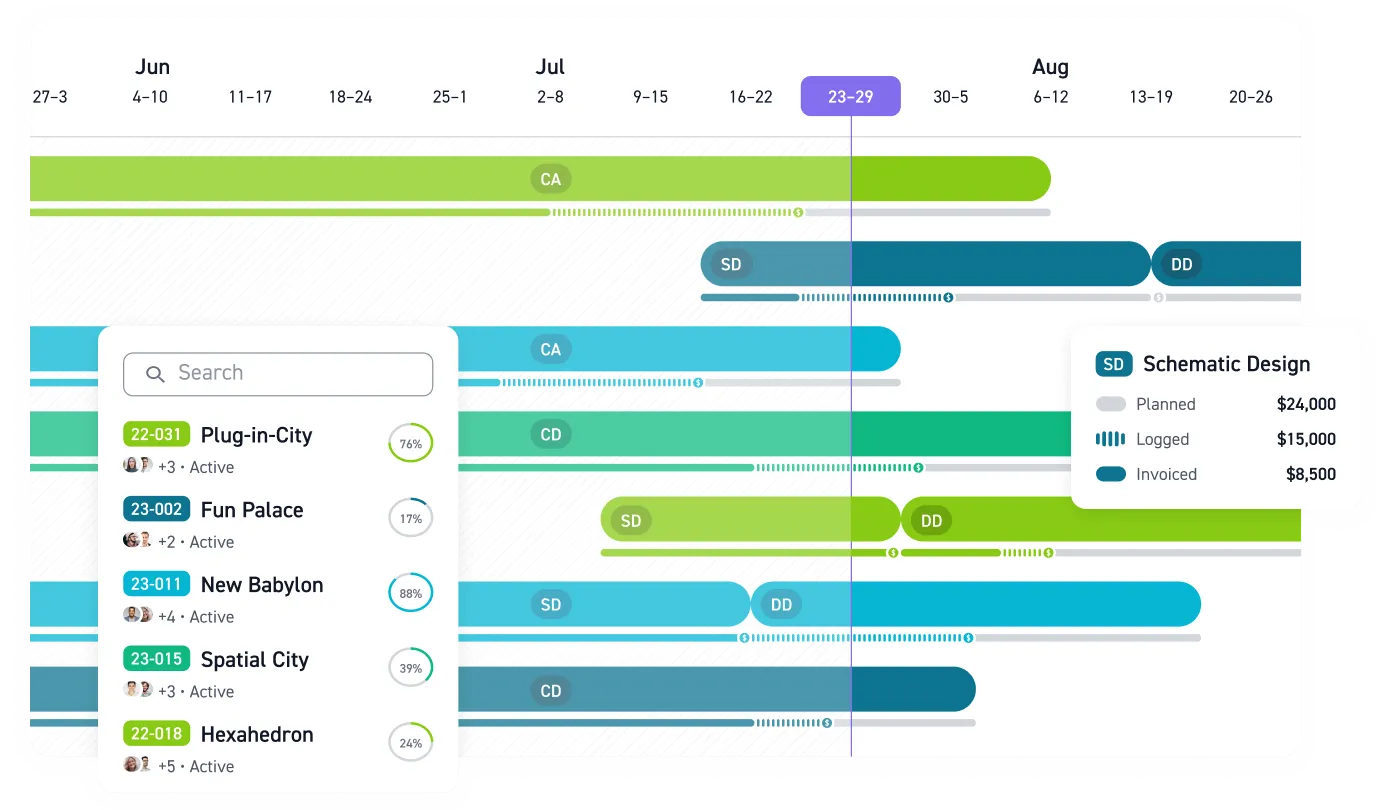
A pipeline built for A&E firms should mirror the progression of project delivery itself:
- Initial Inquiry/Contact: First identification of an opportunity through RFI, referral, or direct outreach
- Conceptual Design: Early conversations about project vision, scope, and alignment with your firm's capabilities
- Schematic Design: Active pursuit with preliminary scope and fee discussions underway
- Design Development: Detailed proposal submission, technical interviews, or shortlist presentations
- Construction Documents: Advanced project documentation and continued pursuit activities
- Negotiation: Scope clarification, fee negotiation, and contract terms
- Contract Execution: Signed agreement with all project data ready to transfer into delivery
This structure acknowledges that a healthcare project at Schematic Design has different conversion odds than a commercial project at the same stage. Your historical data tells a more nuanced story than any generic probability percentage, and tracking conversion rates by both project type and stage over time gives you the only accurate foundation for revenue forecasting.
The payoff for getting this right is significant. Firms using systematic qualification processes achieve 45% win rates, well above typical B2B benchmarks. That reflects the relationship-based selection process that characterizes A&E business development.
Use Go/No-Go Discipline to Pursue Fewer, Better Opportunities
Chasing every RFP that crosses your desk feels productive. The data says otherwise. Selective firms can hit 50% win rates while reducing proposal volume by 38% and increasing award value by 52%, according to annual benchmark data.
A structured Go/No-Go framework should evaluate every opportunity against six to ten criteria before you invest pursuit time:
- Client relationship strength: Do you have an existing relationship and past project history?
- Project fit: Does the scope align with your firm's capabilities and growth direction?
- Resource availability: Can your team realistically handle this pursuit and the project if you win?
- Competitive position: What is your honest win probability given who else is likely pursuing?
- Financial viability: Does the project budget align with your typical fee structure?
- Long-term value: Does this open a new market, geography, or reference project worth the investment?
The discipline here matters more than the specific criteria. Make Go/No-Go evaluation a consistent habit across every pursuit, including smaller ones. When pursuit decisions lack supporting data about past success rates, project profitability, and resource capacity, firms tend to overestimate their chances and say yes to work that does not fit their business goals.
For the proposals you do pursue, industry training programs recommend the Issues-Features-Benefits-Proof process: identify the client's core concerns, differentiate your capabilities from competitors, translate those capabilities into client value, and substantiate your claims with evidence. The goal is clear proposal differentiation that stays focused on the client.
Track Metrics That Reflect A&E Reality
Annual benchmark surveys place industry-wide win rates between 44.7% and 50%, with medium and large firms dragging down the average. But aggregate win rates tell you very little about your firm's pipeline health. The metrics that matter for A&E principals break down into more specific categories:
- Win rates segmented by project type and client status. Your conversion rate on repeat client work will differ dramatically from competitive pursuits for new institutional projects. Track both by project manager and market sector.
- Time in stage and pipeline velocity. A&E sales cycles often run 12-18 months. If opportunities stall at specific stages, that signal is worth investigating. Establish internal baselines rather than relying on industry averages.
- Pipeline mix and concentration risk. The AIA's Business Academy curriculum emphasizes tracking pipeline mix as a core metric. At many firms, one-third of revenue concentrates among just three clients, demanding diversification planning.
- Weighted pipeline value. Apply your firm-specific conversion rates by project type and stage for a realistic revenue forecast. The hybrid approach, combining backlog certainty with probability-weighted pipeline data, gives the most accurate picture for multi-year delivery cycles. One useful primer outlines the model options available for professional services forecasting.
Review these metrics weekly for opportunity status and aging deals. Monthly and quarterly, step back to evaluate stage-to-stage conversion trends and forecast accuracy.
Connect Business Development to Project Delivery
Disconnected systems cause the biggest pipeline pitfalls in A&E firms. When your CRM lives in isolation from project management, time tracking, and financials, you guarantee the manual recreation that makes your technical team resist CRM adoption in the first place.
A&E firms generate 80-85% of revenue from repeat clients. That means your pipeline system needs to preserve every conversation, scope discussion, and client preference from business development through project delivery and back into the next pursuit. Losing that context between systems costs real money.
Woodhull Architecture, a 25-person Maine firm, cut admin time and budget overages by 66% after connecting their CRM to project management and accounting, as detailed in this CRM best practices analysis. Workshop/APD, a 50-person New York practice, shares a profit-growth story tied to building systematic business development processes across their entire team rather than siloing BD responsibility. This broader approach is covered in this acquisition playbook.
These results come from treating business development as "project phase zero," where opportunity data flows directly into project records when you win, and delivery performance feeds back into smarter pursuit decisions.
Technology Adoption as Competitive Advantage
The performance gap between tech-forward and tech-static A&E firms continues to widen. Benchmark data confirms that tech-forward firms achieve 75-100% win rates at nearly double the rate of tech-static firms. In the same benchmarking study, 67% of tech-forward firms hit project profit rates of at least 20% within 12 months compared to 52% of tech-static firms.
For firms with 5-50 employees, the practical starting point matters. One consistent recommendation from industry advisors: pick one or two processes to improve and a couple of metrics to start tracking. Trying to change everything at once rarely works.
Given that the majority of A&E firms rely on seller-doers rather than dedicated BD staff, your pipeline tools need to minimize administrative burden. The principals and project managers doing business development are also delivering projects. Every minute spent on CRM data entry is a minute not spent on design, engineering, or client relationships. Tools built specifically for A&E workflows, like Monograph, recognize that reality and connect pipeline setup, project tracking, budgeting, and contact management without forcing technical professionals into sales-focused interfaces.
Start with your pipeline stages. Get those right, and the metrics, forecasting, and integration decisions that follow will have a solid foundation to build on.
Build a Pipeline That Actually Reflects Your Practice
Generic sales tools force you to treat complex design projects like software subscriptions. That misalignment costs you visibility, accuracy, and ultimately, winnable work.
Monograph connects your pipeline directly to project delivery. When you win a pursuit, all that historical context, scope discussion, and fee negotiation flows right into your active project budget. No double entry, no lost data.
Your pipeline should work the way your firm does. Book a demo.
Frequently Asked Questions
How many pipeline stages should a typical A&E firm have?
Keep it between five and seven. Anything less than five usually lumps too many distinct pursuit activities together, making forecasting inaccurate. Anything more than seven creates administrative burden that your seller-doers will simply ignore. Map them directly to your standard project delivery phases.
Should we track public RFPs differently than repeat client work?
Yes. Your win probability on a public RFP where you have no prior relationship is fundamentally different from a repeat client asking for a proposal. Track them in the same pipeline, but use different project types or tags so you can segment your win rates and forecast accurately.
How do we get principals to actually update the CRM?
Stop making them do double data entry. When your CRM is disconnected from your project management and financial tools, updating the pipeline feels like busywork. Connect the systems so that updating a pursuit stage automatically updates the firm's revenue forecast and resource planning.