

Every firm owner has stared at a project that is mostly billed and wondered whether it is mostly done. That gap between what you've spent and what you've delivered is where profit quietly disappears.
The firms that stay profitable track the right engineering metrics early enough to act. Here's what to measure, what healthy looks like, and how to start.
The Three Metrics That Drive Profitability
Labor represents up to 75% of a firm's total operating costs, so labor-related metrics carry the most weight on profitability.
A firm can grow revenue and still lose money if labor is priced or deployed poorly.
- Net multiplier (Net Revenue ÷ Direct Labor Cost): the amount of revenue you generate for every dollar of direct labor. A healthy target sits at 2.75 to 3.25, with the industry averaging around 2.90.
- Labor utilization rate: the share of available time your team spends on billable work.
- Overhead rate (Total Indirect Costs ÷ Direct Labor): typically running 150% to 175% of direct labor.
The trap is treating these as independent. A strong net multiplier can still hide profitability problems if overhead runs high or utilization falls. Track all three together.
Utilization: Get the Denominator Right First
Utilization rate is the percentage of available work time spent on billable tasks. Simple math, except the denominator changes everything.
Some benchmarks count gross annual hours, including PTO and holidays. Others count net hours after time off. Before you compare yourself to any published figure, confirm which method it uses.
Reasonable net-hours targets vary by role:
- Technical staff (architects and engineers): 75-85%
- Project managers: roughly 88%
- Principals: around 72%, since they spend more time on business development
Comparing each role against its own target reveals more than a single firm-wide average.
Rates above 90% risk burnout and reduced work quality. Sustained overutilization leaves almost no room for mentorship, meetings, professional development, or recovery. Pushing utilization too high costs you your team.
Percent Complete vs. Percent Spent
This is the pairing that catches overruns before they land. Percent complete measures how much planned work you've actually delivered. Percent spent measures how much of the budget you've consumed. When they diverge, you have a signal.
If percent spent runs ahead of percent complete, you're heading for an overrun while there's still time to adjust scope or rebalance the team. Experienced project managers flag both directions of divergence as risk indicators.
The Cost Performance Index (Earned Value ÷ Actual Cost) turns this into one signal. A CPI below 1.0 means over budget. A CPI above 1.0 means you're delivering more work per dollar than planned. Measure completion from installed quantities or delivered milestones, not a gut estimate of "about halfway."
What the Data Says About AI-Adopting Firms
Monograph's 2026 Architecture & Engineering Business Benchmarks Report draws on anonymized data from Monograph, with benchmarks broken down across 660–856 A&E firms per metric. AI-adopting firms show a measurable utilization gap.
Operations staff at AI-adopting firms reach 84% utilization, above the 81% at baseline firms. That three-point gap compounds across a full year of billable hours.
Utilization maps directly to hours the firm can invoice. A team that recovers even a few points of billable time each week turns that time into fees the same staff would otherwise spend on unbilled work.
Cash Flow: Getting Paid Is a Separate Discipline
You can bill perfectly and still run out of cash. The metric that exposes this is Days Sales Outstanding (Accounts Receivable ÷ Average Daily Net Revenue). A healthy A&E target sits at 45 days or fewer. Once DSO creeps past that, you're financing your clients' projects with working capital you could put toward staff or technology.
Practice leaders have found that billing speed and collection speed move independently. Recent industry data shows AEC firms are billing faster but collecting slower, with work-in-process turnover improving even as collection periods stretch. Better invoicing software doesn't help if the money still arrives late.
Garrison Architects, for example, reported 1.5x faster billing and 2.5x faster time-to-payment after moving from ArchiOffice.
A few habits tighten the cycle without adding administrative weight.
- Invoice as soon as milestone sign-off is complete.
- Collect a retainer before kickoff.
- Shorten payment terms in your contracts.
- Review AR aging on a regular cadence and follow up quickly on overdue invoices.
Each habit can shave days off the collection cycle without adding overhead.
Where Small Firms Should Start
Small and growing firms track the same metrics: net multiplier, utilization, and DSO. They have more flexibility in the tools they use and can afford to start narrow.
Begin with utilization using a time-tracking activity report, net profit margin, and days sales outstanding. Once they are stable, expand into project-level profitability and overhead tracking. Establish a baseline before setting goals, because you can't set a realistic target until you know where you stand.
Most firms know which metrics matter. The obstacle is seeing them soon enough. When a project engineer's hours outpace budget, you want to see the multiplier drop while the project is still open, in time to adjust scope before the overrun lands.
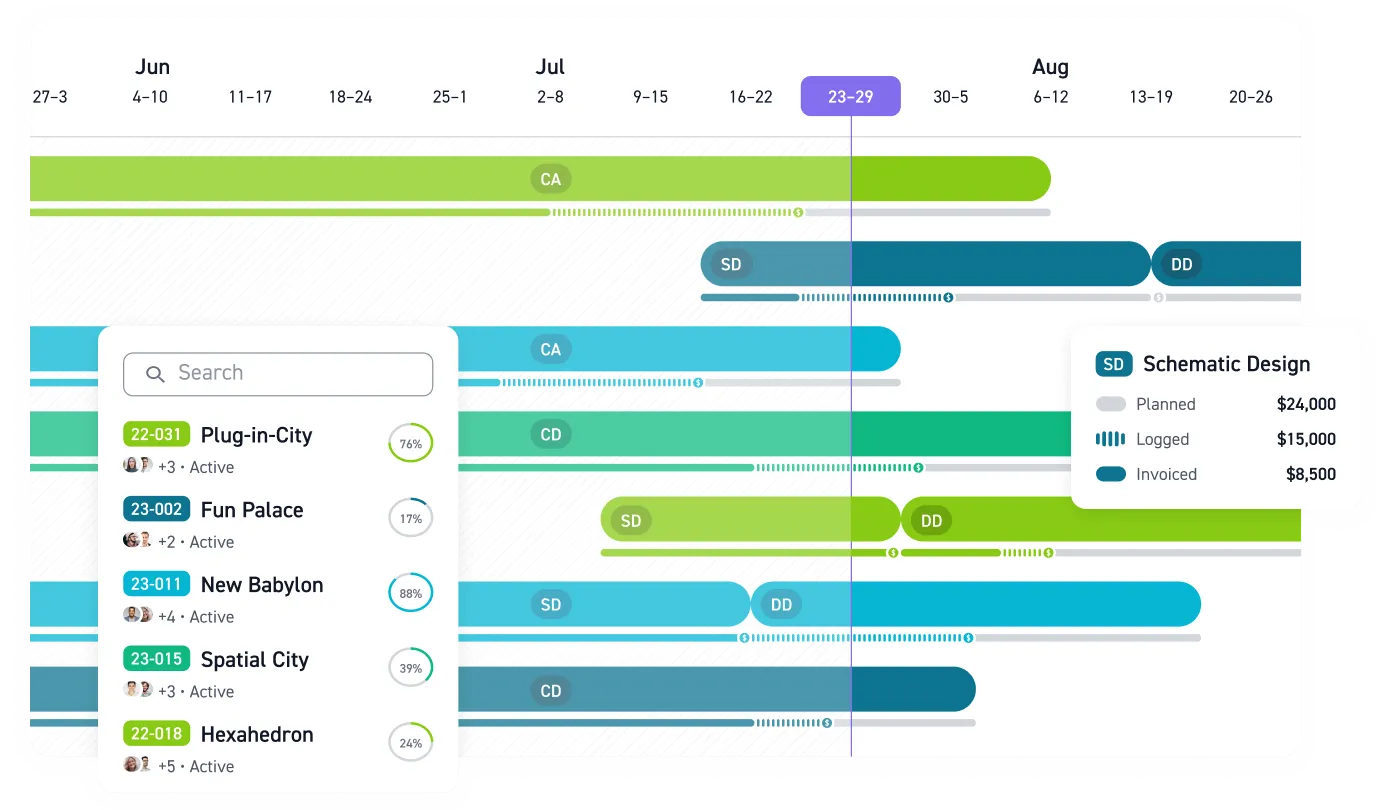
Purpose-built A&E tools like Monograph connect time tracking, budgets, and invoicing, giving project managers real-time visibility into budget risk without rebuilding spreadsheets. Monograph is built for A&E firms that have outgrown spreadsheet tracking, and Monograph's MoneyGantt™ brings budget and cash progression into a single timeline.
See Your Metrics Before They Become Problems
Month-end reports arrive after the damage is done. By then, utilization has slipped, percent spent has outrun percent complete, and DSO has turned your firm into the bank.
Monograph gives project managers, operations leaders, principals, and owners one place to track utilization, project profitability, budgets, time, invoices, and cash progression. MoneyGantt™ shows where a project is drifting before month-end.
Catch the leak early. Your metrics are already telling you where profit is slipping. Book a demo.
Frequently Asked Questions
Which engineering metric should a small firm track first?
Start with utilization rate because it shows whether available time is turning into billable work. Pair it with net profit margin and days sales outstanding. Once those are stable, add project-level profitability and overhead tracking.
What is a healthy utilization rate for engineers?
For technical staff, a reasonable net-hours target is 75-85%. Project managers often run higher, around 88%, while principals sit lower, around 72%, because leadership and business development take time. Be careful above 90%; that leaves little room for mentorship, coordination, training, or recovery.
How often should we review utilization and project profitability?
Review active projects weekly. A short look at utilization, percent complete, percent spent, and AR aging gives you time to rebalance staffing, adjust scope, or follow up on overdue invoices. Waiting until month-end turns early warnings into cleanup work.
Why can a project look profitable while still hurting cash flow?
Profitability and cash flow move on different clocks. A project can be on budget while invoices go out late or payments stretch past the 45-day DSO target. Treat billing and collections as their own discipline, because earned fees do not help your firm until they become cash.