



Firm management made easy

Every engineering project plan rests on three variables: budget, resources, and schedule. Change one, and the other two shift immediately. A&E firms with 5 to 50 employees feel this acutely because labor is the dominant cost. The project budget is really a forecast of how many hours, from which staff grades, will be applied over a specific timeframe. Get that forecast wrong, and profit disappears.
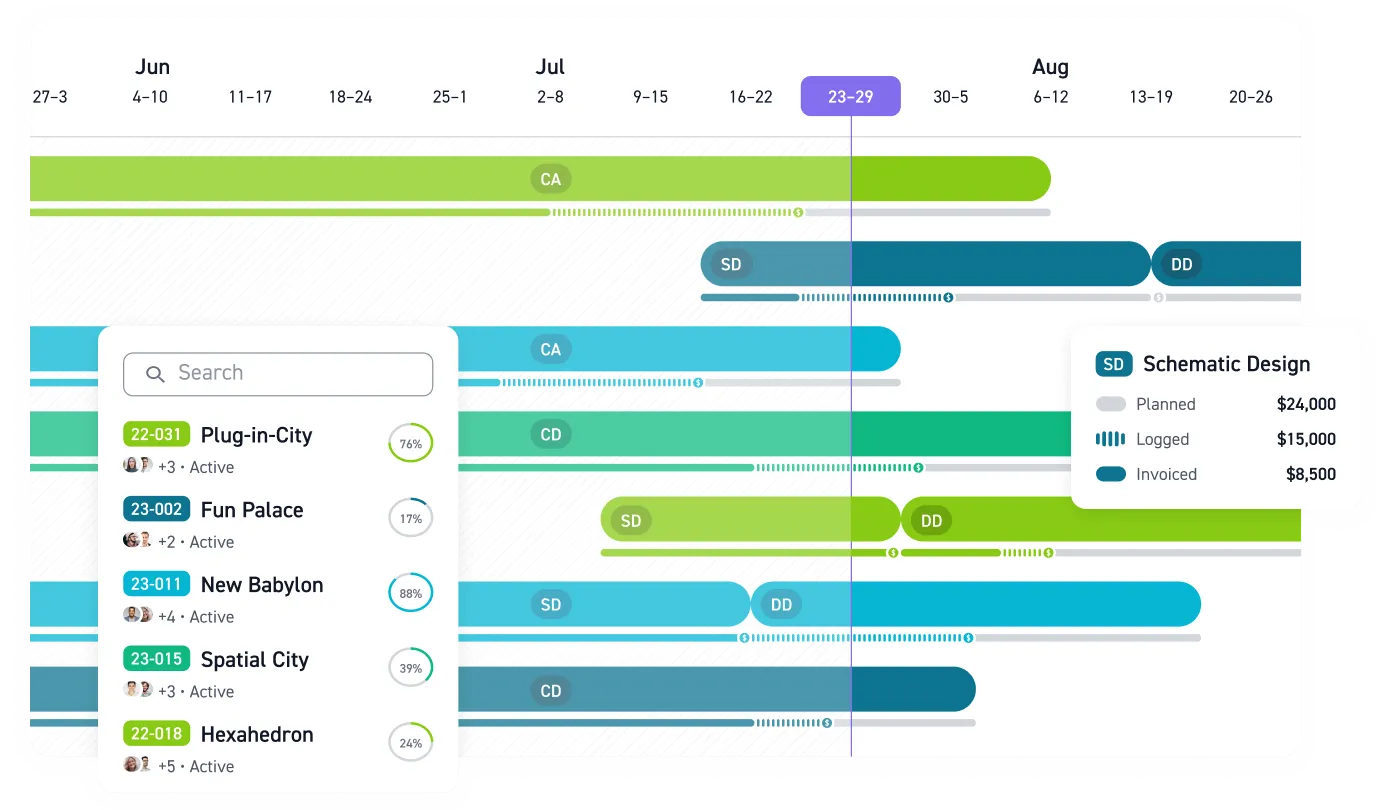
The project manager's core responsibility is bringing schedule, budgets, and scope to completion simultaneously. Engineers are expected to develop resource-loaded schedules with scopes and budgets built in from the proposal stage. A staffing and cost-loaded timeline, where staff assignments and associated costs are embedded directly into the timeline, shows how these planning elements connect.
Phase-Based Budgets That Reflect Real Delivery
Standard project phases provide the framework for structuring fees: Schematic Design, Design Development, Construction Documents, Bidding/Negotiation, and Construction Administration. Each phase represents distinct deliverables and works as a natural cost container for internal budgeting and client billing.
No single allocation is correct, but two benchmarks define the range you should work within:
- Schematic Design: 15% traditional baseline to 18% public-sector guideline
- Design Development: 20% across both benchmarks
- Construction Documents: 31% public sector to 40% traditional baseline
- Construction Administration: 20% traditional to 27% public-sector guidance, plus an additional 2% for project closeout
The biggest divergence is in CA. Public-sector guidelines weight CA more heavily because of the oversight burden in publicly bid projects. Practitioner analysis of CA losses identifies CA as the phase where firms most frequently lose money. If you're using 20% as your CA fee allocation, you are likely underpricing that phase.
Reconciling fees from both directions, bottom-up and top-down, is standard practice. When the two approaches produce similar numbers, the fee is probably right. When they diverge, one set of assumptions needs revisiting.
Build internal contingency into every fee. Guidance calls for separate layers: roughly 10% of fee for profit contingency, roughly 10% of hours for working hour contingency, and roughly 3% of fee for special situations. Those layers protect the margin that separates profitable projects from projects that quietly erode your bottom line.
Resource Planning Beyond a Single Utilization Number
A single firm-wide utilization target is inadequate because different roles carry different non-billable responsibilities. A principal operating at 55% utilization may be fully productive if the remaining time goes to business development and firm leadership. A junior engineer at 55% has a capacity problem.
Industry data supports role-differentiated utilization targets:
- Junior designers and engineers: 75–85%
- Mid-level staff: 70–80%
- Senior project managers: 60–70%
- Principals: 40–60%
Firm-wide, Deltek's A&E Clarity report puts utilization at 61.1%, and Deltek notes that a utilization rate above 60% can put a firm above the industry average. Practitioner analysis flags anything above 75% firm-wide as a sign that business development and quality review are getting squeezed. A 95% utilization rate can signal overwork and leave limited capacity for mentoring, coordination, and internal project work.
Utilization alone doesn't predict profitability. PSMJ found an R² of only 0.1104, which means utilization explains about 11% of profit variance. The rest comes from fee structure, realization rate, overhead management, and project selection. Firms chasing higher utilization by filling schedules with low-margin work trade real profitability for a false signal.
Track utilization, billability, and realization together to understand workload health. A firm can show strong utilization numbers while still losing money to write-offs and unbilled rework that never make it to collected revenue.
Scheduling Around What You Can and Can't Control
Milestone-based scheduling tied to project phases is standard, but the gap between design complete and client accepted is where schedules quietly slip. Common milestone payment structures include full payment at phase completion or a split structure where the final portion is paid upon client acceptance. Client acceptance is formally separate from design completion, and that gap has to be built into your phase timelines.
Several schedule elements sit largely outside your control and need dedicated buffers:
- Owner board approvals and lender reviews during Design Development
- Permit review timelines that run on the reviewing agency's clock
- Consultant deliverables on the critical path, where delays cascade across disciplines
- Budget reconciliation cycles at phase transitions, particularly at DD completion
Those items belong in the plan before the project starts, not after the schedule begins to slip. When milestones depend on external parties, the buffer is not optional.
Seasonal billing patterns add another consideration. Monograph's 2026 Architecture & Engineering Business Benchmarks Report shows a 34% swing between peak and trough billing months, with months below average to start the year. If you manage multiple concurrent projects, front-load staffing plans for peak periods and plan lighter workloads or internal project work during Q1 troughs.
When Integration Breaks Down
Scope creep is the central mechanism through which budget, resource, and schedule planning falls apart. A Zweig Group article frames scope creep as a core project management failure: work is added, resource consumption increases, schedule expands, but the budget stays fixed, so the direct labor multiplier falls and the project can lose money.
A scope change must trigger simultaneous responses:
- A budget amendment reflecting the additional work
- A resource reallocation adjusting staff assignments and hours
- A schedule revision accounting for the new timeline
If any one of those responses is missing, the project absorbs extra work without a matching operational reset. That is how margin disappears.
The LA Bureau of Engineering's project delivery manual defines scope creep in two forms: numerous small incremental changes, and a fundamental change in design approach. Clearly defined phase boundaries are natural pause points where scope changes can be formally assessed rather than absorbed mid-phase without documentation. Guidance also recommends designating 10% of budget for project management itself.
See Budgets, Staffing, and Schedule in One Place
Disconnected systems produce disconnected decisions. When budget data lives in a spreadsheet, resource assignments sit in a shared calendar, and the schedule exists in yet another tool, overruns become predictable. After consolidating those workflows, the team at Workbench reported 8x faster staffing, a 4x faster billing process, and 75% less unbilled fees.
Monograph's Project Planner connects phase-based budgets, staff and consultant assignments, and capacity forecasts in a single workspace. MoneyGantt™ displays scope, schedule, and cash flow in one visual, so you can see whether a phase is burning hours too fast before the budget is gone.
Stop planning in fragments. See your budgets, staffing, and schedule in one place. Book a demo.
Frequently Asked Questions
How detailed should an engineering resource-loaded schedule be?
It should include staff assignments and associated costs directly in the timeline from the proposal stage. That makes the schedule the operational expression of how budget, resources, and timing connect.
What should we do when utilization looks healthy but projects are still losing money?
Track more than utilization. Utilization alone doesn't predict profitability, so you need to look at billability, realization, fee structure, overhead management, and project selection at the same time.
How much contingency should we build into engineering project fees?
The guidance here is separate layers: roughly 10% of fee for profit contingency, roughly 10% of hours for working hour contingency, and roughly 3% of fee for special situations.
When should a scope change trigger a budget and staffing reset?
Immediately. A scope change should trigger a budget amendment, a resource reallocation, and a schedule revision at the same time. When one of those responses is missing, profit fades.