
Engineering firms rarely lose money because they deliver bad work. They lose money because they cannot see what is happening to their budgets until the project is over. The gap between top-performing and median A&E firms comes down to real-time visibility, not technical capability.
Industry benchmark data shows profitability across A&E firms varies significantly, with high-performing firms reaching around 31% profit margins while median firms land closer to 12.5%. The difference is that top firms track money in real time, and median firms find out after the fact.
For principals and project managers running 5- to 50-person firms, better project management starts with understanding where projects bleed profit and what to do about it. Most of us learned this the hard way, finishing a project feeling great about the work, then discovering the margins told a different story.
Where Engineering Projects Lose Money
Fixed-fee contracts amplify every planning error. On time-and-materials contracts, scope creep can generate additional revenue. On fixed-fee contracts, it directly erodes margin. That distinction matters because 52% of firms report at least one in four projects goes over budget, with scope creep as the top cause.
The problem compounds when firms lack the systems to catch overruns early. Delayed recognition of scope changes is a profit drain in A&E firms. By the time leaders realize a project has expanded beyond the original agreement, the firm has already delivered thousands of dollars in unbilled services.
If you've ever had a PM quietly absorb a scope change because raising it felt harder than just doing the work, you've seen this play out. Three specific tracking failures enable this leakage:
- Manual resource management: Many firms still manage resources using spreadsheets or meetings rather than dedicated systems
- Invisible realization rates: 41% of firms don't track realization rate or aren't sure how much of their logged time actually gets billed and paid
- Unknown overhead: 39% of firms don't track their overhead rate or are uncertain of the number
These aren't minor operational gaps. They're structural blind spots that make profitability a guessing game. When project managers lack real-time budget visibility, they tend to absorb changes rather than document and price them, because change orders issued after the fact are harder to get approved and often never get issued at all.
The Financial Metrics That Separate Top Firms
The average A&E firm bills roughly 81% of available staff time, which means nearly one-fifth of potential revenue disappears into project administration, rework, and untracked scope changes. Recovering even a fraction of that leakage moves the needle on firm profitability.
Engineers apply rigor to every calculation on a project. The same rigor applied to tracking project finances changes outcomes. Key metrics include utilization and chargeability, overhead rate, effective multiplier, and balance-sheet metrics like current ratio, debt to worth, and working capital.
Phase tracking helps firms spot problems earlier. That matters most when a project still has enough fee left to correct course. Once a phase is mostly spent, the conversation changes from prevention to damage control.
Realization rate deserves particular attention, and multiplier metrics remain closely watched benchmarks for AEC firm profitability. If your team logs the hours but the invoices never catch up, the gap usually traces back to weak visibility into what got worked on, what changed, and what can still be billed.
Bonus trends show growing use of compensation approaches designed to reward project profitability and utilization targets. When PMs see realization rates reflected in their bonuses, those numbers get attention.
A simple operating rhythm helps. Review utilization at the firm level, review realization at the project level, and review phase performance before monthly billing goes out. That sequence keeps financial reviews tied to active decisions instead of turning them into a postmortem after the fee is already gone.
Resource Planning When You Can't Just Hire More People
Engineering firms face an unusual tension right now. Survey data from 710 executives shows 48% of firms report one year or more of work on hand, with a median backlog of 11 months. At the same time, that market context points to capacity pressure. That combination creates strong demand.
You've got more work than people, but hiring takes months and the projects need to ship now. project management research finds that roughly half of project managers spend at least one full day each month manually assembling status reports. Cutting that administrative drag back effectively increases capacity without adding headcount.
The most effective staff planning approaches four areas simultaneously:
- People: Map workforce capabilities against current and projected project needs
- Processes: Standardize allocation workflows so resource decisions aren't made ad hoc
- Tools: Deploy technology that gives real-time visibility into who's working on what
- Culture: Build organizational commitment to resource discipline, not just tool adoption
Tools alone won't fix this. Your team has to actually use them, and that means changing how you make resource decisions, not just buying a new tool.
For small engineering firms, this usually breaks down in familiar ways. One senior engineer becomes the default answer for every urgent project. PMs make staffing decisions in separate spreadsheets. Weekly priorities shift, but the staffing plan does not. Then timesheets tell you what happened only after the hours are gone.
Better planning starts with a visible weekly view of workload by phase and person. You need to know who is overloaded, who has capacity, and which project is consuming hours faster than expected. That kind of view helps firms rebalance work before burnout sets in or a profitable job gets crowded out by a noisy one.
Why Connected Systems Outperform Disconnected Tools
83% of firms in engineering and construction have adopted or begun adopting Project Management Information Systems. Connected systems give firms an advantage by keeping project information easier to find and use across the work.
Dedicated research covering 130 A&E firms found that improved project team coordination was cited as the most significant business impact from AEC technology adoption, ranked above administrative efficiency gains like automated invoicing or time tracking alone. Siloed data and fragmented toolsets, a challenge that ongoing industry surveys consistently surface, make it harder to find relevant project information quickly and act on it before the window for correction closes.
A case study of a 40+ person firm reported a 6% boost in profitability after implementing software. The gain came from clearer forecasting, tighter billing, and stronger project accountability. For 5- to 50-person firms, that integration benefit is amplified. There's rarely much capacity to reconcile spreadsheets, a standalone time tracker, a separate invoicing tool, and QuickBooks.
Duplicate data entry wastes time, but the deeper cost is decision lag. When project budgets live in one place, timesheets in another, and invoices in a third, every answer arrives late. By the time someone reconciles the numbers, the staffing plan has changed, the client has requested more work, and the PM is already making the next judgment call without current data.
Connected systems reduce that lag. They help teams move from chasing information to acting on it. For engineering firms managing concurrent deadlines, consultant coordination, and fixed-fee work, that shift is often the difference between a controlled project and a profitable one that still has margin at billing.
Building Visibility Into Every Project Phase
Most firms don't need another disconnected tool. They need one place to track budgets, time, staffing, and billing without rebuilding the same report every week. That's the workflow Monograph is built around for A&E firms.
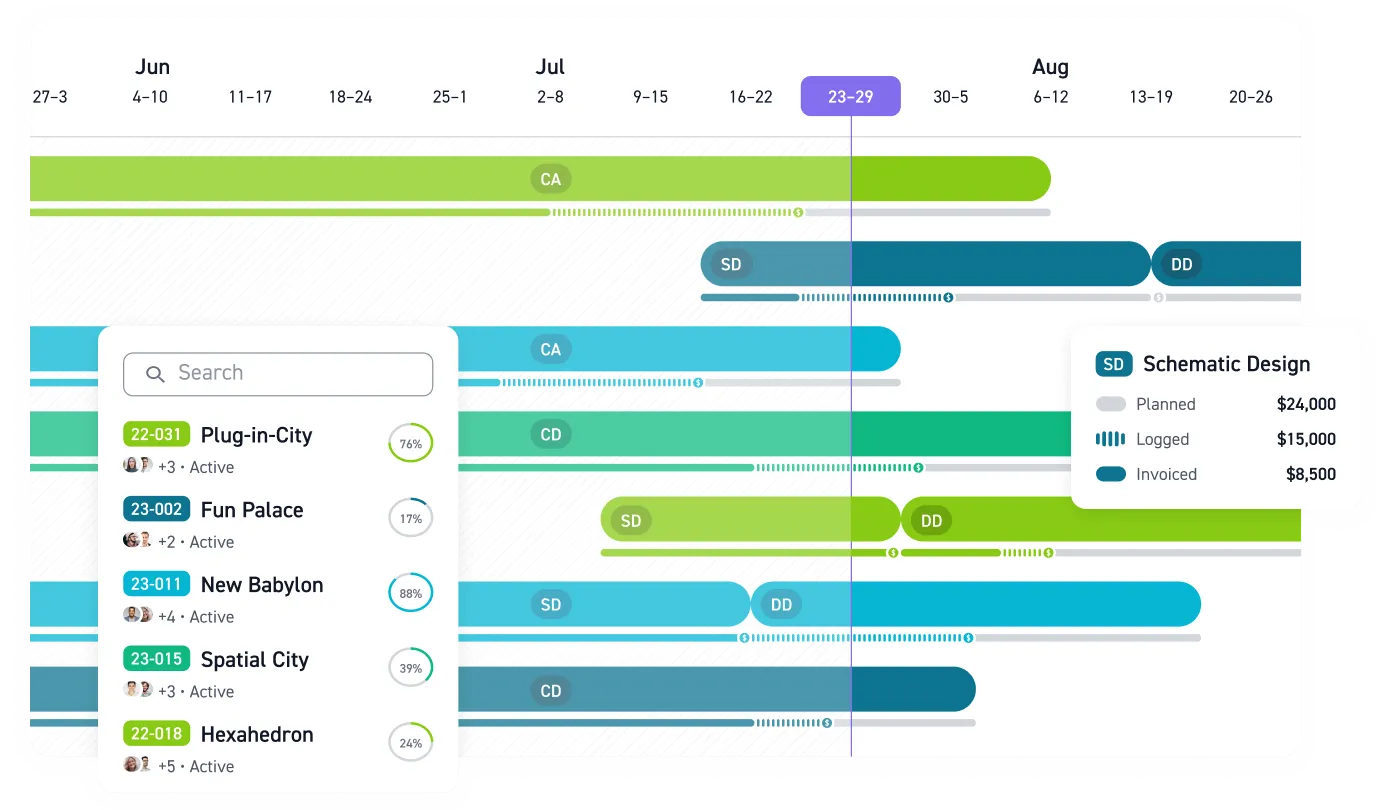
Used by 13,000+ architects and engineers across 1,800+ firms, Monograph connects phase budgets, time tracking, staff planning, billing tools, and real-time financial dashboards in a single system. Monograph's MoneyGantt™ helps teams see how planned fees move through logged, invoiced, and paid stages in one visual.
Real-time insights highlight the value of continuous visibility into utilization, capacity planning, and project profitability for managing billable time. In practice, that means teams can see phase-level drift earlier, check whether staffing still matches the budget, and catch billing delays before they turn into cash flow issues.
The value here is operational, not theoretical. A PM can review weekly staffing against phase budgets. An operations lead can see what is ready to bill and what is still stuck in draft. A principal can look across active work and spot which projects are healthy, which ones need a scope conversation, and which ones are simply carrying too much unbilled time.
The results show up in real numbers. Dynamic Engineering, an engineering firm that moved off Excel, reported 25% profit growth. Cascadia Architects reported 50% time saved on admin and 2x faster billing as a 19-staff firm case study. Garrison Architects reported 1.5x faster billing and achieved 2.5x faster payment.
Those results come from applying the same rigor engineers bring to technical work to how they track, bill, and get paid.
See Where Your Projects Are Losing Profit
If you're a principal, PM, or operations leader trying to run profitable projects without adding more administrative drag, the next step is straightforward: get your budgets, staffing, billing, and project visibility into one connected system. That's how you catch problems while there's still time to fix them.
Monograph gives A&E firms a practical way to manage the work behind the work. Instead of piecing together spreadsheets, time logs, invoices, and accounting data after the fact, teams can see project performance as it changes and act on it before margin disappears.
You can't afford to find out after the project ends. See how Monograph can help you track project profitability in real time and replace spreadsheet guesswork with a system built for A&E firms. Book a demo.
Frequently Asked Questions
What is the difference between utilization rate and realization rate?
Utilization measures how much of your team's available time is spent on billable work. Realization measures how much of that billable time actually converts to invoiced and collected revenue. A firm can run strong utilization but still lose money if realization is poor, which usually points to unbilled scope changes, written-off hours, or billing delays rather than an effort problem. Both numbers matter and they diagnose different things.
What is a good utilization rate for engineering firms?
The industry median sits around 81.9%, with healthy firms typically operating between 75% and 85% firm-wide. That target varies by role: job captains and project architects often run closer to 90%, project managers around 88%, and principals typically land around 72% given their business development and leadership responsibilities. Pushing utilization above 85% firm-wide can signal that non-billable work like QA, training, and internal coordination is getting cut, which tends to show up as quality or retention problems later.
Which financial metrics matter most for A&E firms?
The most important metrics include utilization and chargeability, overhead rate, effective multiplier, realization, and phase-level budget performance. The multiplier tells you how efficiently your labor cost converts to revenue. Overhead rate tells you what it costs to keep the lights on relative to direct labor. Tracking all of these together, rather than just watching project totals, is what separates firms that price confidently from those that guess.
How does phase-based tracking help project profitability?
Phase tracking gives you the ability to catch problems when there is still fee left to work with. If a project is 60% through schematic design but has burned 80% of the schematic design budget, you know that now rather than at the end. That visibility creates a choice: have the scope conversation, adjust staffing, or at minimum plan for what the remaining phases can realistically carry. Without phase-level data, the first signal that something went wrong is the final invoice.
Why does resource planning matter so much right now?
Backlog data shows nearly half of engineering firms are carrying more than a year of work on hand, while hiring timelines remain long. That combination puts capacity pressure on existing staff rather than adding headcount. Firms that plan staffing by phase and project, rather than by gut feel or weekly meetings, are better positioned to take on the right work at the right time without overloading the people they already have.
How can software improve engineering firm profitability?
Connected systems improve coordination by reducing the manual reconciliation between time tracking, project budgets, and billing. That reduction matters less for the time it saves and more for the decision lag it eliminates. When a PM can see phase-level performance against budget in real time rather than after month-end close, they have a window to act. That window is where profitable projects get protected.
How do I get my team to actually use project tracking systems?
Adoption usually fails when the tool adds work rather than removing it. The firms that see strong adoption tend to start with a single workflow, like time entry against project phases, and demonstrate that the output directly reduces manual reporting or billing prep. When a PM sees that logging time accurately means less time building the same status report every week, the behavior tends to stick. Buy-in from principals matters too: if leadership is reviewing phase performance in the same system, it signals that the data is worth capturing.