
Here's the truth most project management guides won't tell you: Budget at Completion isn't calculated through a formula. BAC represents your authorized baseline budget: the number you establish during project planning and measure against throughout execution. So the real question isn't how to calculate BAC, but how to establish one that actually reflects reality.
For A&E project managers juggling multiple projects, tight margins, and clients who expect precision, getting BAC right from the start determines whether you'll spend the next eighteen months firefighting budget overruns or confidently delivering profitable work. Research shows that 75% of A&E projects exceed their budgets with an average 28% cost overrun. This gap often traces back to inaccurate BAC establishment during planning. Getting BAC right requires three validation methods (bottom-up, parametric, and analogous estimation), accounting for the documented 19% utilization gap between planned and actual billable hours, and applying the PSMJ "10% rule" to budget project management overhead that's frequently overlooked.
Understanding What BAC Actually Represents
Budget at Completion (BAC) is defined as the total authorized budget for accomplishing the project scope of work. For architecture and engineering firms, this means BAC is your approved project budget established during the proposal or contracting phase. It is the benchmark against which project performance is measured from the start through final close-out.
This distinction matters because BAC serves as the foundation for every Earned Value Management metric you'll use to track performance. Your Earned Value calculation depends on it: EV equals BAC multiplied by percent complete. Your Estimate at Completion forecasts depend on it. Your variance analysis depends on it.
When BAC is inaccurate at establishment, every downstream metric inherits that inaccuracy. Research analyzing construction and engineering projects found that 75% exceeded their budgets with an overall average cost overrun of 28%. Much of this stems from flawed baseline budgets rather than execution failures.
Three Methods for Building an Accurate BAC
According to AIA's practice guidance, after considering effort, risk, and value, you should build a fee three different ways by combining bottom-up estimating, parametric estimating, and analogous estimating to validate your project budget numbers.
- Bottom-up estimating breaks down work by individual staff members and deliverables, then aggregates to determine phase budgets. This approach captures coordination time, quality reviews, and client communication that simplified methods overlook. According to the AIA's official practice guidance on setting fees, bottom-up estimates "tend to be higher than other methods because all effort and risk is considered."
- Parametric estimating uses statistical relationships from historical data: cost per square foot, labor hours per drawing sheet, or percentage of construction cost for design phases. ENR's Cost Data Dashboard provides Construction Cost Index and Building Cost Index data across 20 cities and national averages for regional calibration.
- Analogous estimating applies expert judgment from similar past projects, adjusted for differences in scope, complexity, and market conditions. This works best during proposal development when detailed project information is limited.
When these methods produce significantly different results, that's valuable information. The gap between your bottom-up estimate and your parametric benchmark reveals where your assumptions need scrutiny—whether your labor hour estimates are realistic, whether your historical cost data applies to the current project, or where market conditions have shifted.
The 10% Rule: Allocating Budget for Project Management
One consistent finding across industry research: A&E firms systematically underestimate project management overhead. PSMJ Resources recommends designating 10 percent of your project budget specifically for project management tasks.
This allocation covers activities that don't produce deliverables but consume significant hours: project coordination, client communication, internal team meetings, schedule management, and quality control reviews: roughly half a day per week for a typical project.
The math compounds quickly. Benchmarking data shows the average A&E firm bills only 81% of staff time, meaning 19% of hours are non-billable due to administrative, coordination, and support activities. When project managers estimate labor costs assuming 100% productivity without accounting for this non-billable time, they systematically underestimate actual resource consumption. For a project with $500,000 in planned labor costs, that $500,000 only represents the billable portion: the true resource cost is approximately $617,000 ($500,000 ÷ 0.81), representing roughly $117,000 in unaccounted effort.
Structuring BAC by Design Phase
Standard design phases should drive your BAC structure. Some practitioners and secondary sources commonly allocate design fees across four main phases approximately as follows, though these ranges do not come from AIA's Basic Services guidance, which does not specify percentage allocations by phase:
- Schematic Design: 15-20% of design fee
- Design Development: 20-25%
- Construction Documents: 40-50%
- Construction Administration: 15-20%
Adjust these percentages based on project complexity, but maintain the phase structure. This granularity allows early detection of budget problems rather than discovering overages during final billing. When your SD phase burns through a larger percentage than planned, that's an early warning signal, not a final verdict.
Phase-based structure also supports formal change control processes. Research confirms that without a formal change management system, engineering projects are vulnerable to scope creep, as a lack of review and approval processes may allow extra tasks to be added continuously.
Using BAC to Monitor Performance
Once established, BAC becomes your anchor for Earned Value Management calculations. Two indices matter most for tracking performance against your BAC:
- Cost Performance Index (CPI): Earned Value divided by Actual Cost. A CPI of 0.90 means you're spending $1.11 for every $1.00 of value earned—a 10% cost overrun.
- Schedule Performance Index (SPI): Earned Value divided by Planned Value. An SPI of 0.94 means you've completed 94% of planned work value at this point—you're falling behind schedule.
These indices feed directly into Estimate at Completion calculations. The standard formula—EAC equals BAC divided by CPI—tells you where the project is heading based on demonstrated performance rather than optimistic assumptions.
Real-Time Visibility Changes Everything
Real-time budget monitoring transforms how A&E project managers control costs. Woodhull, a 25-person architecture firm in Maine, reduced their budget overages by 66% after implementing real-time budget tracking with Monograph, showing that into BAC performance directly translates to improved project profitability.
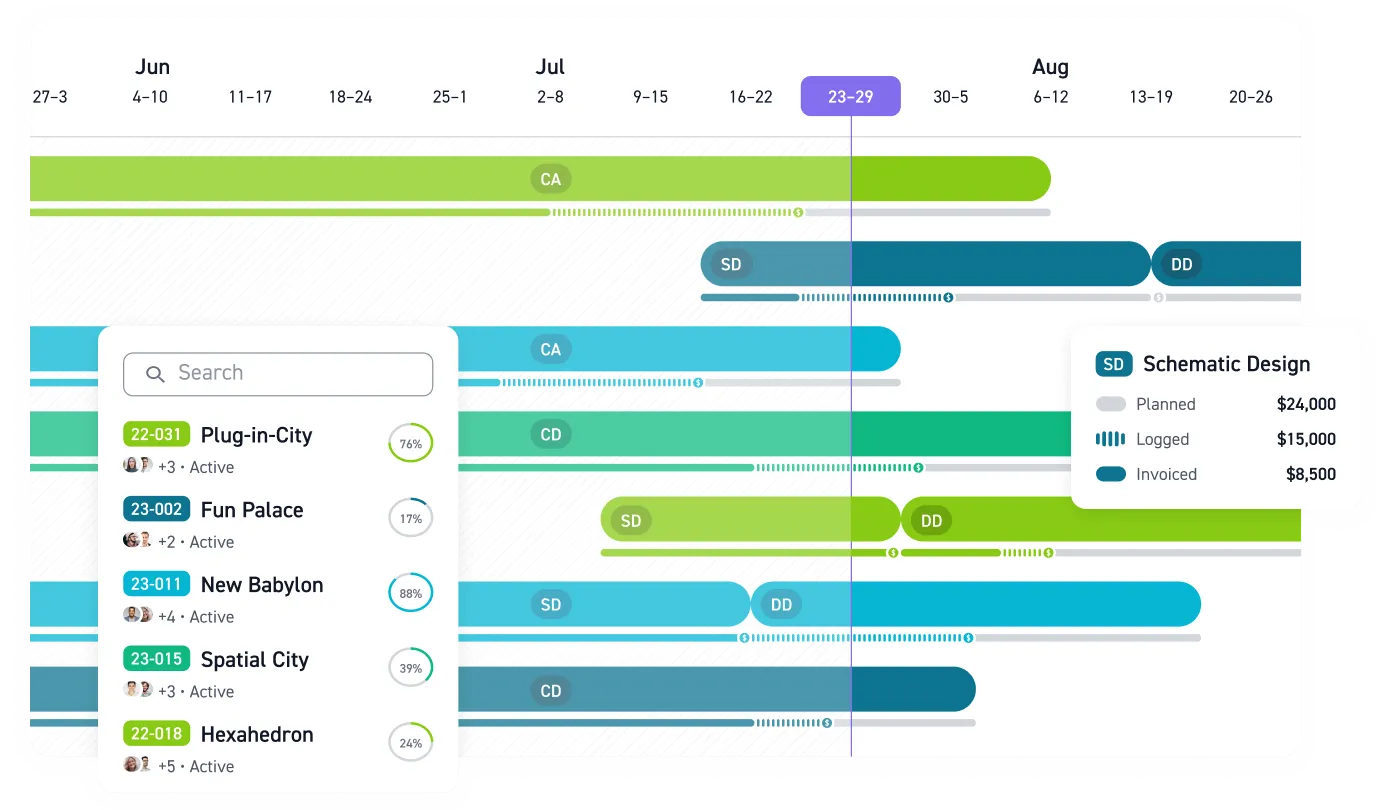
Monograph's signature MoneyGantt™ displays budget-to-cash progression in real time, giving you instant visual intelligence into project financial performance. The platform structures tracking around design phases, supports the 10% rule through non-billable time budgeting, and integrates with QuickBooks Online to eliminate data fragmentation that delays financial insight.
The pattern we see across successful firms is consistent: establish accurate BAC through multi-method estimation, account for non-billable time, and monitor deviations in real-time. That's how you spend less time explaining overruns and more time delivering profitable work.
Stop Budget Overruns Before They Start
Every project that blows its budget started with a flawed BAC. You've seen the pattern: rushed proposals, optimistic assumptions, and the slow realization that you're subsidizing the project from other work.
Monograph gives A&E firms the visibility to establish accurate BACs and catch deviations before they become disasters. Real-time phase tracking, utilization monitoring, and the 10% rule built into your workflow, not another spreadsheet to maintain.
Your next project deserves a realistic baseline. Book a demo.
Frequently Asked Questions
How often should I revisit my BAC during a project?
BAC is your baseline. It shouldn't change unless scope formally changes through a contract modification. Monitor variance against BAC through EVM metrics like CPI and SPI weekly during active phases.
What do I do when my three estimation methods produce wildly different numbers?
That gap is telling you something. When bottom-up exceeds parametric by 20%+, your labor assumptions need scrutiny. When analogous exceeds bottom-up, your historical comparisons may not reflect current market conditions. Investigate the largest discrepancy first.
Should consultant fees be included in my BAC?
Yes. Your BAC should represent total authorized project budget, including consultants. Track them separately within your budget structure so you can monitor their performance independently.
How do I justify the 10% project management overhead to clients who push back on fees?
Build it into your phase allocations rather than showing it as a separate line item. Firms that don't budget for it don't stop doing it, they absorb the cost and wonder why their margins are thin. The 10% accounts for real hours every project consumes.
.png)