


Firm management made easy

Every A&E firm owner has heard the question "Do we have the capacity to take on this project?" It sounds like a simple one. But industry experience shows this question actually makes or breaks firms. Behind that question lies the difference between profitable growth and costly chaos. You're calculating team availability and project timelines. Meanwhile, competitors with better capacity planning are winning work, retaining talent, and building sustainable practices.
Business capacity planning is more than just keeping people busy. It's about aligning your team's skills and availability with project demands to improve both profitability and job satisfaction. For architecture and engineering firms, this creates a unique challenge: balancing fixed-fee projects with specialized expertise, managing paused projects, and maintaining quality standards under financial pressure.
The Capacity Reality Check
Successful A&E firms operate differently than many assume. The median utilization rate is 81.9%, with healthy firms maintaining 75-85% overall utilization. The highest-performing firms reach 95.2% average utilization. Yet this extremely high rate comes with important trade-offs. While seemingly impressive, firms focusing on maximizing individual utilization rates often sacrifice profitability compared to high-performers that prioritize team stability. Firms benefit more from the 75-85% range than chasing 95%+ targets.
Utilization does not equal profitability. Maximizing billable hours doesn't necessarily create the most profitable firms. Instead, high-performance firms prioritize team stability over constantly reshuffling staff to hit utilization targets.
The capacity metrics that actually matter include several key performance indicators that distinguish thriving practices from struggling ones:
- Team stability metrics: How long teams stay together versus constant reshuffling
- Project delivery consistency: Meeting deadlines and budgets across multiple projects
- Revenue per employee productivity: Not just billable hours, but profitable output
- Client satisfaction and repeat work rates: Sustainable relationships over transactional projects
These metrics shift the entire conversation from "how busy are we?" to "how effectively are we deployed?"
Role-Based Capacity Reality
Firm-wide utilization averages mask critical role-based differences that small to mid-size firms must acknowledge. Indirect labor represents 39.7% of your overhead, your single largest cost. This reality means expecting everyone to maintain identical utilization rates ignores basic business math.
Realistic utilization targets should reflect actual responsibilities:
- Principals and owners: 50-70% utilization, focused on business development, strategic planning, and team leadership
- Project managers: 70-80% utilization, balancing mixed billable project work with coordination activities
- Production staff: 80-90%+ utilization, handling predominantly billable technical work and design
- Specialized consultants: Variable based on project pipeline and expertise demand
Accepting these differences prevents the common mistake of pressuring principals to bill more hours when their highest value lies in strategic work that drives firm growth.
Note: These targets reflect industry benchmarks and should be interpreted as role-based guidelines within an overall firm-wide 75-85% utilization target. Research emphasizes team stability and project outcomes matter more than maximizing individual utilization rates.
Building Sustainable Capacity Frameworks
The most effective capacity planning frameworks recognize that A&E work differs fundamentally from other professional services. A&E project challenges include unexpected pauses, scope changes requiring different expertise, and regulatory requirements that create bottlenecks pure scheduling cannot solve.
Successful firms use a Capacity Budget Template that bridges high-level financial planning with operational resource allocation. This template allows firms to develop annual budgets based on realistic firm capacity rather than aspirational revenue targets. It flows company-wide budgets down to individual business units or practice areas.
Proven capacity frameworks incorporate these essential elements:
- Skills inventory management: Documenting who can do what type of work at what level, with role-specific utilization baselines. Principals maintain 50-70%, project managers 70-80%, and production staff 80-90%+ billable rates.
- Pipeline visibility: Understanding project probability and timing beyond just signed contracts. This includes paused projects and timeline shifts that create utilization gaps.
- Buffer capacity planning: Maintaining 75-85% overall firm utilization rather than maximizing to 95%+. This accommodates team stability, non-billable essential work, and unpredictable project changes.
- Cross-training strategies: Reducing bottlenecks by developing overlapping capabilities within teams. This maintains stable team structures rather than constant staff reshuffling to chase utilization targets.
These frameworks prevent firms from experiencing the feast-or-famine cycle that destroys both profitability and team morale. For small to mid-size firms, capacity miscalculations have proportionally greater impact on smaller practices, making systematic planning essential rather than optional.
Technology's Strategic Role
Technology helps you see what's happening, but it won't fix bad processes. Analyzing hundreds of firms reveals four key areas that separate mature firms from those still struggling with capacity planning: people, processes, tools, and culture. Technology represents one critical component of a complete approach.
The research distinguishes mature firms where "project managers and firm decision-makers have the insight they need into resource utilization and availability to be consistently on-point with deployment decisions, forecasting and planning" from less mature firms lacking systematic visibility.
However, industry data reveals a critical gap. 54% of high-performing architecture firms identified financial planning as their top process to modernize. Yet only 40% planned to invest in project management software. This recognition-implementation gap suggests firms struggle to prioritize technology investments that actually improve capacity management.
Woodhull, a 25-person architecture firm in Maine, addressed this gap by transitioning from BQE Core to integrated practice management. They achieved 66% time saved on admin and 50% faster billing processes that transformed their capacity visibility.
Essential technology capabilities for capacity planning include:
- Real-time visibility: See current resource utilization and staff availability without waiting for reports
- Integrated data systems: Connect project management with financial and business systems for complete visibility
- Forecasting capabilities: Predict future capacity needs based on pipeline development and project demand
These capabilities work together to give you the visibility needed for confident capacity decisions.
Making This Work in Practice
Start with process improvements before technology investments for small to mid-size firms. Clear resource allocation processes, documented decision-making frameworks, and regular capacity review meetings often provide more immediate impact than software purchases. The goal is building organizational muscle for capacity-based decisions rather than reactive project acceptance.
Successful implementation follows this progression:
- Start by understanding where you are now: Evaluate current maturity across people, processes, tools, and culture
- Find the easiest wins first: Address highest-impact gaps requiring minimal technology investment
- Get your processes documented: Document how resource allocation decisions are made and communicated
- Add technology that supports what you're already doing: Implement tools that support established processes rather than forcing new ones
This way, each step you take actually builds on what's working instead of creating more problems. The key insight is that maturity development represents a progression, not a single implementation project.
For firms just beginning this journey, prioritize team stability and foundational capacity management over aggressive utilization targets. Healthy small to mid-size A&E firms should target 75-85% overall firm-wide utilization. This accommodates necessary non-billable work including business development, professional development, and administration while supporting sustainable growth.
Before implementing complex forecasting systems, focus on building capacity intelligence through three foundational elements: understanding who in your firm can do what, tracking when team members are available, and maintaining visibility into how current projects are progressing. This foundation of people, processes, and basic tools allows more effective resource allocation decisions than advanced systems applied without this groundwork. Even small improvements in capacity planning efficiency translate to significant financial impact across an industry of this size.
Stop Guessing About Capacity. Start Seeing It.
You know the frameworks. You understand the role-based targets. You've read about team stability mattering more than maximizing utilization rates. The question isn't whether capacity planning matters. It's whether you can actually see what's happening across your projects right now.
Most A&E firms piece together capacity intelligence from disconnected systems. Timesheets live in one place, project budgets hide in spreadsheets, and resource allocation exists in someone's head. By the time you compile the data, it's already outdated. You're making Monday morning capacity decisions based on Friday's guesswork.
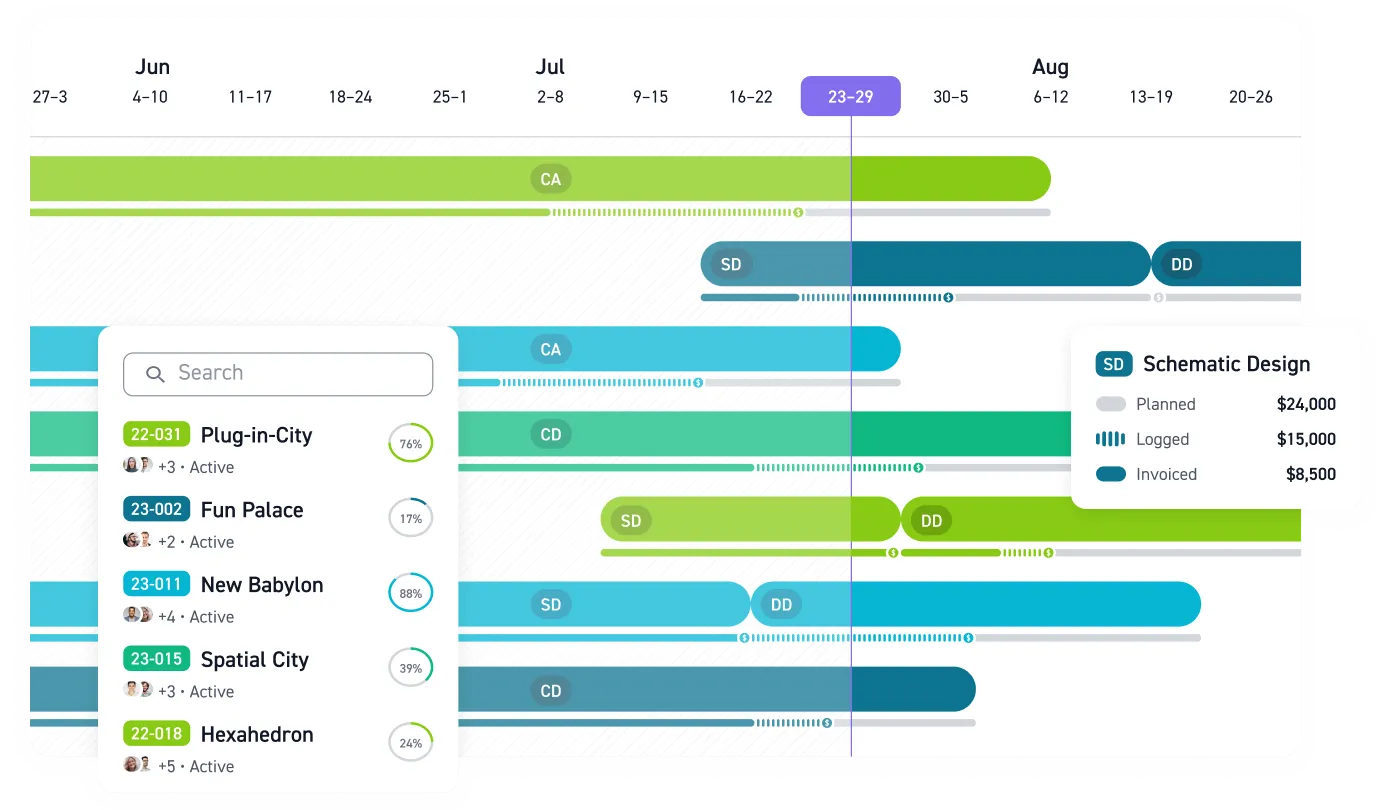
Monograph gives project managers, operations leaders, and principals the real-time capacity visibility that transforms reactive decisions into strategic planning. Over 13,000 architects and engineers across 1,800+ firms use Monograph to gain the capacity visibility that transforms reactive decisions into strategic planning. Monograph's signature MoneyGantt™ connects project timelines directly to budget performance and team allocation. It shows you which projects are consuming capacity, which team members are approaching burnout, and where you have room to take on new work.
See role-based utilization in real-time. Principals maintain their 50-70% targets while focused on business development. Project managers balance 70-80% billable work with coordination activities. Production staff optimize their 80-90%+ technical hours. Track team stability instead of constantly reshuffling people to chase utilization percentages. Identify capacity problems before they become project crises.
The platform connects your existing workflows from time tracking to financial forecasting into unified capacity intelligence that actually helps you make better decisions. No more spreadsheet archaeology. No more guessing which projects can absorb additional scope. No more wondering if you have capacity for that Monday morning opportunity.
Your competitors already have the capacity visibility you're hunting for in spreadsheets. Close the gap. Book a demo.
Frequently Asked Questions
How do I implement role-based utilization targets without causing team friction?
Start by explaining the business reality behind different targets. Principals at 50-70% need time for strategic work that drives firm growth, while production staff at 80-90%+ focus on billable technical delivery. Frame these targets as recognizing different value contributions rather than creating hierarchy. The key is transparency about how non-billable work supports everyone's success.
Introduce targets gradually rather than announcing firm-wide changes overnight. Begin by tracking current utilization patterns for 4-6 weeks to establish baselines. Then have individual conversations about what realistic targets look like for each role. Most team friction comes from surprise policy changes, not the actual targets themselves.
Make sure your project management system can track and display role-based metrics without manual calculation. When people can see their own utilization data in real-time, they understand the targets better and take ownership of managing their mix of billable and non-billable work.
Should I start with technology or process improvements for capacity planning?
Start with process improvements, but don't delay technology indefinitely. Document your current resource allocation decisions. Who decides project staffing? What information do they need? How do teams communicate availability? Once you understand your actual workflows, technology becomes the tool that executes them efficiently rather than forcing you into someone else's process.
The recognition-implementation gap is real. 54% of high-performing firms identify financial planning as their top modernization priority, yet only 40% invest in the tools that actually deliver visibility. Small firms often wait too long, assuming they'll "figure out the process first" while competitors gain ground with integrated systems.
If you're spending more than two hours weekly compiling capacity reports from spreadsheets, you've already crossed the threshold where technology delivers immediate ROI. The key is choosing platforms built for A&E workflows that support your processes rather than forcing artificial ones.
What if my small firm can't afford dedicated capacity planning time?
You can't afford not to plan capacity. The cost of accepting projects without available resources, burning out key staff, or missing profitable opportunities far exceeds the time investment in basic capacity management. Start with 30-minute weekly check-ins focused on three questions: What projects are consuming more capacity than planned? Which team members are overloaded? Where do we have capacity for new work?
Small firms actually need capacity planning more than large ones because losing a single senior person or misjudging one project's resource requirements has proportionally greater impact. You don't need complex forecasting models. You need visibility into current utilization and near-term project demands.
The right technology makes capacity planning manageable even for small teams. Automated timesheet assignment based on project plans, real-time utilization dashboards, and integrated budget tracking eliminate most manual work. Firms report that moving from spreadsheet-based tracking to integrated systems reduces capacity management time by 60-70% while actually improving decision quality.
How do I balance team stability with hitting utilization targets?
Team stability matters more than maximizing utilization rates. Research shows high-performance firms prioritize keeping teams together over constantly reshuffling staff to chase billable hour targets. The question isn't whether to sacrifice stability for utilization. It's recognizing that stable teams operating at 75-85% overall utilization outperform unstable teams pushed to 95%+.
Maintain core project teams throughout entire project lifecycles rather than pulling people onto other work the moment a phase slows down. Yes, this might mean someone bills 70% one week while waiting for client feedback, but you preserve the project knowledge and team dynamics that prevent costly mistakes and rework.
Buffer capacity, that 15-25% non-billable time, isn't wasted. It absorbs the unpredictable nature of A&E work. Projects pause unexpectedly. Scope changes require expertise shifts. Regulatory reviews create bottlenecks. Firms that build buffer capacity into their planning can accommodate these disruptions without destroying team stability or forcing constant staff reallocation.
What's the fastest way to get visibility into current capacity without disrupting projects?
Start with automated timesheet assignments based on your existing project plans. If you already have projects scheduled with staff allocations, use those plans to pre-populate weekly timesheets. Team members confirm or adjust their hours rather than starting from scratch. This gives you immediate visibility into planned versus actual capacity consumption.
Connect your time tracking to project budgets in real-time. The moment someone logs hours, you should see updated project budget performance and remaining capacity. This eliminates the monthly ritual of compiling timesheet exports, matching them to project budgets in spreadsheets, and discovering problems weeks after they occurred.
Implement role-based utilization tracking that distinguishes principals (50-70% targets), project managers (70-80%), and production staff (80-90%+). When you can see utilization by role rather than just firm-wide averages, capacity problems become obvious. Principals billing too many hours instead of developing business. Production staff underutilized while project managers are overwhelmed. Real-time visibility turns these patterns from quarterly surprises into weekly course corrections.