

Minimalist architecture looks effortless. Executing it is anything but. Every exposed surface, every flush joint, and every material transition carries the full weight of the design. There is no ornament to absorb a tolerance deviation and no layered finish to hide a substitution. For firm principals and project managers, that means minimalist projects demand a different kind of discipline, from schematic design through the final punch-list walk.
Several Traditions, One Design Discipline
Minimalist architecture did not emerge from a single movement. It draws from minimalist roots, the geometric abstraction of the De Stijl legacy, the industrial material logic of the Bauhaus school, and the spatial restraint of Zen philosophy and traditional Japanese design. Together, these traditions shaped a design discipline built around reduction. Ludwig Mies van der Rohe popularized radical reduction, but in practice minimalism means design distilled to essential form, where every element must justify its presence.
Core Principles
Across canonical works, a few principles consistently define minimalist architecture. Each one shapes how projects get documented, detailed, and delivered:
- Reduction to essential elements. Every component serves a purpose, and every element earns its place.
- Dissolution of boundaries. Mies used glass to blur boundaries between interior and exterior. Ando reworked this through the mediation of nature, bringing the built environment and the natural world together.
- Material honesty. Architectural criticism describes Ando's ambition to develop a material's intrinsic character to its highest expressive level. The structural system becomes the ornament.
- Light as spatial medium. From Ando's Church of the Light to Mies's glass pavilions, natural light functions as a spatial material.
- Structural clarity. The Seagram Building's added vertical elements were welded to the window panels for articulation. The structure becomes the expression.
Taken together, these principles raise the tolerance bar for execution precision.
Measurable Benefits for the Built Environment
The performance case for minimalist architecture reaches well past aesthetics. Simplified building forms can produce outcomes that matter for client proposals, sustainability reporting, and long-term asset value.
Building envelope research has documented thermal defects affecting 6 to 18 percent of wall area in the buildings inspected, with thermal bridges among the most common heat-loss paths. Construction and demolition activity also generates over 40 percent of the U.S. solid waste stream. Industry guidance positions simple, durable, low-maintenance materials as a core strategy for longer building life and avoiding the global warming potential of new manufacturing.
Embedding sustainability in buildings can produce a 50 percent or greater increase in asset value over the life of the investment, and energy-efficiency analysis points to roughly $2 in savings for every dollar invested in upgrades. Those are the kinds of numbers that belong in client proposals.
Built Precedents Worth Studying
The strongest built examples of minimalist architecture are also case studies in execution discipline.
- Mies van der Rohe's Barcelona Pavilion demonstrated how a free plan anchored by a steel column grid could turn marble, glass, and water into spatial dividers rather than enclosures.
- Tadao Ando's Church of the Light concentrates its architectural argument in a cross-shaped opening cut into the sanctuary wall. Ando initially wanted to omit the glass entirely to intensify the connection to the Pantheon's oculus. Climate conditions made that unacceptable, but the ambition reveals the discipline.
- SANAA's New Museum offers an instructive precedent for firms working within real budgets. The original plan called for each stacked box to be clad in a different metal with hairline joints, but that approach proved over budget. SANAA shifted to a rougher expression, a contextually adapted minimalism the canonical record treats as a design decision rather than a failure.
These examples matter because minimalist architecture succeeds or fails in detailing, cost control, and construction discipline.
The Practice Management Reality
Minimalist projects carry execution risks that conventional projects absorb more easily. With every surface exposed and every joint visible, tolerance demands translate directly into fee exposure and staffing decisions.
Designers working in this tradition have long argued that construction is inherently imprecise and that tolerance failures matter more in minimalist work. In that context, an un-level floor can undermine the whole result. Construction administration on minimalist projects often requires more site observation than comparable conventional work, and CA fee allocations should reflect that reality from the proposal stage. Material selection carries outsized risk when only a few materials carry the entire design, which is one reason professional training on materials treats specification as far from simple. Specification should begin in Schematic Design, with supplier lead times and mock-ups treated as fee-bearing milestones.
Scope creep is especially destructive in minimalist work:
- Premium baselines amplify additions. Tight tolerances and custom fabrication mean mid-project changes can create disproportionate cost impact.
- Additions conflict with the philosophy. A client's instinct to add or upgrade often compromises the space.
- Budget disruptions are harder to absorb. Architects may still look for ways to improve cost decisions, but there is less room to hide substitutions.
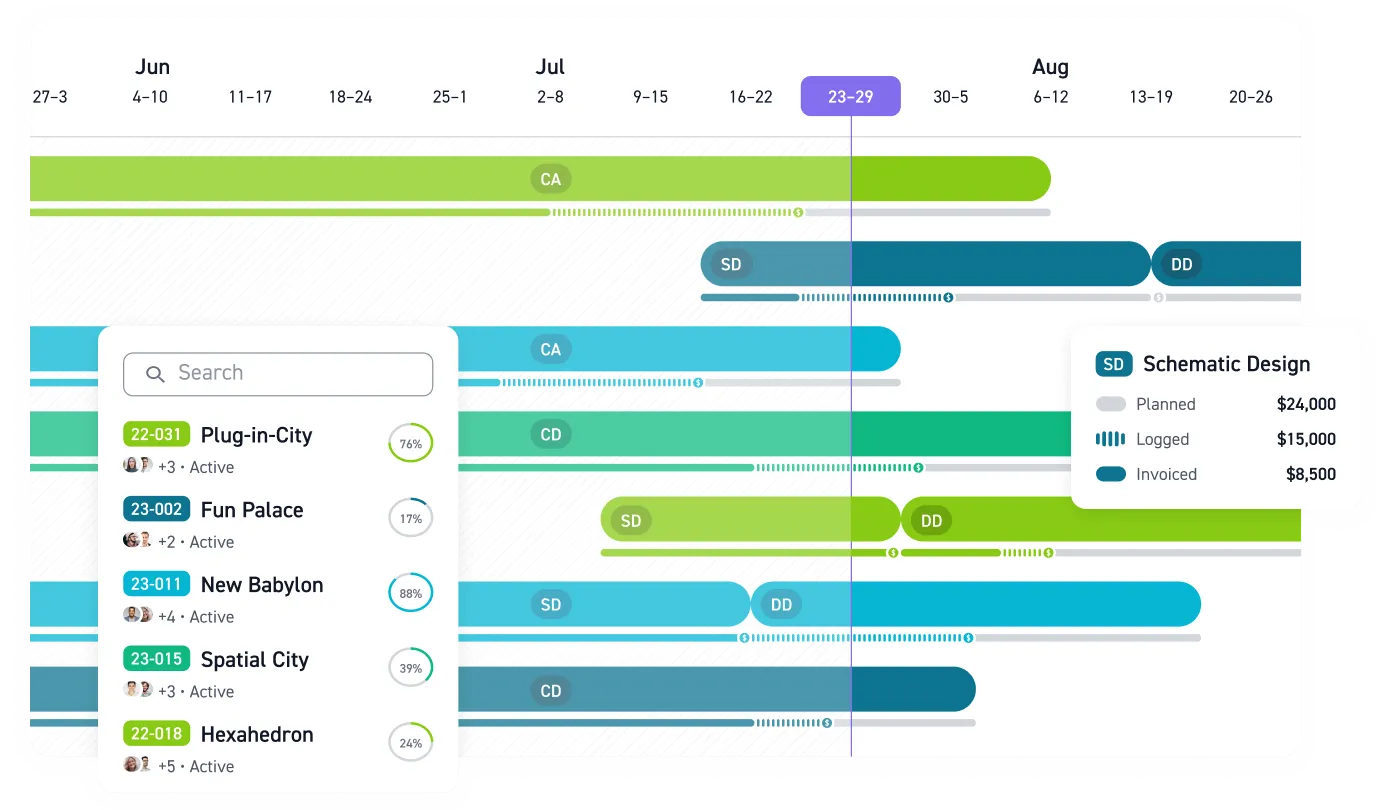
Phase-level budget tracking is essential because CA hours can exceed initial allocations and a single material substitution can undermine design intent. Strong budget visibility helps PMs catch scope drift before it turns into a billing problem. One 30-person California firm reported 8x faster staffing and 75 percent fewer unbilled fees after consolidating tracking onto a single platform.
Where the Discipline Is Heading
Recent awards point to design priorities that translate well to small and mid-size firms. Contextual minimalism, materials-forward design, and adaptive reuse work at any budget level when paired with design clarity and the project discipline to deliver them.
- Materials-forward minimalism. HDR's Mountain Line Downtown Connection Center received Southwest recognition from a major industry publication and was noted for its use of mass timber.
- Contextual minimalism at small scale. A recent Small Project Award honored several firms for design excellence.
- Adaptive reuse as minimalist practice. Recent fellowship citations pair minimalism with reclamation, signaling that the profession increasingly recognizes transformation of existing structures as a design discipline.
For firms at any scale, the throughline is straightforward: minimalist architecture demands precision on-site, and the same standard should apply to project operations.
See Budget Risk Before It Shows Up on Site
Minimalist work raises the cost of every missed hour, late material decision, and untracked scope addition. When design depends on tight tolerances and exposed execution, principals and PMs need the same clarity in staffing, phase budgets, CA burn, and substitutions.
Monograph helps A&E firms see where time is slipping outside the baseline, where fees are getting exposed, and when scope drift is turning into a billing problem. Monograph's MoneyGantt™ and financial timeline give teams real-time visibility to catch overruns early, while stronger scope controls keep the work aligned with the original design intent.
Pick a platform built for architects and engineers. Book a demo.
Frequently Asked Questions
Is minimalist architecture always more expensive?
Not always, but it is less forgiving. Simplified forms can support performance, durability, and long-term asset value. Exposed surfaces, tight tolerances, and custom fabrication raise execution risk quickly, so the pricing premium often shows up in coordination time and finish work rather than the building program itself.
Why does construction administration matter more on minimalist projects?
Small deviations stay visible. Every surface, joint, and transition carries more visual weight when there is no ornament to absorb errors. CA hours often exceed initial allocations on minimalist projects, which is why fee proposals should reflect heavier site observation from the start.
When should material selections be locked in?
Early. When only a few materials carry the entire design, specification cannot wait until Design Development. Lead times, mock-ups, and detailing decisions should be built into the schedule starting in Schematic Design.
Can small firms deliver minimalist architecture without luxury-level budgets?
Yes, if the design is disciplined and the project is managed with the same discipline. Contextual minimalism, materials-forward design, and adaptive reuse all point in that direction and show up regularly in recent small-project awards.
How do you protect minimalist design intent when clients keep adding scope?
Treat every addition as a design, fee, and coordination problem. Track phase-level budgets closely, catch scope drift early, and evaluate each request against the original concept before accepting it.