

.png)

Firm management made easy

Every A&E project manager knows the feeling: a client asks for "just one more option," a stakeholder requests "a quick revision," or an owner decides mid-project that the program needs to change. Individually, these requests seem minor. Collectively, they destroy profitability and expose firms to professional liability risk. Scope creep is like a building with no foundation wall. Small cracks eventually bring down the whole structure.
Research shows 52% of projects across industries experience scope creep, making it one of the most persistent challenges in project management practice. For firms working fixed-fee contracts, every hour of uncompensated work erodes margins that are already tight. The difference between profitable projects and budget disasters often comes down to how systematically you manage scope boundaries.
Start with Crystal-Clear Contract Documentation
The foundation of scope creep prevention is thorough contract documentation that explicitly defines deliverables, exclusions, and assumptions. Vague scope language creates ambiguity that clients naturally interpret in their favor. Effective scope documentation includes:
- Detailed scope matrices showing deliverables, iteration limits, level of detail, and submission formats
- Clear exclusion lists stating what is NOT included in base scope
- Documented assumptions about site conditions, client-provided information, and regulatory requirements
- Review timelines with consequences for client delays outside the design team's control
These elements work together to create contractual clarity that prevents misunderstandings before they become disputes.
Implement Formal Change Management with Written Authorization
Informal scope expansion kills profitability. Firms with disciplined change order processes capture 95% more additional services revenue than firms relying on informal arrangements.
Require standardized change request forms documenting the requested change, reason, schedule impact, fee impact, and authorization signatures. To keep approvals moving efficiently, we've found tiered thresholds work best:
- Project manager approval for requests under $5K
- Principal approval for $5K-$25K
- Formal client authorization for requests over $25K
This structure ensures appropriate oversight without creating bottlenecks that frustrate clients or slow down projects. Issue written confirmation within 48 hours of any verbal scope discussion.
Conduct Structured Kickoff Meetings with Decision-Makers
Projects with structured kickoff meetings involving all decision-makers experience 40% fewer scope disputes during execution. Schedule kickoffs within two weeks of contract execution and require attendance from client decision-makers, key consultants, and internal design team leads.
Present the detailed scope matrix, project schedule, and communication plan. Most importantly, review your change management process and obtain explicit agreement on how scope changes will be handled. Distribute meeting minutes within 48 hours and require explicit confirmation from all attendees.
Establish Progressive Documentation and Approval Gates
The design process moves through distinct phases, including Schematic Design, Design Development, Construction Documents, and Construction Administration, each serving as a formal approval gate where scope must be locked before proceeding. Think of design phases like concrete pours: once it's set, changes become exponentially expensive.
According to Architectural Record's analysis, firms requiring formal written approvals at each design phase reduce late-stage revisions by 60%. Before proceeding to the next phase, obtain signed approval documenting that previous phase deliverables meet client expectations. Your contract should explicitly state that revisions to previously approved phases constitute additional services, following the AIA B101-2017 framework.
Invest in Proactive Client Education
Scope creep most frequently occurs with clients unfamiliar with the design and construction process. Research shows firms investing in client education at project outset reduce scope disputes by up to 50%. This investment takes several forms:
- Written guides explaining the design process, decision timelines, and cost implications of changes
- Decision schedules identifying when key decisions must be finalized
- Visual presentations showing the "cost of change curve," illustrating how modifications become exponentially more expensive as projects progress
- Process diagrams illustrating dependencies between decisions and design phases
First-time clients especially benefit from understanding that design is a sequential process where early decisions constrain later options.
Track Progress Weekly and Flag Variances Immediately
You can't manage what you can't see. If you've ever discovered at month-end that a project went 40 hours over budget, you know the sinking feeling. Research shows that only about 58% of projects meet their original goals. Scope creep and poor cost management are primary factors.
Implement weekly status reviews comparing work performed against contracted scope. Track hours by task against budget allocations to identify scope expansion patterns before they compound. When you spot a team member spending hours on work outside the defined scope, address it immediately, not at month-end when the damage is already done.
Define Decision-Making Authority Clearly
We've all experienced this: you receive three contradictory change requests from three different people at the client's organization, and suddenly you're in the middle of their internal politics. PSMJ Resources identifies unclear decision-making authority as a leading cause of scope creep.
Designate a single point of contact on the client side with authority to approve scope and changes. Document in your contract that direction from other parties requires POC confirmation. Politely redirect unauthorized requests: "I've documented your request and will discuss with [Client PM] to determine if this is within our current scope."
Validate Scope at Every Client Interaction
Begin each client meeting by reviewing the agenda against contracted scope and project phase objectives. When clients request work outside defined scope, identify it immediately: "That's an excellent idea, and it would be Additional Services under our agreement. Let me prepare a scope and fee proposal."
Your instinct as a designer might be to accommodate the request. But that instinct is costing your firm money. Train your design staff to recognize and flag scope expansion requests rather than simply accommodating them in the name of client service.
Structure Fees with Allowances and Contingencies
Some project components have inherently uncertain scope, including entitlements requiring unknown revision cycles and engineering analyses dependent on field conditions. Just as you build structural redundancy into a building, build financial redundancy into your fee structure.
Include allowances for activities with unpredictable iteration requirements (e.g., "fee includes up to 3 reviews with Planning Commission; additional reviews at $X per meeting"). Establish unit prices for repetitive work items that may vary in quantity.
Firms building 5-10% scope contingencies into fixed-fee proposals are more profitable. Structure fees to front-load early phases where scope is most likely to expand, protecting your firm when the inevitable "we need to explore more options" request arrives.
Build Real-Time Budget Visibility
Most firms don't know they're bleeding money until the project is over. With most A&E firms lacking real-time budget visibility, many discover cost overruns only after profitability damage occurs. Implement phase-based budget monitoring that reveals cost overruns while corrective action remains viable. Weekly budget burn monitoring and living forecasts transform scope management from monthly post-mortems to proactive intervention. Woodhull, a 25-person Maine architecture firm, implemented phase-based budget monitoring and reduced budget overage by 66% while achieving 50% faster billing, demonstrating how real-time visibility directly protects project margins from scope creep.
Stop Scope Creep Before It Destroys Your Margins
The strategies above work, but only if you can see what's happening on your projects in real time. Most firms discover scope creep at month-end, when the damage is already done. Real-time budget visibility lets you catch scope expansion the moment it starts, not after it's eaten through your profit.
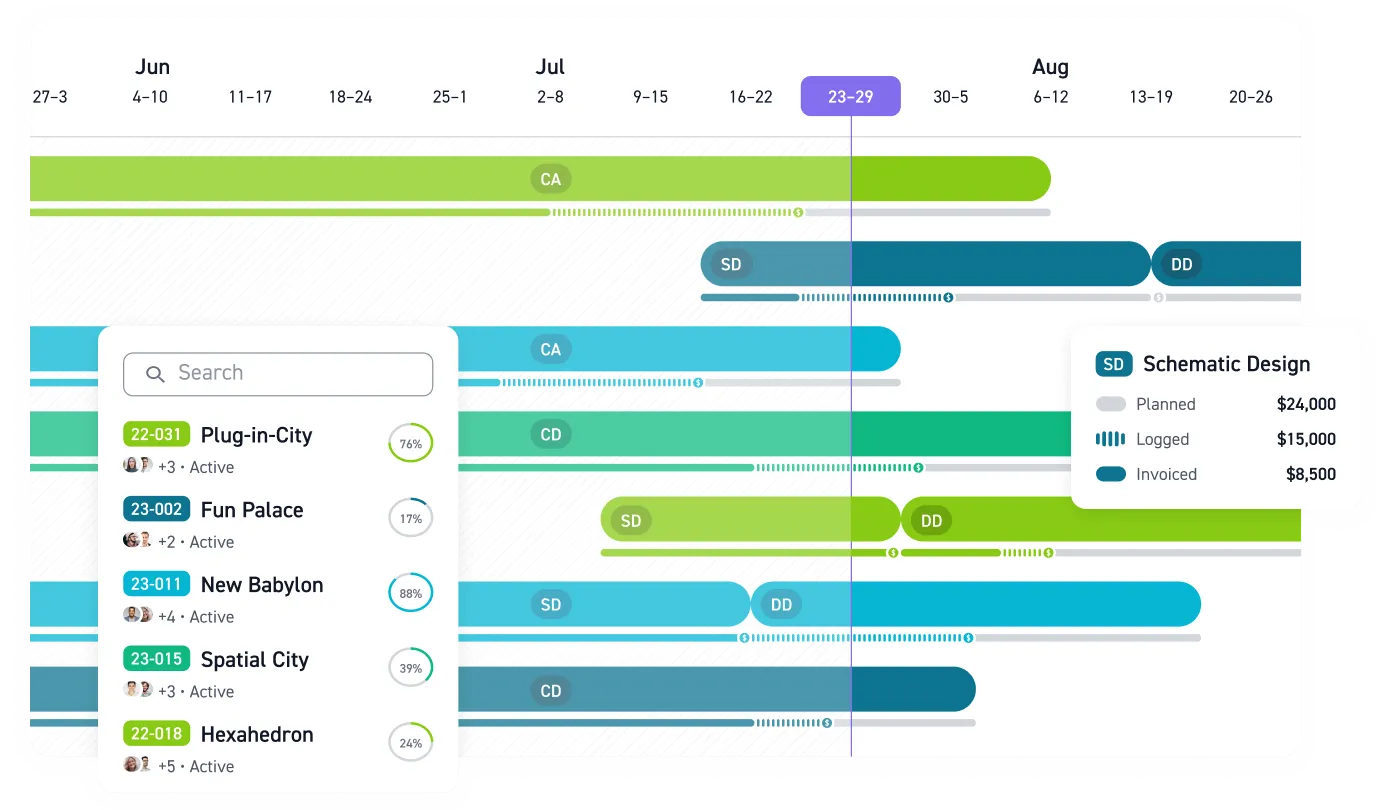
Monograph's signature MoneyGantt™ feature shows budget-to-cash progression across every phase, giving you instant visual intelligence into which projects are off-track without digging through spreadsheets. Weekly burn tracking and phase-based monitoring transform scope management from reactive damage control to proactive intervention.
Every untracked scope change is margin walking out the door. Book a demo and see exactly where your projects stand.
Frequently Asked Questions
How do I implement change management without damaging client relationships?
Frame change orders as protecting the client, not billing them more. When you catch scope expansion early and document it clearly, clients appreciate the transparency. The conversation becomes "Here's what this change involves and what it costs" rather than a surprise invoice at project end. Most clients respect firms with clear processes because it signals professionalism.
What should I do when scope creep has already started on a project?
Stop the bleeding immediately. Document all work performed outside original scope, calculate the hours and cost impact, and have an honest conversation with your client. Present it as a reset: "Here's where we are, here's what we've absorbed, and here's how we move forward." Then implement formal change management for the remainder of the project. You may not recover past losses, but you'll prevent future ones.
How do I get my team to actually track scope changes instead of just accommodating requests?
Make it easy and make it visible. Train staff to recognize scope expansion and give them simple language: "That sounds like it's outside our current scope. Let me check and get back to you." Review scope tracking in weekly project meetings so it becomes routine. When team members flag scope changes that get converted to additional services, recognize them. People repeat behaviors that get noticed.
Do formal scope management processes work for smaller or shorter projects?
Yes, but scale them appropriately. A two-month tenant improvement doesn't need the same documentation as a multi-year institutional project. The principles remain the same: clear scope definition upfront, written change authorization, and regular budget tracking. Even a simple email confirmation of scope changes protects you better than nothing. The process overhead should match the project risk.
How do I handle clients who push back on change orders for every small request?
Set expectations in your kickoff meeting, not during the first dispute. Explain that your change management process protects both parties and ensures nothing falls through the cracks. For clients who consistently resist, build more contingency into your base fee for future projects. Some clients will always push boundaries. Your job is to hold them clearly and professionally.