

A&E firm profitability doesn't live on the income statement. It lives inside individual projects, buried in phase-level budgets, consultant pass-throughs, and the gap between hours worked and hours billed. Your firm-wide P&L summarizes those outcomes after the fact. By the time it signals a problem, the damage is done.
Before running calculations, get the revenue definition right. Net revenue strips out subconsultant fees, reimbursable expenses, and markups, leaving only what your staff actually earns. Revenue rules confirm that pass-through payments must be excluded.
Every downstream metric should use net service revenue as the denominator.
Step 1: Map Your Cost Structure and Breakeven Floor
Start by separating direct and indirect costs clearly enough to calculate. Direct labor is salary charged to billable projects. Indirect costs cover rent, administrative staff, software, marketing, and non-billable time.
The overhead rate formula is straightforward:
Overhead Rate = Total Indirect Costs ÷ Total Direct Labor Costs
The standard range sits between 150% and 175% of direct labor. A higher overhead rate raises the breakeven multiplier you need before profit. Accurate overhead allocation directly shapes how you price work, since underestimating it compounds across every project in the portfolio.
This step depends on disciplined timekeeping. Without accurate time data coded to project numbers or overhead accounts, every later calculation turns into guesswork. Daily time entry reduces recall errors and improves data quality for downstream calculations.
Once you know your overhead rate, calculate the minimum billing rate required to cover all costs. Your breakeven multiplier rises directly with overhead, so recalculate whenever staffing or cost assumptions change.
Step 2: Build Phase-Level Budgets Before Work Begins
Don't start a project without a locked budget baseline. This is where many firms lose money. The fee gets negotiated, work begins, and nobody documents what each phase is supposed to cost. Assign budgeted hours and dollar amounts to each phase, including SD, DD, CD, CA, or whatever phase structure your project type uses.
A few essentials for budget construction:
- Track consultant costs on a separate line item. You need that separation to see what the project earned after labor and outside costs.
- Use historical project data as your starting point. Past results on similar work are the most reliable input for the next proposal's budget.
- Benchmark your labor allocation. The direct labor percentage of net revenue typically falls between 32% and 34%, which gives you a quick sanity check.
- Record actual hours and costs against each phase as work progresses so you can compare plan to reality.
Phase-level budgets give you checkpoints instead of a black box that reveals profitability only after the last invoice is sent.
Step 3: Calculate Project-Level and Phase-Level Margins
This is where phase visibility matters. A healthy-looking project total can hide a phase that is burning through budget. Apply these calculations at the phase level:
- Gross Margin: Net fee revenue minus direct labor minus direct project expenses.
- Net Margin: Gross margin minus allocated overhead.
- Achieved Net Multiplier: Net revenue divided by direct labor cost.
The gap between your achieved multiplier and your breakeven floor from Step 1 shows whether that labor is producing profit or loss. Run these numbers at the phase level, not just the project total. That is what turns a project review into something you can act on before the job closes out.
Step 4: Run Budget-to-Actual Variance Analysis
Think of this like a punchlist walk. You catch problems item by item. Profitability patterns become visible only when you track results by customer, geography, and discipline, since single-project analysis hides patterns that segmented data exposes.
Focus your review on three areas:
- Which phases consistently run over budget? Look for patterns across project types.
- Which project types or client types show the worst results? Segmenting by client and discipline reveals where pricing breaks down.
- Are overruns driven by scope creep, inefficiency, or underestimation? Each cause needs a different response.
Set alert thresholds that trigger review when margin falls below a defined floor so you catch problems while correction is still possible.
Step 5: Measure Utilization and Realization Together
Utilization rate shows how much employee time is spent on billable, revenue-generating work. The general industry benchmark for utilization sits between 60% and 65% of total labor dollars, though firms tracking utilization in hours often target 75% to 85%.
But utilization alone is incomplete. Realization rate measures how much of the billable work performed is actually invoiced and collected. A firm can have high utilization and low realization, which compresses margins despite constant activity.
Realization captures revenue lost to write-downs, absorbed scope creep, and discounted billing. Track it across projects and project managers so you can see whether busyness is turning into collected revenue.
Step 6: Benchmark and Act
Industry sentiment data shows firm leaders continue to focus on profitability, staffing, and fees as their top business concerns heading into 2026. The numbers you've calculated through Steps 1 to 5 feed three decisions that move margins:
- Pricing: When achieved multipliers on a project type consistently fall below breakeven, fees must increase or scope must shrink.
- Staffing: Low utilization across a team signals overstaffing relative to current workload.
- Project selection: Historical profitability data by client, geography, and discipline tells you which work to pursue.
These decisions only help if your team reviews them regularly.
See Your Profitability Before It Slips
Spreadsheets are where many firms stall. Principals, project managers, and operations leaders need one place to connect time, budgets, staffing, and billing so phase-level problems show up before they become write-downs.
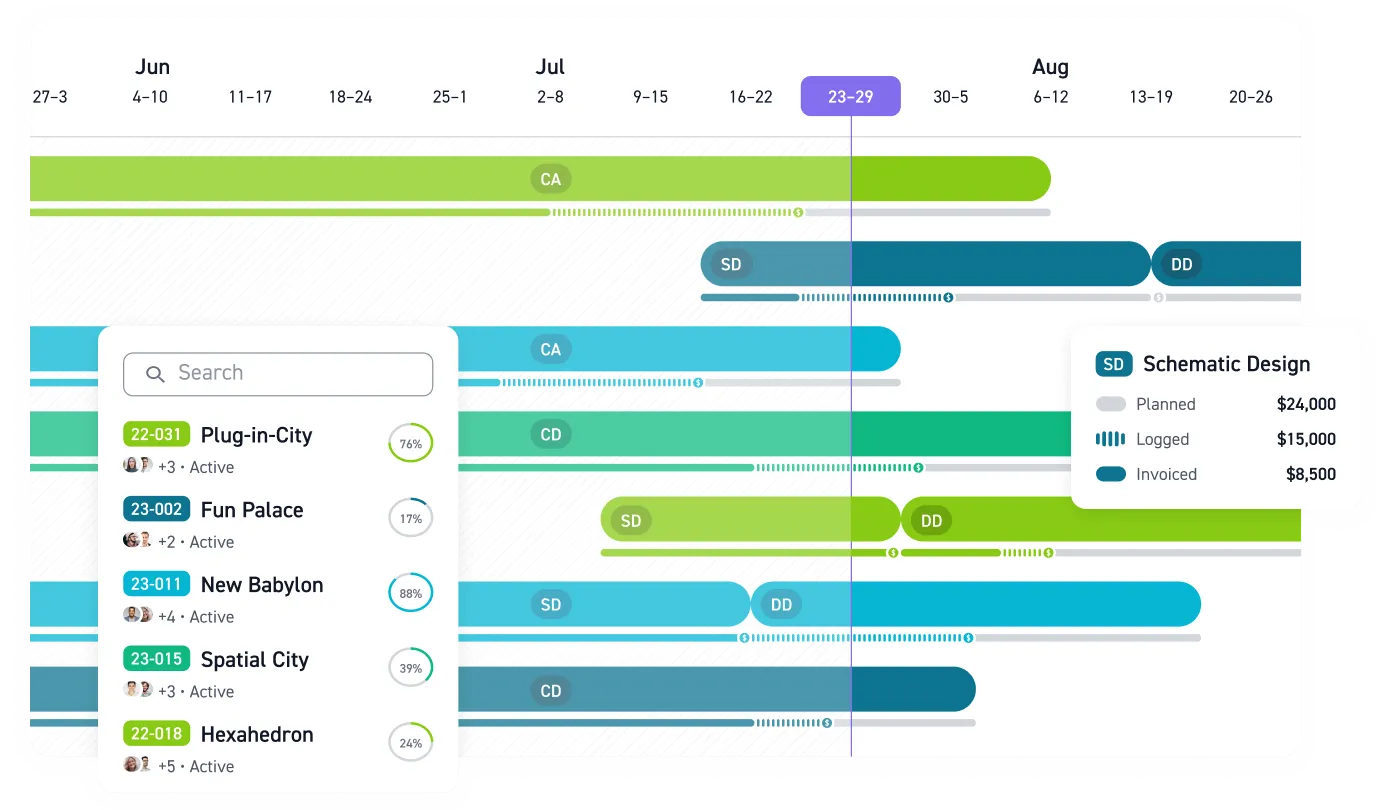
Tools built for project economics, like Monograph, can help make budgeting and financial tracking more consistent. Workbench, a 30-person firm in California, reports 8x faster staffing, 4x faster billing, and 75% less unbilled fees after switching from BQE Core. Monograph's MoneyGantt™ visualizes project profitability by layering financial data onto project timelines, so phase budgets and cash progression appear in one view.
The time logging guide shows how timesheets connect to project phases, budgets, and invoicing, and dashboard alerts plus reports on utilization and profit-related performance help replace spreadsheets. Better visibility gives your team more time to fix margin problems before they become write-downs.
Profit leaks don't wait. Book a demo.
Frequently Asked Questions
What's the first profitability metric an A&E firm should track?
Start with net revenue and your breakeven floor. If you don't separate pass-through consultant fees, reimbursables, and markups from the revenue your staff actually earns, the rest of the analysis gets distorted.
Can a small firm do phase-level profitability analysis without a finance team?
Yes. The process starts with accurate timekeeping, phase-level budgets, and regular budget-to-actual review. A 5-person to 15-person firm can build this discipline using a single platform that connects time entry to phase budgets, then layer in dashboards as the team grows.
How often should we review margins and variance?
Review them often enough to correct problems before the project is effectively over. Record actual hours and costs as work progresses, track realization across projects and project managers, and set alert thresholds when margin falls below a defined floor.
How do we tell whether low margins come from pricing or utilization problems?
Look at the relationship between achieved multiplier, breakeven multiplier, utilization, and realization. If achieved multipliers on a project type consistently fall below breakeven, fees may be too low or scope may be too broad. If utilization is high but realization is low, the problem is usually write-downs, absorbed scope creep, or discounted billing.
