



Firm management made easy

You know the feeling. A project that looked profitable on paper starts bleeding money by Design Development, and by the time you catch it, there's nothing left to fix. For A&E firms managing fixed-fee contracts, late visibility into project costs isn't just frustrating. It's financially dangerous.
Research shows that 35% of A&E projects exceed their budgets, with design-related errors accounting for up to 50% of failure costs. The good news? Budget tracking is one of the few aspects of a project entirely within your control. Here's how to take that control back.
Step 1: Choose Your Cost Tracking Methodology
Before tracking anything, you need to decide how you'll measure costs. Research shows that firms typically choose between two approaches:
- Job Cost Rate (Burdened Pay): Includes overhead in real-time cost calculations, providing granular reporting at the employee level. Best for complex fixed-fee projects requiring detailed cost driver analysis.
- Overhead Allocation: Spreads overhead proportionately across projects using multipliers. Better suited for smaller firms prioritizing simplicity over granular detail.
Neither approach is universally better. The right choice depends on your accounting approach and how much detail you actually need to manage projects effectively.
Step 2: Use Earned Value Management
Hours burned doesn't equal progress made. This dangerous illusion sinks fixed-fee projects. Earned Value Management (EVM) prevents this by measuring actual deliverable completion rather than time spent, providing objective measurement of project progress through the comparison of Earned Value (actual value of work completed) against Planned Value (budgeted cost of work scheduled) and Actual Cost (actual costs incurred to date).
The core framework tracks three numbers: Planned Value (what you budgeted for work scheduled), Earned Value (the actual value of work completed), and Actual Cost (what you've actually spent). When Earned Value exceeds both Planned Value and Actual Cost, you're ahead of schedule and under budget. When Actual Cost exceeds both? You're in trouble.
Progress should actually be reported by physically accounting for work completed, not by measuring incurred costs. For small firms where each project represents a significant revenue percentage, these early warning signals allow intervention before overruns become catastrophic.
Step 3: Track Net Multiplier as Your Primary Metric
Net labor multiplier, the ratio of net revenue to direct labor cost, is the single most important profitability indicator for A&E firms. This metric integrates both billing effectiveness and cost control through the relationship: Profitability = 1 - (N / (M × U)), where M represents your direct labor multiplier, U represents your utilization rate, and N represents non-labor overhead. If your net multiplier exceeds your break-even rate, you're profitable. If it falls below, you're losing money regardless of revenue volume.
Industry benchmarks show engineering firms typically operate with multipliers of 2.75-3.25, with high performers reaching 3.5 or higher. For fixed-fee projects, you must maintain a net multiplier above your break-even rate throughout project delivery, not just at completion.
Step 4: Set Up Real-Time Analytics
For fixed-fee contracts, real-time dashboards let project managers see cost overruns while intervention is still possible, rather than discovering problems through monthly reviews that arrive too late for meaningful course correction.
Advanced analytics make data "as real-time as your timesheets," according to PSMJ Resources. This represents a fundamental shift from historical reporting to predictive management. The key capabilities you need include:
- Interactive dashboards that filter based on any significant data point and drill through summary information
- Single source of truth that eliminates isolated, static, outdated reports
- Predictive focus that gives you a clearer picture of the future for forecasting and planning
These capabilities transform project management from reactive firefighting to proactive course correction, catching problems when they're $5,000 issues instead of $50,000 disasters. Woodhull, a 25-person architecture firm in Maine, reduced budget overages by 66% after implementing real-time cost visibility for their fixed-fee projects.
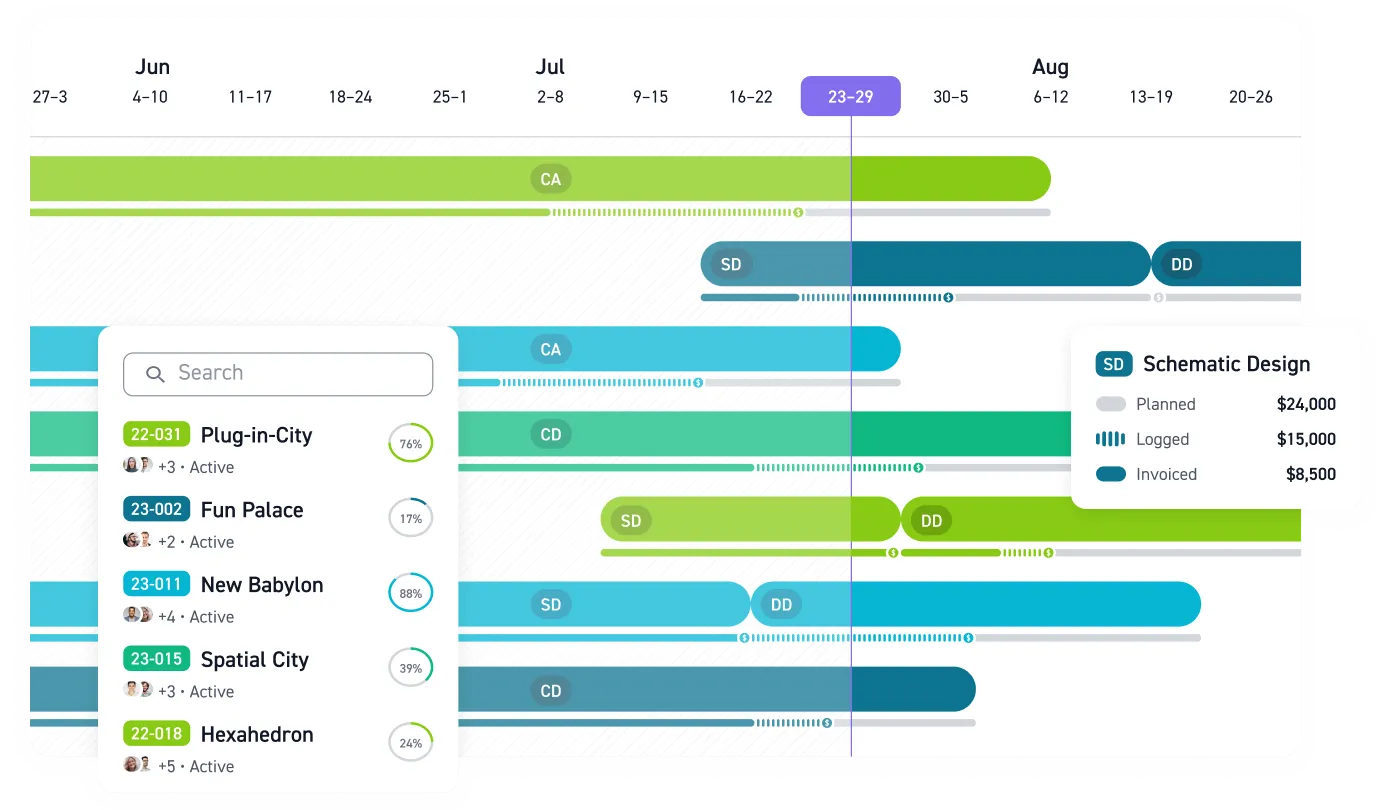
Monograph's signature MoneyGantt™ feature provides instant visual intelligence into project budgets, combining traditional timelines with budget-to-cash progression (planned → logged → invoiced → paid) without mathematical complexity. This approach lets you see which phases and projects are off-track in seconds.
Independent research from a Forrester Consulting study found that organizations using Enterprise Project Performance solutions with real-time cost visibility achieved an average 20% cost reduction. While this research covered enterprise project management broadly rather than A&E firms specifically, the cost control mechanisms align directly with fixed-fee contract challenges. Real-time dashboards let project teams view cost data in real-time, quickly analyze findings, and adjust plans as needed.
Step 5: Track Revenue Factor, Not Just Utilization
An employee with 95% utilization working on unprofitable fixed-fee projects contributes less to firm profitability than someone with 70% utilization on highly profitable engagements. That's why Zweig Group recommends focusing on revenue factor, defined as net service revenue divided by total raw labor, whether that labor is billable or not. They urge firms to stop using one-size-fits-all utilization targets.
High-performing firms track multiple financial metrics simultaneously rather than relying on single utilization targets.
Step 6: Structure Budgets Around AIA Project Phases
The five standard AIA project phases, Schematic Design, Design Development, Construction Documents, Bidding/Negotiation, and Construction Administration, provide a universal framework for budget structuring. Each phase represents distinct deliverables and scope, making them natural cost containers.
Build budgets bottom-up from task-level estimates using the Direct Labor Multiplier to convert labor costs into billable rates. But don't forget the 10% rule: budget an additional 10% for coordination activities often missed in task-based estimates. That "profitable" project still loses money when nobody budgets for the PM's weekly coordination calls, principal client meetings, or other administrative time processing consultant invoices.
This phase-based approach also simplifies client communication. When a client asks why you need more fee, you can point to specific deliverables in specific phases rather than vague claims about "complexity."
Step 7: Manage Design Contingency Separately
Each project should include owner's, contractor's, and designer's contingencies, all with the same objective: completing the project on budget. According to AIA guidance, the design contingency amount usually ranges from 5–10% of the overall construction cost, and the owner should include this cost directly in the project budget.
For fixed-fee projects, this distinction is essential. Design contingency protects against scope additions during design refinement and should be contractually separate from your fixed fee.
Step 8: Separate Collections from Project Management
Data shows that 18% of high-performing firms improved collections by removing this responsibility from project managers entirely. Accounting manages follow-up calls and aged accounts receivable tracking instead.
This matters for fixed-fee projects because cash flow is critical when you cannot bill for overruns. Project managers should focus on scope and budget management. When collections calls compete with design reviews for their attention, both suffer.
Step 9: Establish Firm-Wide Change Order Protocols
Scope creep is the silent killer of fixed-fee profitability. Effective change management requires three components:
- Clear contractual scope definition using AIA standard forms like G701-2017 Change Order for documenting changes
- Staff training to recognize and flag out-of-scope requests before work begins
- Accessible scope documentation so everyone, from interns to principals, can identify when requests exceed the original agreement
Scope protection cannot be the sole responsibility of project managers. When you establish firm-wide policies for identifying and documenting additional services before work begins, you protect margins consistently across all projects.
Stop Discovering Budget Overruns After It's Too Late
You've read the steps. You know what good cost tracking looks like. The question is whether you're still willing to discover budget overruns from your monthly accounting reports instead of catching them in real-time.
The AIA notes that monitoring utilization rate and labor multiplier allows tracking up to 75% of a firm's operating costs. For professional services firms where labor dominates the cost structure, effective project cost tracking isn't administrative overhead. It's essential for survival.
Over 13,000 architects and engineers across 1,800+ firms use Monograph to catch budget problems before they become disasters. Real-time dashboards show which projects are bleeding cash, automated alerts flag budget risks while intervention is still possible, and phase-based tracking works the way A&E firms actually manage projects.
Every day without real-time cost visibility is another day projects slip into the red. Book a demo.
Frequently Asked Questions
How do I start cost tracking if my firm currently uses spreadsheets?
Start with one project type where you have consistent historical data. Import 6-12 months of timesheet records, set up phase-based budgets that mirror your actual workflow, and run the new system alongside your spreadsheets for one billing cycle. Once you trust the numbers, stop updating the spreadsheets.
How often should we review project costs during active phases?
Weekly reviews catch problems early enough to fix them. Monthly reviews often arrive too late for meaningful course correction on fixed-fee projects. Set up automated alerts for when projects hit 75% and 90% of phase budgets so you're not relying solely on scheduled check-ins.
What's the biggest cost tracking mistake A&E firms make?
Tracking hours without tracking progress. A project can burn 80% of its budget while completing only 50% of deliverables, and if you're only watching timesheets, you won't know until it's too late. Earned Value Management solves this by measuring actual deliverable completion against time spent.
Can these methods work for both hourly and fixed-fee projects?
Yes, but the stakes are different. Hourly projects let you bill for overruns, while fixed-fee projects don't. The same tracking methods apply, but fixed-fee contracts require tighter monitoring and faster intervention when budgets trend over. Real-time visibility matters more when you can't recover lost margin through additional billing.
What if my team resists detailed time tracking?
Resistance usually comes from time tracking that feels like surveillance without benefit. Show your team how their data connects to project decisions. When they see that accurate tracking protects budgets and prevents last-minute scrambles, compliance improves. Automated staffing plans that pre-fill timesheets also reduce the daily friction that causes resistance.