


Firm management made easy

Running a profitable architecture or engineering firm means making smart decisions about which opportunities to pursue. Yet most A&E professionals are tracking proposals the same way they managed projects in 1995: spreadsheets, email chains, and institutional memory scattered across principals' heads.
The result? 50% industry win rates that haven't improved in decades, wasted effort on losing pursuits, and missed opportunities that could have transformed your practice. If you're spending more time hunting through files than designing, something's broken.
Understanding Proposal Tracking for A&E Firms
Proposal tracking systems for architecture and engineering firms are fundamentally different from generic sales software. While most CRM platforms focus on product sales and transactional relationships, A&E firms operate in a qualifications-based selection environment where technical expertise, past project experience, and team credentials matter more than price.
Your firm doesn't sell widgets. You sell complex, long-term project relationships. According to our analysis, 45.5% of work comes from repeat clients, meaning your tracking system needs to maintain relationships across multiple projects spanning years, not just single transactions.
The qualifications-based selection (QBS) process creates unique requirements that generic CRM systems can't handle. QBS-procured projects experience 3% cost growth versus 6% national average for non-QBS projects. So your tracking system must accommodate this reality by focusing on credentials, past performance, and technical expertise rather than traditional sales metrics.
Consider the typical A&E pursuit process documented by industry sources: initial screening based on technical qualifications, detailed proposal development, shortlisting, and interviews. Each stage requires different team members, documents, and decision criteria. Industry best practices outline a complete pursuit workflow including Receive RFP, Go/No Go Decision, Kickoff Meeting, Proposal Review, Submission, Client Clarifications, Interview Strategy, Interview Preparation, Rehearsal, and Debrief. Generic sales pipelines simply weren't designed for this complexity.
Essential Features Your Firm Actually Needs
Not all proposal tracking systems understand A&E workflows. Here are the capabilities that separate industry-specific platforms from generic sales software:
Core A&E-Specific Capabilities:
- Qualifications-based selection accommodation that tracks expertise, credentials, and past project performance, recognizing that most A&E work follows qualification-first procurement rather than price-based bidding
- SF330 automation for federal opportunities, automatically populating Part I (firm qualifications) and Part II (project-specific qualifications) to eliminate manual form completion
- Go/No-Go decision frameworks that capture pursuit decisions with clear criteria, recognizing that A&E firms currently win just 50% of bids pursued, with poor decisions requiring 3x billable recovery effort at typical multipliers of 2.94-3.54x
- Multi-stage process management accommodating qualification, proposal, shortlist, and interview phases, aligned with the typical industry process documented by institutional procurement offices
Integration and Efficiency Features:
- Project delivery integration that maintains context from opportunity through project completion, enabling seamless transition from proposal to project execution without losing institutional knowledge
- Content libraries and template automation for rapid proposal assembly, reducing proposal prep time from days to hours while maintaining quality and consistency across firm branding
- Resource planning visibility to understand staffing capacity and expertise availability before committing to pursuits, connecting business development pipeline to project profitability and resource allocation
- Team and project sheet management with version control for resumes, project descriptions, and credentials, enabling automatic population of qualified team information and relevant past project experience
The most successful systems handle the reality that A&E business development requires participation from principals, project managers, and technical staff, not dedicated sales teams. Research shows that principals must use the CRM if you want everyone else to follow. Systems that create administrative burden rather than reducing it will fail in design-focused cultures.
Measurable Benefits Worth Pursuing
The financial impact of organized proposal tracking extends far beyond winning more work. With proposal activity showing modest year-over-year improvement, efficient proposal management has become increasingly critical for firm sustainability.
A&E firms implementing the integrated systems reported 10 percentage point improvement in forecasting accuracy and 25% increase in operational efficiency. These translate directly to better resource planning and reduced overhead waste.
The cost of poor pursuit decisions compounds quickly. With typical net multipliers of 2.94-3.54x, every 100 hours wasted on a losing proposal requires 300-350 billable hours to recover the overhead impact. For firms pursuing 20+ opportunities annually with 50% average win rates, improved Go/No-Go decisions alone can save thousands of hours. That's equivalent to half an FTE or more.
One documented case study shows concrete results: a structural engineering firm improved its win rate from 34% to 78% while delivering designs 52% faster after implementing organized tracking and proposal automation (Monograph research). The 44-percentage-point improvement in win rate represents the difference between struggling to maintain workload and selective pursuit of ideal projects.
Strategic Implementation Approach
Success with proposal tracking systems requires thinking before tool selection. Too many A&E firms buy software first, then struggle with adoption because they haven't addressed fundamental industry-specific challenges. Engaging technical professionals in business development without formal training creates adoption barriers.
Firms should prepare a proposal outline and define what needs to be addressed in scope before implementing tracking systems. This foundation ensures design-focused principals don't skip critical planning in their rush to adopt tools.
Foundation Setting:
- Define proposal approach before implementing systems to ensure tracking serves business goals
- Establish quantifiable success metrics like win rate improvement and time-per-proposal reduction
- Create firm-wide buy-in by demonstrating how tracking reduces administrative burden rather than increasing it
- Build content libraries and templates to minimize time impact on busy technical professionals
Integration matters more than feature richness. The most effective systems connect business development data directly to project management and financial systems, creating continuous workflow from opportunity identification through project profitability analysis. Winning A&E firms have moved beyond ad hoc relationship management to connect their business development pipeline directly to project profitability and resource planning, ensuring seamless transition from opportunity closure to project execution.
When approached this way, CRM data can become powerful market intelligence that illuminates broader trends and client behaviors, transforming proposal tracking from administrative necessity into business planning asset.
Beyond Traditional CRM Thinking
The most innovative A&E firms are moving beyond traditional proposal tracking toward integrated lead management systems that bridge business development and project delivery. Rather than treating proposals as separate sales activities, leading firms view opportunity management as the first phase of continuous project delivery. Successful A&E firms connect business development data directly to project management and financial systems, ensuring seamless transitions from won opportunities to active projects.
This integration directly addresses the industry's 50% average win rate by enabling firms to focus pursuit efforts on qualified opportunities with higher closing potential, while automatically populating project setup data from winning proposals to eliminate manual re-entry and maintain proposal context throughout execution.
This approach addresses a critical disconnect in most A&E firms. Business development teams track opportunities in one system while project managers execute work in completely different platforms. Data gets lost, context disappears, and insights from completed projects never inform future pursuit decisions.
About 45.5% of the average firm's work comes from repeat clients. When your next opportunity emerges with a past client, your system should seamlessly surface relevant information through integrated project delivery data that shows past project outcomes, team performance, and financial results, not through separate contact databases.
Move From Pursuit Chaos to Organized Wins
You know the pattern: scrambling to assemble proposals from scattered files, making gut-feel Go/No-Go decisions without real data, and wondering which pursuits actually deserve your team's time. Meanwhile, your 50% win rate means half your proposal effort vanishes into losing pursuits that require 3x billable work to recover overhead costs.
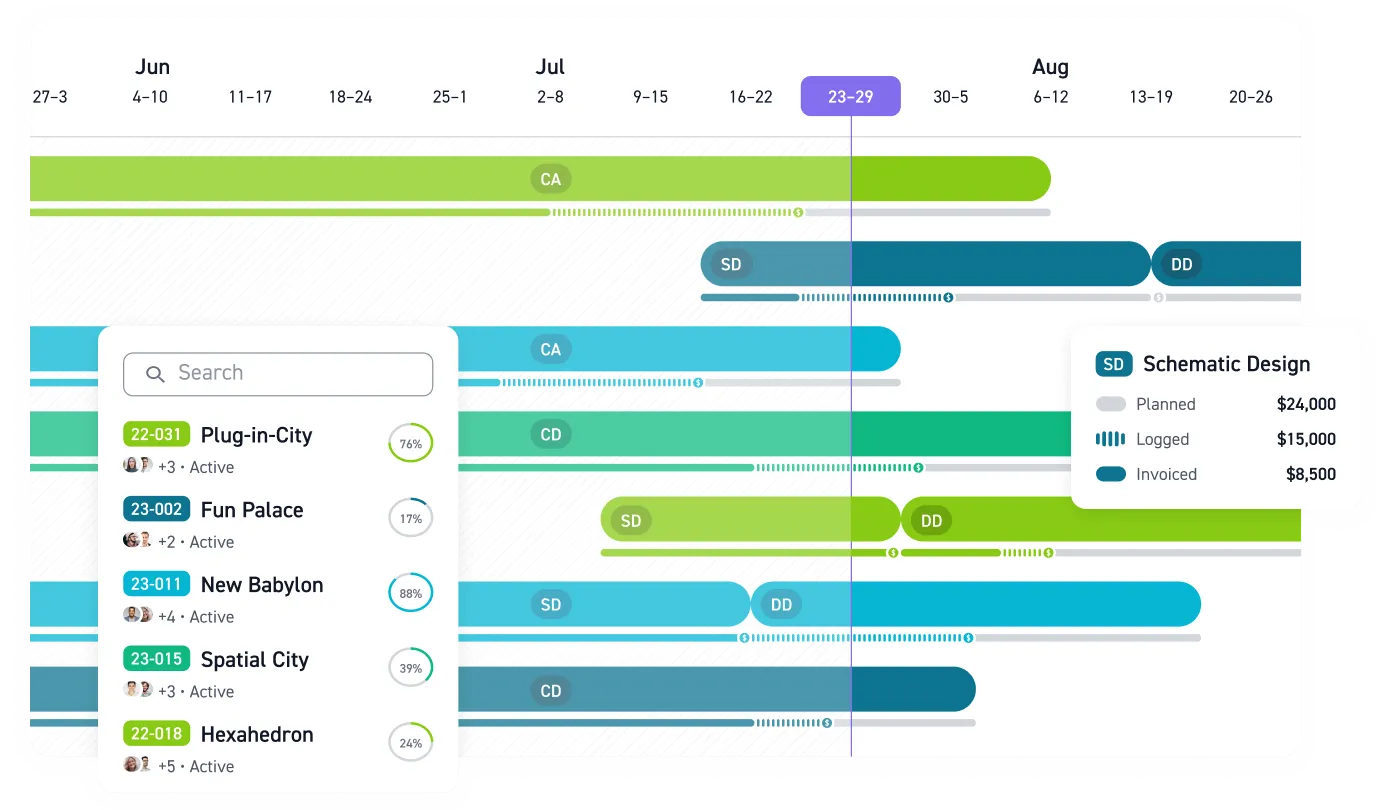
Monograph connects your business development pipeline directly to project execution and financial performance. Monograph's MoneyGantt™ transforms complex proposal tracking into simple visual intelligence, showing which opportunities deserve your pursuit efforts and which projects are heading off-track before they become problems. When you win work, proposal data flows automatically into project setup. Team assignments, phase budgets, consultant coordination, and client context transfer without manual re-entry. When past clients return with new opportunities, you see complete project history, financial outcomes, and team performance in one unified view.
Track which opportunities align with your firm's expertise and capacity before committing resources. Monitor pursuit decisions against actual win rates. Understand the true cost of proposal development across your overhead structure. Connect every pursuit to the resource planning and financial forecasting that determines whether you can actually deliver the work profitably.
Built by former architects who lived the chaos of disconnected business development systems, Monograph gives principals real-time visibility into pursuit pipeline, operations leaders faster proposal workflows, and project managers seamless transition from won opportunity to active project. Over 13,000 architects and engineers across 1,800+ firms use Monograph to connect business development directly to project delivery.
Your competitors are making pursuit decisions with better data. See how Monograph connects business development to project delivery.
Frequently Asked Questions
How do I know if we need a proposal tracking system?
If you're pursuing more than 5-10 opportunities annually and tracking them in spreadsheets or email, you need organized tracking. The clearest signal: you can't quickly answer "What's our current win rate?" or "Which pursuit types are most profitable?" Without tracking, you're making expensive Go/No-Go decisions blind. At 50% industry win rates, half those decisions waste substantial overhead investment.
Will proposal tracking work if our principals don't use technology consistently?
Successful systems reduce administrative burden rather than creating it. The key is choosing platforms that work with existing workflows instead of forcing new processes. When proposal data automatically flows into project setup and connects to financial systems, principals get value without extra work. Focus on tools that serve principals' actual needs: visibility into pursuit pipeline, resource capacity, and win rate analysis, rather than systems that demand data entry for its own sake.
How long does it take to see ROI from proposal tracking?
Most firms see measurable impact within 3-6 months: improved Go/No-Go decisions, reduced proposal assembly time, and better win rates on qualified opportunities. The immediate benefit comes from avoiding even one losing pursuit. At typical A&E multipliers of 2.94-3.54x, a single prevented 100-hour proposal waste saves 300-350 billable hours of overhead recovery. Calculate your current annual pursuit hours, multiply by your overhead multiplier, and apply industry average 50% win rate. Any system that improves those economics pays for itself quickly.
Should we track proposals separately from active projects?
The most effective approach integrates business development with project delivery. When you win work, proposal context should flow directly into project setup without manual re-entry. Team assignments, budget structure, client requirements, and consultant coordination transfer seamlessly. This integration ensures institutional knowledge transfers and enables analysis of which pursuit types translate to profitable project execution. Separate systems create data gaps, lost context, and duplicate administrative work.
What if our firm only pursues 5-10 proposals per year?
Even low-volume firms benefit from organized tracking when pursuit decisions carry high stakes. With fewer opportunities, each Go/No-Go decision matters more. Choosing the wrong pursuit at 2.94-3.54x overhead multipliers creates significant financial impact. Focus on integrated systems that connect business development to resource planning and project profitability, ensuring you pursue opportunities your firm can actually deliver profitably rather than just opportunities you might win.