



Firm management made easy

The question keeping architecture firm principals awake at night isn't whether artificial intelligence will impact their profession. The real question is whether their practice will survive the transformation. After years of speculation, the answer is finally clear from industry research and real-world implementations.
The AIA, now representing over 95,000 architects, has expressed strong support for the idea that AI will augment and improve architects' work, emphasizing AI's role as a tool to enhance professional capabilities. Research shows that a large majority (84%) of architects are optimistic about AI's potential to solve complex problems and drive innovation in the profession.
Current AI Capabilities: What's Actually Happening in Practice
Architecture firms are implementing AI tools across eight distinct building design capabilities, with measurable results that improve rather than eliminate human work. The most successful adoptions focus on automating repetitive tasks that previously consumed significant architect time.
Generative design platforms like TestFit automate site planning by generating multiple layout options based on zoning requirements, setbacks, and parking regulations. BSB Design adopted the platform to streamline site planning workflows, allowing architects to focus on evaluating design options rather than manually creating each iteration.
AI-powered rendering tools including Midjourney and DALL-E enable architects to generate photorealistic visualizations in hours. You can use AI to do things like experiment with material choices, lighting, and massing arrangements. Much of this isT work previously assigned to junior associates.
Documented results from successful implementations include:
- Site planning that took days now completed in minutes through compliance checking
- 20% cost reductions through improved accuracy and reduced waste
- Code research timelines collapsed from days to minutes via automated analysis
- Workflow efficiencies particularly during early-stage design phases
The Irreplaceable Human Elements
Five fundamental aspects of architectural practice remain uniquely human despite AI advancement, creating natural boundaries that protect rather than threaten professional roles.
Contextual design judgment represents the most critical human capability. AI generates designs by recombining patterns from training data, producing homogenized results that lack emotional resonance or contextual intelligence. AI cannot execute informal design moves that emerge from unexpected site constraints or cultural imperatives.
Professional responsibility and legal accountability create an absolute barrier to AI replacement. When projects fail, licensed architects remain legally liable. AI systems cannot assume professional responsibility, face disciplinary action, or maintain professional licenses. This legal framework protects your firm's role while allowing you to leverage AI's computational advantages.
Client relationships continue requiring human trust-building and communication that AI cannot replicate. Essential capabilities that remain uniquely human include:
- Navigating conflicting stakeholder priorities through interpersonal negotiation
- Building long-term professional relationships extending beyond individual projects
Regulatory expertise involves complex interpretation that extends beyond automated compliance checking. While AI collapses code research timelines from days to minutes, architects must interpret ambiguous code language, understand code intent versus literal compliance, and negotiate variances with building officials.
Emotional intelligence in design encompasses understanding how people experience spaces and cultural meanings in built forms. AI lacks emotional intelligence and cultural sensitivity essential to architecture that creates lasting value beyond mere building.
Real-World Transformations: How Firms Are Actually Using AI
Architecture firms implementing AI tools report workflow improvements rather than job eliminations. Brooks Scarpa Architects, a 17-person Florida firm, achieved 25% profit growth and 50% efficiency gains by implementing integrated practice management tools that automate administrative workflows while preserving human focus on design excellence.
When AI tools handle computational work, architects can focus on higher-value activities requiring human judgment, creativity, and client relationships. These capabilities have led to improved productivity without headcount reduction and faster client response times creating market edge.
The Next Five Years: Planned Transformation
The architecture profession's future involves planned AI integration rather than workforce replacement, with clear implications for practice development and competitive positioning.
Emerging specializations will create new revenue opportunities:
- Fire-resistant residential construction design responding to climate challenges
- Self-sufficient home design incorporating personal power generation and food-growing spaces
- Climate-responsive resilient building design
- Energy efficiency and sustainability improvement through AI-powered tools
Industry practitioners predict that the next year is a critical turning point where AI adoption will shift from experimental to practical application.
Essential Skills for AI-Augmented Practice
Architects must develop specific competencies to work effectively with AI tools, with education options available through professional organizations and academic institutions.
AI tool interaction and prompt engineering skills enable architects to communicate project requirements to AI systems with precision. Critical evaluation and quality control capabilities ensure appropriate AI output assessment.
The American Institute of Architects offers continuing education that includes courses on artificial intelligence and its applications in architecture. Collaborative efforts by the AIA, universities, and specialized education providers suggest an evolving preparation for AI-augmented practice in architecture, with attention to integrating AI technologies while upholding professional judgment.
Build the Foundation for AI Transformation
You can't experiment with AI tools when you're drowning in manual project management. While firms across town test generative design platforms and AI rendering tools, you're stuck reconciling timesheets across three spreadsheets and chasing down project budgets.
AI transformation requires operational capacity. Most architecture firms lack that capacity because manual practice management consumes the time and energy needed for innovation. You need project data at your fingertips, automated workflows that run themselves, and real-time visibility into where your firm stands financially.
Monograph creates the operational foundation that enables AI adoption. 13,000+ architects and engineers across 1,800+ firms use Monograph to automate practice management and gain the operational clarity needed for AI adoption. When your project budgets update automatically, your timesheets feed directly into invoicing, and your profitability tracking requires zero manual work, your team gains the bandwidth to explore AI tools that enhance design work.
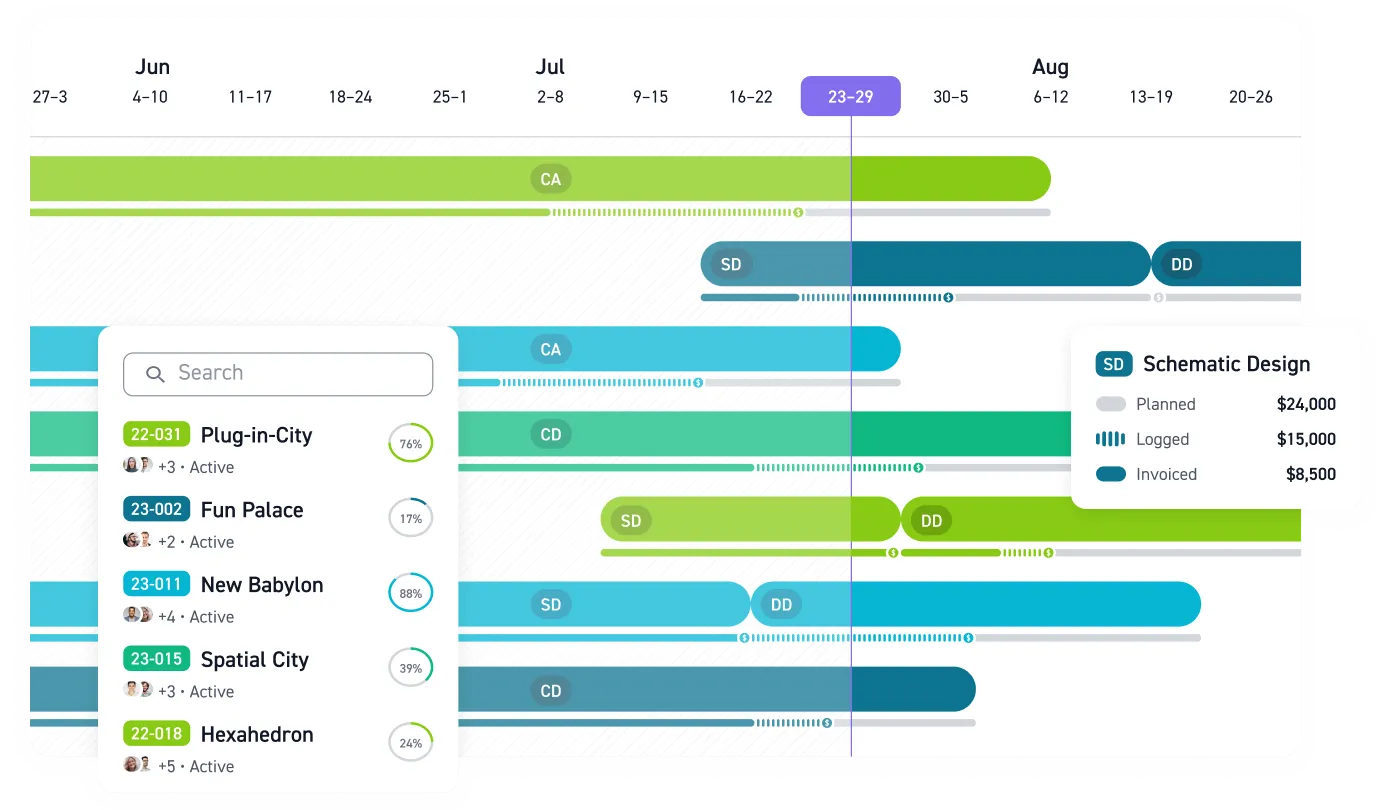
Our signature MoneyGantt™ transforms complex financial tracking into instant visual intelligence. See planned, logged, invoiced, and paid status across all projects without mathematical complexity. This proprietary innovation converts budget tracking from spreadsheet chaos into the visual clarity your firm needs before AI tools deliver meaningful value.
Operations leaders use Monograph to eliminate the administrative chaos that prevents innovation efforts. Project managers coordinate AI-augmented workflows because they're not buried in status updates. Principals evaluate AI investments with confidence because they finally understand their true project profitability.
The AI gap widens every quarter. Firms with operational clarity can experiment and adapt. Firms stuck in spreadsheet chaos fall further behind. Build your foundation.
Frequently Asked Questions
What architectural roles are most at risk from AI automation?
Junior positions handling repetitive production work face the biggest shift. Not elimination, but transformation. AI tools are automating tasks like generating multiple rendering options, initial code compliance checking, and routine drawing production. This means entry-level architects will focus on design judgment and client communication earlier in their careers rather than spending years on pure production work. Firms adapting well are repositioning junior staff toward higher-value activities that AI can't handle: contextual design decisions, stakeholder coordination, and creative problem-solving.
How much should a 15-person architecture firm budget for AI tools in 2025?
Initial AI tool investments range from $3,000 to $8,000 annually for a 15-person firm, depending on which capabilities you adopt first. Generative design platforms like TestFit start around $200 to $500 per user monthly. AI rendering subscriptions run $20 to $60 per user monthly. The bigger question is whether your practice management foundation can absorb new tools. If you're spending 15 hours weekly on manual project tracking, invest in operational efficiency before adding AI complexity.
Should I hire architects who already know AI tools or train my existing team?
Train your existing team. AI tools evolve too quickly for "AI expertise" to remain current, and your experienced architects already understand your firm's design philosophy, client relationships, and project workflows. Invest in continuing education through AIA courses on AI integration and give your team dedicated time to experiment with new platforms. The architects who succeed with AI aren't the ones who know specific tools. They're the ones who understand which design problems AI can solve and which require human judgment.
Will AI tools actually improve my profit margins or just add costs?
AI tools improve margins when they eliminate specific, measurable inefficiencies. But only if your operations are stable enough to absorb them. Firms report 20% time savings on tasks like site planning and early-stage rendering, which directly impacts project profitability when you're billing fixed fees. However, adding AI tools to chaotic project management just creates expensive chaos. Fix your operational foundation first: automated time tracking, real-time budget visibility, and streamlined invoicing. Then AI tools deliver ROI instead of complexity.
Which AI capability should I adopt first? Rendering, site planning, or something else?
Start where your firm bleeds the most time on repetitive work. If you're spending 10 hours per project on early-stage renderings for client presentations, AI rendering tools deliver immediate ROI. If site planning consumes days of junior architect time on feasibility studies, generative design platforms make sense. Don't adopt AI because competitors are. Adopt it because you've identified a specific workflow bottleneck costing you money. Measure time savings on one project type before expanding to firm-wide adoption.


.png)