
You've spent years building estimates from scattered spreadsheets, watching projects go over budget, and discovering problems too late to fix them. AI is changing that equation, but you need to make smart choices based on real data, not vendor hype.
The numbers tell a compelling story: only 27% of professionals currently use AI in operations, yet 94% plan increased investment. That gap represents both opportunity and risk when weighing your next move.
68% of firms estimate AI could automate up to 29% of tasks. Regional data shows 37% now use AI, up from 26% in 2023. That's 42% year-over-year growth.
What the Accuracy Data Actually Shows
The strongest evidence comes from controlled academic research rather than vendor marketing. A peer-reviewed study documented measurable improvements: 20.4% better accuracy, 51.3% faster completion, and 28.4% improved coordination.
Those aren't marginal gains. If you're managing fixed-fee contracts where every scope creep eats directly into margin, improved estimation accuracy fundamentally affects project economics. A 20% improvement in accuracy can mean the difference between a profitable project and one that drains resources.
Research shows that AI-powered tools achieve less than 5% variance on bid day when using auto-refreshed material and labor indices. The same analysis documented 6-10 hours saved per estimate through automated pricing updates. These time savings translate directly to increased capacity for your estimating team.
Major firms demonstrate production deployments. Bechtel uses AI assistants that "change days of activity into minutes" for project workflows. This represents real operational transformation, not theoretical benefits.
The ROI Question on Everyone’s Mind
Here's what vendors won't tell you: most AI implementations fail because firms skip the data foundation step. If your historical project data lives scattered across spreadsheets and disconnected systems, AI algorithms are making predictions in a vacuum. The outputs might look precise, but they're based on incomplete information.
Dynamic Engineering, a 10-person Florida firm, achieved 25% profit growth and 2x efficiency gains through integrated practice management systems. This demonstrates the ROI you need when structuring internal pilots. The key is connecting AI capabilities to clean foundational data that makes predictions accurate.
Existing A&E business research reveals important context. Median operating profit margin reached 20.1% in 2023, described as record-breaking. Median utilization rate sits at 59%, leaving capacity for productivity gains.
Tech-forward firms show 67% projecting 20%+ profit, compared to 52% of non-tech-forward firms. Research found 82% report project benefits versus just 31% for light adopters. That's a 51 percentage point differential. Partial implementations don't deliver meaningful returns.
Architecture vs. Engineering: Different Workflows
AI estimating isn't one-size-fits-all. The value proposition differs fundamentally between disciplines.
Architecture practitioners emphasize AI's role in managing complexity and accelerating decision-making. Alexandre Perrossier from LWK+P states: "Architecture needs AI now to manage increasing complexity, accelerate decision-making, and explore design possibilities beyond human limits." The primary benefit centers on real-time cost feedback during conceptual design iterations.
Engineering firms prioritize different capabilities. The ACEC Research Institute emphasizes engineering implementations require robust APIs, documented BIM and ERP integration, structured quality control procedures, and clearly mapped workflows. Engineers need validation at each step because technical errors carry regulatory and safety implications.
Key differences:
- Architecture priority: Speed of iteration during client-facing design with visualization-to-estimation pipelines
- Engineering priority: Technical accuracy with discipline-specific calculation validation and documented SOPs
- Shared requirement: Revit integration remains critical, though architects need design-phase feedback while engineers need calculation validation
Both disciplines share one requirement: whatever tool you choose must connect to what you already use. Integration with accounting systems, project management platforms, or time tracking tools eliminates data silos that make manual estimating such a burden.
Implementation Reality for Small Firms
If you're running a firm with 5-50 employees, implementation success depends on what you do before purchasing any tool. According to technology consultancy analysis, AI readiness requires addressing four key areas: data strategy development, infrastructure readiness assessment, training program establishment, and scalability planning.
The most realistic metric? Five hours weekly per project manager freed from administrative estimating tasks. That translates to approximately 260 hours annually, or 6.5 weeks of productive capacity recovered without adding headcount.
Woodhull, a 25-person Maine architecture firm, saved 66% of administrative time and cut budget overages by 66% after implementing integrated practice management. This demonstrates proper tool selection delivers measurable operational improvements for firms in this size range. The key was establishing clean data foundations before layering AI capabilities on top.
A phased approach works best:
- Phase 1: Document current processes and assess data readiness
- Phase 2: Start with contained use cases like administrative workflows that show results within the first billing cycle
- Phase 3: Incorporate human review protocols with documented procedures for data input, output interpretation, oversight, and quality control
- Phase 4: Scale based on proven results and firm-specific metrics, not vendor promises
The critical mistake is implementing tools before establishing data strategy. Research found poor data quality costs the construction industry $1.84 trillion annually. Clean data foundations make the difference between AI that delivers results and AI that amplifies existing problems.
Making the Decision
Competitors already using AI are moving faster and winning more business. Combined with low current adoption (only 27%) and strong investment momentum (94% increasing investment), early adopters appear positioned to gain competitive advantage before AI capabilities become standard industry practice.
The decision comes down to timing and readiness. If you have clean historical project data, you can move quickly. If your data lives scattered across spreadsheets, you need to address foundational issues first. Either way, waiting means falling further behind competitors who are already using AI to deliver faster turnarounds and more accurate estimates.
AI Estimating Needs Clean Project Data
After working with 13,000+ architects and engineers across 1,800+ firms, we've learned something critical: AI estimating accuracy depends entirely on your historical project data quality.
Here's the problem: AI estimating tools need complete project context. Actual costs by phase, real utilization patterns across your team, consultant coordination timelines, and how your estimates compared to final project performance. If that data lives scattered across spreadsheets, QuickBooks, and disconnected tools, AI algorithms are making predictions in a vacuum. The outputs might look precise, but they're based on incomplete information.
Firms seeing measurable ROI start with integrated practice management that connects time tracking, budgeting, and actual project costs in one platform. When your project data flows through connected systems instead of scattered spreadsheets, AI estimating becomes dramatically more accurate because algorithms have the complete picture.
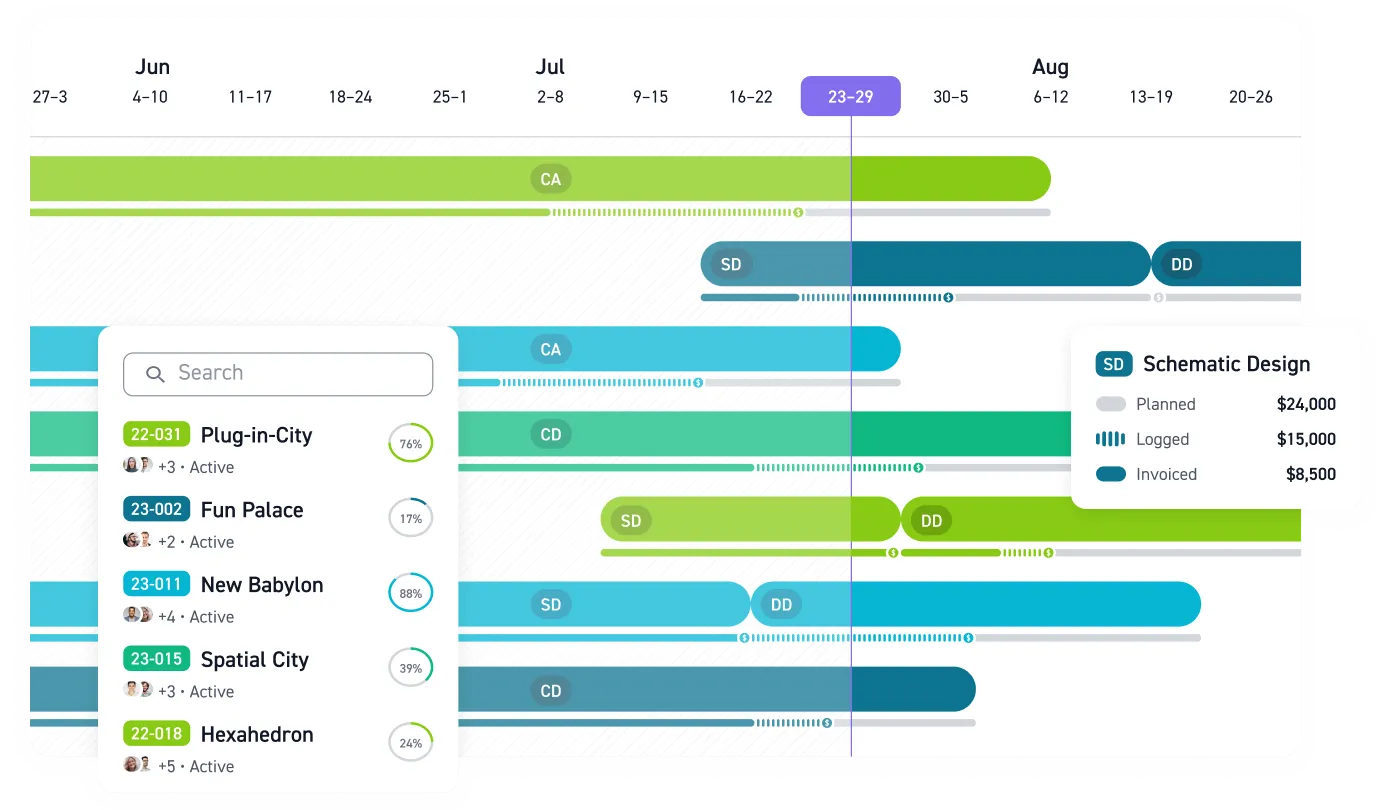
Monograph provides the unified practice management foundation that makes AI estimating work. Our platform connects time tracking that auto-assigns based on staffing plans, real-time budget monitoring with our signature Monograph's MoneyGantt™, which transforms complex financial data into simple visual insights showing budget-to-cash progression (planned, logged, invoiced, paid), and integrated invoicing that's 2x faster with online payments. This connected foundation gives AI estimating tools the clean historical data they need to deliver accurate predictions.
While you're manually updating project budgets and piecing together estimates from scattered systems, firms across the street are using integrated practice management to feed AI estimating tools with complete project context. They're winning bids with faster turnarounds and protecting margins with more accurate predictions. See how Monograph builds the data foundation for AI estimating.
Frequently Asked Questions
How do I know if my firm's historical project data is clean enough for AI estimating?
Can you quickly pull accurate cost data by project phase for your last 10 completed projects? If that takes more than 30 minutes or requires reconciling multiple spreadsheets, your data needs work before AI estimating will deliver reliable results. Look for consistent phase coding, complete time tracking records, and actual costs matched to original estimates.
Clean data doesn't mean perfect data. It means consistent tracking across projects with the same phases coded the same way, time entries matched to specific deliverables, and final costs documented accurately. If you can't answer basic questions about past project performance without hunting through multiple sources, AI estimating will struggle to provide accurate predictions for future work.
Should architects and engineers use the same AI estimating tools?
No. You need real-time cost feedback during conceptual design iterations if you're an architect. You need technical accuracy with discipline-specific calculation validation and documented procedures if you're an engineer. While both disciplines benefit from AI estimating, architectural tools prioritize speed of iteration and visualization-to-estimation pipelines, while engineering tools emphasize compliance, multi-discipline coordination, and calculation validation.
The workflow differences matter. Architects cycle through multiple design options quickly during client presentations, needing instant cost feedback to guide decisions. Engineers work through systematic calculations with regulatory requirements, needing validation at each step with documented audit trails. One tool can't serve both needs effectively because the underlying workflows are fundamentally different.
What happens to estimate accuracy when AI models get updated?
AI model updates improve over time as they learn from more project data, but consistency requires human validation protocols. Build documented procedures for interpreting AI outputs, required oversight checkpoints, and quality control standards. Track variance between AI estimates and actual project costs to identify when model behavior changes significantly.
Model updates should make predictions more accurate, but sudden changes in outputs signal something needs review. Maybe the model learned from an unusual project that skewed patterns. Maybe your firm's typical work shifted and historical data no longer reflects current reality. Regular variance tracking helps you catch these issues before they affect client proposals.
How long before AI estimating delivers measurable ROI for small firms?
Realistic timelines for 5-50 person firms: 2-4 weeks to complete initial data preparation and tool setup, 1-2 billing cycles to see time savings on administrative tasks, and 3-6 months to measure accuracy improvements and profit impact. If you have clean historical data, you'll see results faster. If you need data cleanup, plan 4-6 months before full implementation.
Don't expect immediate transformation. The first phase involves learning the tool and establishing workflows. The second phase starts showing time savings as administrative tasks get automated. The third phase demonstrates accuracy improvements as AI learns from your firm's specific patterns. Realistic expectations prevent disappointment and help secure leadership buy-in for the timeline actual implementation requires.
Can we implement AI estimating without disrupting active projects?
Yes, with a phased approach. Start with one contained use case on new projects while maintaining existing workflows for active work. Use administrative applications like invoice generation that don't touch critical project deliverables. Run AI estimates in parallel with manual estimates for 2-3 projects to validate accuracy before relying on AI outputs for client-facing proposals.
This parallel approach builds confidence without risk. Your team sees how AI estimates compare to their manual work. You identify where outputs need adjustment before they affect actual proposals. Once accuracy validates consistently, you can shift more work to AI-assisted processes. The key is proving value before committing fully, giving your team time to build trust in the new tools.


.png)