


Firm management made easy

If you run an A&E firm, you've probably asked some version of the same question: do I need an ERP, a CRM, or both? Your firm's operating model determines the right system mix. A&E projects are structured by phases, staffed with consultants, billed at milestones, and paused without warning. Most business software was not built for that, so understanding where ERP and CRM fall short is the first step toward a technology decision that doesn't cost you months of workarounds.
ERP Runs Delivery. CRM Manages Development.
ERP runs project delivery for the work you've already won. CRM manages the work you're trying to win. The contract award is the dividing line. In A&E, the CRM pipeline feeds into the ERP delivery engine, and both systems need to treat the project as the core data object. Generic CRMs built for product companies and manufacturing ERPs that track inventory instead of billable hours miss that requirement.
For A&E firms, ERP must cover project delivery functions that connect finance and operations. PSMJ Resources describes this scope more generally as connecting project management, accounting, resource planning, and workflow automation, including capabilities such as job costing and project financial management. A&E ERP needs to cover:
- Project accounting, WIP tracking, and revenue recognition
- Billing, invoicing, and time/expense tracking
- Resource planning and utilization
- Financial KPI reporting
Those functions give firms visibility into delivery performance and financial control after a project is won. CRM covers a different responsibility set: lead and opportunity tracking, client relationship history, pursuit pipeline management, and win rate reporting. Business developers and marketers are building client-intelligence databases for the whole team to access, and that data can support AI-assisted pursuit decisions.
If pipeline data doesn't connect to delivery, teams rebuild project records from scratch every time they win a contract.
Why Generic Tools Break Down for A&E Firms
General-purpose platforms treat project accounting as a module. Purpose-built platforms treat it as the foundation everything else sits on. A&E projects are organized by phases such as Schematic Design, Design Development, Construction Documents, and CA, each with its own fee allocation, staffing plan, and billing milestone. Generic tools have no native concept of project phases tied to budgets and billing.
If you've run evaluations yourself, the common problems are familiar. In common software fit problems discussed by AIA members, an AIA member described software that lacked needed features, did not connect to QuickBooks, or was not a fit for the firm's size. A&E firms run into the same problems:
- Duplicate data entry across financial, project management, and CRM systems
- QuickBooks dependency when outside accountants require it
- Vendor fit problems when platforms are priced or packaged for larger organizations
- No true all-in-one that covers financial management, project management, and CRM without gaps
When information is trapped within specific teams or tools, records stay incomplete and coordination breaks down at month-end. Those gaps rarely stay administrative for long. They turn into billing delays and profitability reports no one trusts.
The Financial Workflows That Separate A&E from Everything Else
The financial system must model project progress at the phase level to produce accurate WIP figures, revenue recognition, and profitability reporting. WIP depends on what has been earned relative to what has already been invoiced. WIP is a project accounting requirement.
Two high-friction workflows need A&E-specific handling:
- Subconsultant billing reconciliation: Tracking what's been committed, invoiced, approved for pass-through, and marked up, all at the phase level and on AIA-format invoices
- Paused project revenue recognition: When a project goes on hold mid-phase, revenue recognition should stop at the appropriate measure-of-progress point for each performance obligation under current accounting standards, so accrual does not continue while work is paused
The accounting structure also needs to separate direct and indirect labor. That distinction often needs to be handled explicitly, and generic cost center structures may not capture it on their own.
These are the workflows where generic ERPs usually need heavy configuration, while purpose-built A&E tools start with the accounting structure already aligned to how firms work.
Matching Software to Firm Size and Complexity
Firm size changes the trade-off between accounting depth and the effort it takes to get there.
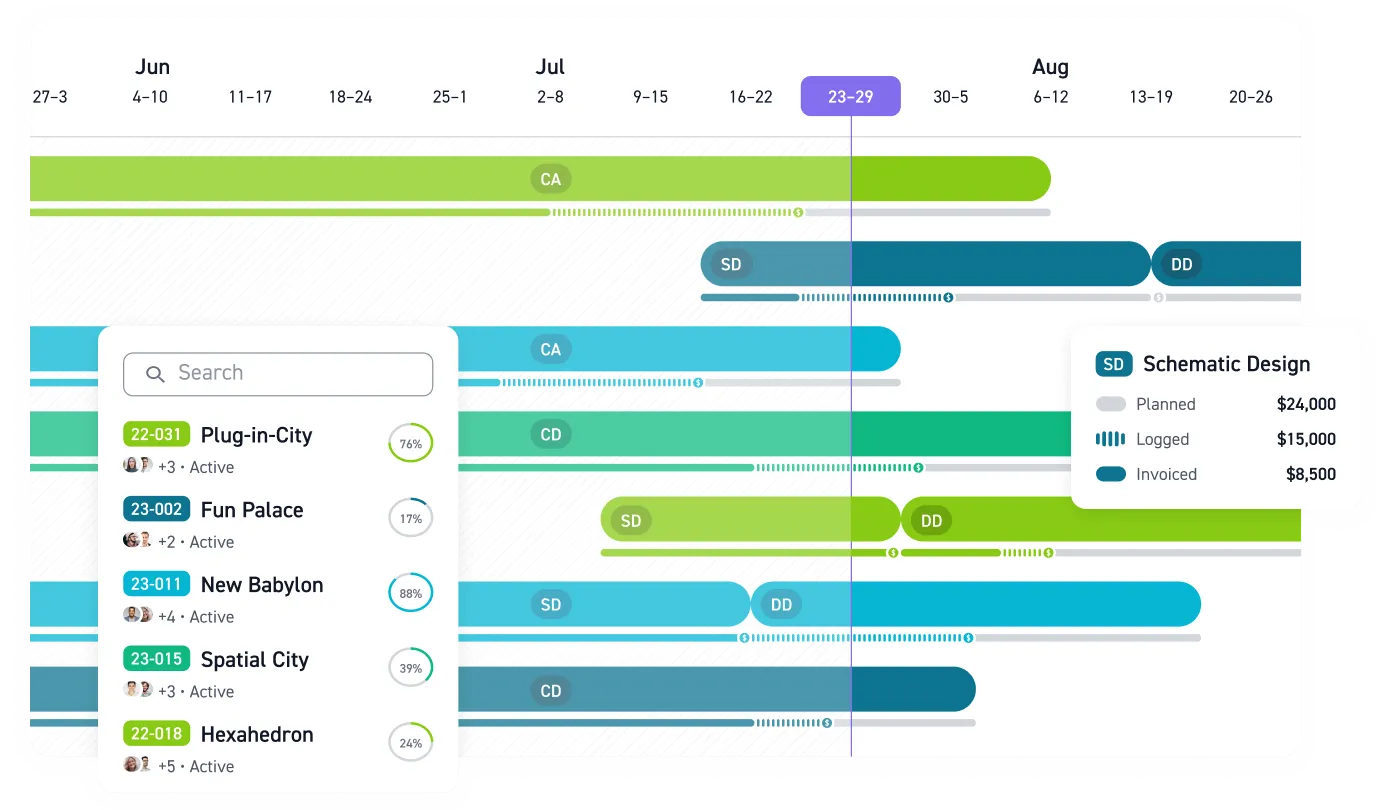
For smaller firms, purpose-built A&E project management platforms paired with QuickBooks often fit the operating need. At that stage, disconnected workflow usually creates the bigger problem. Monograph, for example, connects phase budgeting, time tracking, invoicing, and reporting in a single workflow, with QuickBooks Online handling the general ledger downstream. Monograph's MoneyGantt™ provides a Gantt chart with a cash-flow overlay tied to budget-to-cash progression, and Monograph's AI project setup can use uploaded contracts to generate budgets and schedules.
As firms grow, deeper billing controls and broader accounting needs start to matter more. The Monograph vs. Deltek Ajera comparison on Basebuilders frames one version of that trade-off by positioning Monograph as built for use by project managers, designers, and principals, while Deltek Ajera is characterized as a more ERP-style system with broader accounting functionality and a heavier implementation lift. That difference also shows up in firms moving off older tools: 66% time saved on admin, 50% faster billing, and 66% less budget overage were reported by Woodhull, a firm in Maine previously using BQE Core.
Larger firms often benefit from full A&E ERP with connected CRM, such as Deltek Vantagepoint, especially when leadership needs one system of record across pipeline, staffing, and delivery.
CRM Is the Underinvested Half
Many A&E firms focus their technology budgets on the project-to-paid workflow and underinvest in business development infrastructure. Relationship knowledge lives in principal memory, and pipeline visibility depends on informal forecasting instead of measured win rates.
Good CRM practice in A&E looks different from product sales. You need to track which clients generated the most revenue over time and measure proposal win rates by project type. Without that foundation, go/no-go decisions stay subjective, and AI-assisted pursuit tools have very little useful information to analyze.
Monograph's recently launched Pipeline feature connects leads, proposals, and revenue forecasting in one place. It connects pre-project business development with project delivery. For firms that need better visibility into pursuits before adding a standalone CRM, that creates structured pipeline tracking in the same workflow.
Choose the System That Fits How Your Firm Actually Works
The right answer depends on where your firm feels the most friction. If your problems show up in phase budgets, invoicing, WIP, and staffing, start with the delivery side. If your team is still managing pursuits from inboxes and scattered spreadsheets, start with the pipeline side.
A&E firms do better with software that treats the project as the center of the business. That means visibility into phases, budgets, billing, and pipeline in a way that matches how your firm wins and delivers work. Monograph brings those workflows together for firms that need project delivery and pipeline tracking to stop living in separate systems.
The cost of waiting shows up in every workaround. Book a demo.
Frequently Asked Questions
Does an A&E firm need both an ERP and a CRM?
Most firms need the functions both systems cover, but not always as two separate platforms. ERP handles project delivery after the contract is signed: phase budgets, time tracking, invoicing, WIP, and reporting. CRM handles everything before the contract: leads, proposals, pursuit tracking, and win rates. Smaller firms often run a purpose-built A&E platform with a lightweight pipeline tool. Larger firms with complex pursuits and multiple offices typically need a connected ERP and CRM with shared project records.
Can QuickBooks serve as the ERP for an A&E firm?
QuickBooks alone does not cover what A&E firms need. It does not model phase budgets, track utilization, handle subconsultant pass-through billing, or produce accurate WIP at the project level. Pairing QuickBooks Online with a purpose-built A&E project management platform covers the gap for smaller firms. The A&E platform handles project accounting and delivery workflows, and QuickBooks handles the general ledger downstream.
What makes A&E project accounting different from general project accounting?
A&E projects are organized by phases, each with its own fee allocation, staffing plan, and billing milestone. Revenue recognition has to follow phase-level progress, not overall project completion. Subconsultant costs need pass-through and markup tracking at the phase level. Projects also go on hold mid-phase, which means revenue accrual has to stop at the right measure-of-progress point. Generic accounting tools treat projects as line items, not as structured deliverables with their own financial logic.
When should a firm move from QuickBooks plus a project management platform to a full ERP?
The trigger is usually growth in billing complexity, multiple offices, or leadership needing one system of record across pipeline, staffing, and delivery. When phase-level billing controls, advanced revenue recognition, and consolidated reporting across business units start consuming significant administrative time, a full A&E ERP becomes the better fit. For most firms under 50 people, a purpose-built A&E platform paired with QuickBooks handles the operating need without the implementation lift of a full ERP.
What should A&E firms track in a CRM that product-focused CRMs miss?
A&E firms need to track win rates by project type, client revenue history over multiple years, pursuit costs against contract value, and relationship history at the firm and individual level. Product CRMs are built around short sales cycles, single decision-makers, and transactional deals. A&E pursuits run for months or years, involve multiple stakeholders on both sides, and depend on long-term relationships. The data structure has to reflect that.