


Firm management made easy

If you're the finance leader at an architecture or engineering firm spending more time hunting through spreadsheets than analyzing project performance, you're not alone. While your technical teams focus on design excellence and engineering precision, your finance department likely burns through 520 hours annually on manual accounts payable tasks alone, and that’s before accounting for time tracking administration, project budget monitoring, and cash flow forecasting.
According to research from leading A&E industry authorities, small-to-mid-size firms burn through 860-1,030 hours yearly on manual financial processes. That's equivalent to half a full-time employee dedicated solely to administrative tasks that modern systems can automate. Meanwhile, 45% of executives cite labor shortages as their primary concern, making every hour of administrative efficiency critical to firm survival.
Financial reporting automation creates the real-time project visibility that lets you focus on what matters: delivering exceptional work while maintaining healthy margins. The firms thriving in today's volatile market aren't necessarily the most creative or technically sophisticated. They're the ones with systems that provide instant answers to critical questions like project profitability by phase, resource utilization rates, and cash flow forecasting.
The Hidden Cost of Manual Financial Management
Architecture and engineering firms face financial complexity that generic accounting software wasn't designed to handle. Unlike businesses with straightforward revenue models, A&E firms must track costs and revenue across multiple project phases, coordinate consultant billing cycles, and manage work-in-progress calculations that comply with professional services accounting standards.
Tracking project and firm finances regularly while managing percentage-of-completion calculations across multiple concurrent projects is a core challenge for small to midsize firms. Each project operates through distinct phases. Schematic Design, Design Development, Construction Documents, Construction Administration require granular cost tracking that standard business accounting cannot provide.
This complexity creates cascading inefficiencies where finance teams manually collect timesheet data, allocate costs across project phases, chase down expense receipts, coordinate consultant invoices, and build cash flow forecasts in spreadsheets.
Economic volatility amplifies these challenges. The Architecture Billings Index dropped to 43.3 in September 2025, the lowest since April, forcing firms to revise revenue forecasts continuously without integrated financial systems.
Essential Automation Capabilities for Project-Based Work
Successful financial automation for A&E firms requires capabilities specifically designed for project-based professional services. Generic accounting software adaptations fall short because they lack the integrated workflows that connect time tracking, phase-based budgeting, and real-time project profitability analysis.
Phase-Based Budget Tracking and Cost Allocation
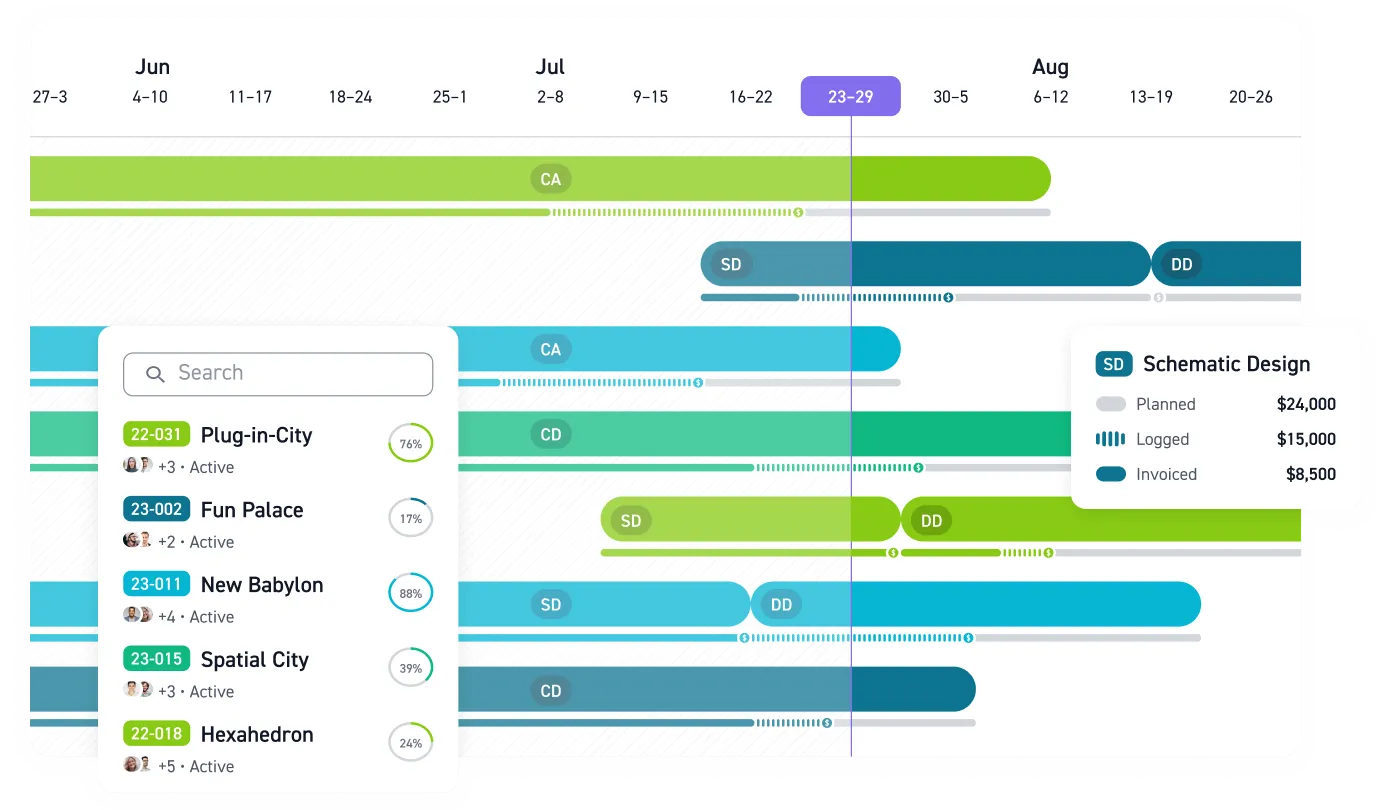
Effective systems allow phases to align one-to-one with your chart of accounts, so that the moment a designer logs two hours in SD you see the burn hit the SD budget line and the project timeline simultaneously. This real-time integration distinguishes A&E-specific platforms from adapted general business software.
Essential project financial capabilities to capture include:
- Time entries at both the phase and task level with automatic project financial updates
- Budget burn rates that provide early warning signals for scope adjustments or fee negotiations
- Real-time cost allocation based on employee hourly rates
- Direct integration between time tracking and invoicing processes
- Phase-level financial reporting that matches A&E contract structures
The impact of proper phase-based tracking is evident in firms like Woodhull, a 25-staff Maine architecture firm that achieved 66% time savings on administrative tasks and 50% faster billing processes after implementing integrated project-based accounting systems. This level of efficiency improvement demonstrates how automated phase tracking transforms operational workflows.
Monograph's signature MoneyGantt™ feature provides instant visual intelligence into project finances by combining traditional Gantt chart timelines with budget-to-cash progression (planned → logged → invoiced → paid). MoneyGantt™ delivers immediate insights into which phases and projects require attention without spreadsheet analysis.
Multi-Project Portfolio Management
A&E firms typically manage 10-30+ active projects simultaneously, requiring consolidated views across the entire portfolio. Leaders need to quickly identify which projects are performing well, which require attention, and how resource allocation affects overall firm profitability.
Effective automation provides multi-level visibility:
- Portfolio-level profitability across all active projects
- Project-level performance for individual client engagements
- Phase-level tracking for detailed project management
- Task-level granularity for time allocation and billing accuracy
Work-in-Progress and Revenue Recognition
Professional services firms face complex revenue recognition requirements under current accounting standards. Financial automation systems must handle percentage-of-completion calculations, work-in-progress reporting, and the ability to manage paused or suspended projects without triggering inappropriate revenue recognition.
Consultant and Subconsultant Coordination
Most A&E projects involve specialized subconsultants with different billing cycles, rate structures, and payment terms. Financial systems must track consultant agreements against project budgets, coordinate consultant billing timing with client invoicing schedules, and provide visibility into consultant burn rates to prevent cash flow problems.
Integration Strategy: Getting QuickBooks Online Right
Architecture and engineering firms choosing QuickBooks Online as their accounting foundation face unique integration challenges. While QuickBooks provides solid general accounting capabilities, BQE's setup analysis explains that while QuickBooks offers helpful accounting and job costing features, A&E firms often require more advanced tools such as phase-based budgeting, consultant coordination, and real-time project dashboards which can be provided by integrating with BQE CORE.
Chart of Accounts Architecture
The foundation of successful integration begins with a proper chart of accounts structure. A&E firms need specialized account configurations that accommodate phase-based tracking where each project phase maps to specific account categories. According to FastTracc Consulting's guidance, a well-structured chart of accounts should support detailed financial tracking for design, architecture, and engineering companies, including at the project or job level.
Integration success depends on mapping project phases to QuickBooks classes, items, or customer/job structures while preserving the ability to track time, expenses, and budgets at the granular phase level that A&E firms require.
Real-Time Data Synchronization Requirements
Effective integration eliminates the problems of disconnected legacy systems that block real-time data sharing and create workflow silos. These inefficiencies can force teams to spend significant time searching for budget data.
The integration architecture must automate three critical workflows: time tracking and budget monitoring integration, invoice creation and payment processing synchronization, and project status reporting with real-time financial data.
Audit Trail and Compliance Maintenance
Automation in professional services should support compliance and professional judgment while streamlining workflows, but human oversight is still crucial. Integration must include user permission controls spanning both project management and accounting systems, transaction logging that captures complete chains of automated actions, and regular reconciliation processes between systems to verify data integrity.
Key Success Factors
Financial reporting automation represents a strategic investment in operational efficiency and competitive advantage for A&E firms. The 860-1,030 hours annually consumed by manual processes can be redirected toward client service, business development, and strategic planning.
Success requires selecting platforms designed for project-based professional services, investing in proper integration architecture, and implementing change management programs that build financial literacy across technical teams. The firms positioning themselves for long-term success are doing more than just adopting technology. They're building financial management capabilities that provide real-time project visibility, empower project managers with actionable data, and create sustainable competitive advantages through operational excellence.
Your Path to Financial Automation Success
Start with an honest assessment of your current processes. Document how much time your team spends hunting for financial data versus analyzing it. Calculate the true cost of those 860+ annual hours consumed by administrative tasks that automation could eliminate.
For Project Managers: Focus on platforms that provide real-time budget visibility and automated alerts before projects go over budget. Look for systems that integrate time tracking with profitability analysis so you can make course corrections while there's still time.
For Operations Leaders: Prioritize solutions that streamline your billing cycles and provide cash flow forecasting based on actual project data. Seek platforms that coordinate consultant billing with client invoicing to eliminate payment timing delays.
For Principals and Owners: Invest in A&E-specific systems that understand phase-based projects, consultant coordination, and fixed-fee accounting requirements. Choose platforms built by practitioners who understand your unique challenges, not generic business software adapted for professional services.
The firms implementing financial automation today will dominate the market tomorrow. Start your automation journey with Monograph.
Frequently Asked Questions
How long does it take to see ROI from financial reporting automation?
Most A&E firms see immediate time savings within 4-6 weeks of implementation, with full ROI typically achieved within 6-8 months. The key is choosing systems designed specifically for project-based work rather than adapting generic business software. Firms often recover their investment costs through improved billing efficiency alone. Faster invoicing and better cash flow provide quick returns.
Will financial automation work with our existing QuickBooks setup?
Yes, but integration depth varies significantly between platforms. Look for two-way synchronization that eliminates double-entry. Your time tracking should flow automatically into invoices, and payments should sync back to update project profitability in real-time. The best A&E-specific platforms integrate seamlessly with QuickBooks Online while adding the phase-based tracking and consultant coordination that QuickBooks lacks.
How do we handle staff resistance to automated time tracking and financial reporting?
Focus on demonstrating value rather than imposing requirements. Show your team how automation eliminates administrative busywork so they can focus on design and technical work. Start with willing early adopters, showcase their improved efficiency, and let success stories drive broader adoption. Most resistance dissolves when staff see automation reducing their administrative burden rather than adding to it.
What happens to our financial data if we need to pause or suspend projects?
This is where A&E-specific platforms shine compared to generic business software. Purpose-built systems handle the reality that 25-30% of projects are paused at any given time. They maintain accurate revenue recognition, preserve project budgets during dormancy, and provide clear restart procedures when projects resume. Generic accounting software often creates compliance issues with paused project revenue recognition.
Can small firms (5-15 people) justify the cost of financial automation platforms?
Small firms often see the greatest relative impact from automation because they can't afford dedicated administrative staff. When your principal spends 10 hours weekly on manual financial tasks, automation pays for itself quickly. Start with core capabilities like integrated time tracking and automated invoicing, then expand as your firm grows. Many platforms offer scalable pricing that grows with your team size.