

A project report showing red numbers at closeout rarely reveals a problem that started during execution. Most of the time, the loss was set at fee negotiation or allowed to compound through invisible overruns. The report only confirms what nobody caught early enough to fix.
For project managers at A&E firms, the data already exists in timesheets, invoices, and budgets. But those records live in different systems, get reviewed at different times, and tell different stories depending on who's reading them. A project report works when it pulls scope, fee, schedule, and effort into one view you review often enough to change behavior before margin disappears.
Three Numbers That Reveal Everything
Every useful A&E project report tracks percent complete, percent spent, and percent billed together, then reads the gaps between them. Compare percent spent and percent complete separately instead of collapsing them into a single indicator.
Each metric captures a different dimension of project health:
- Percent complete measures physical progress toward phase deliverables. PMs estimate it from independent judgment about the work completed against the phase scope.
- Percent spent tracks fee or hours consumed as a percentage of the phase budget. This comes from accounting.
- Percent billed shows the invoiced amount as a percentage of the phase fee.
Those numbers become useful when a PM reads the gaps between them. When percent spent runs ahead of percent complete, the project is burning fee faster than it's producing deliverables. When percent complete exceeds percent billed, the firm has earned income it hasn't invoiced yet, putting cash flow at risk.
A Template Built for A&E Workflows
Generic project management templates fail A&E firms because they don't reflect phase-based fee structures, consultant coordination, or the dual budget obligation built into standard owner-architect agreements. A&E project reports should track the firm's design fee budget and the owner's construction cost estimate separately.
A practical A&E project report template includes these sections:
- Project header: Project name, PM, contract type, total fee, and net service revenue after subtracting consultant fees and reimbursables.
- Phase-level tracking: Phase-by-phase fee allocated, hours budgeted, hours burned, PM-estimated percent complete, earned value, cost variance, and status flag.
- Resource utilization: Staff-level chargeability rates against budgeted hours remaining.
- Financial summary: Net service revenue, billed-to-date, collected-to-date, work in progress, and estimate at completion.
The contract type field matters. Under lump-sum agreements, every hour over budget reduces margin directly.
Phase Gates Are Reporting Triggers
Basic services under standard agreements are organized into sequential design phases, with owner approvals required at each transition. Schematic Design closes when the owner approves the schematic design documents. That approval becomes a billing trigger, a scope baseline for the next phase, and a contractual record the PM should document.
The Design Development phase carries particular weight. If the project exceeds the owner's budget at the end of DD, the owner and project team may need to revisit the budget, scope, or whether to proceed. Each gate is a chance to confirm scope alignment and protect margin before the next phase begins.
KPIs That Actually Change Behavior
A firm's annual plan might list better profitability as a goal, but reporting profitability on a financial statement arrives too late to change behavior. The metric arrives after the conditions that produced it are already in place.
The most widely used KPIs in the architecture profession, according to AIA guidance, include:
- net multiplier
- overall payroll multiplier
- utilization rate
- overhead rate
All can be derived from data firms already collect through timesheets, invoicing, and expenses.
Monograph's 2026 Architecture & Engineering Business Benchmarks Report, built from real platform usage data across 13,000+ architects and engineers across 1,800+ firms, shows the performance gap. High-performing firms bill 34% more hours than low performers, and firms investing in AI tools achieve 100% average realization rates while baseline firms average 96%.
Those gaps close with regular labor monitoring, phase-level earned value tracking, and reports that surface overruns before they become irreversible.
Why Spreadsheets Can't Keep Up
Across the A&E industry, many firms still rely on manual data entry for accounting and finance functions, and administrative time spent maintaining reports and records remains a significant operational challenge. These patterns persist even as AI adoption climbs, because automation layered on top of fragmented data produces unreliable results.
The root cause is tools operating in silos. Time tracking lives in one system, budgeting in another, billing in a third. Assembling a project-level view requires the same manual reconciliation PMs are already drowning in.
Workbench, a 30 staff California firm, reported 8x faster staffing, 4x faster billing process, and 75% less unbilled fees. Those gains matter because a project report is only useful when the underlying data is current enough to support decisions before overruns become permanent.
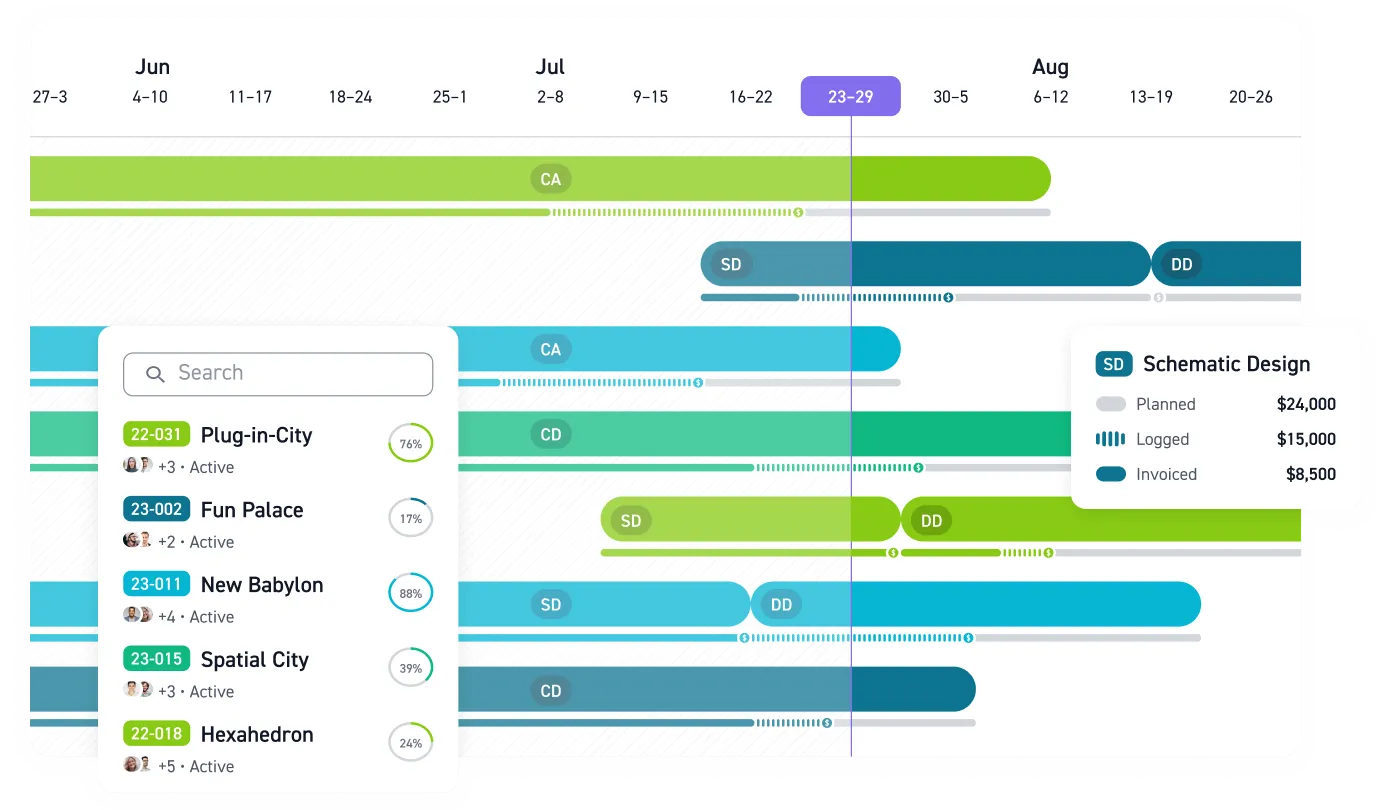
Monograph addresses this with MoneyGantt™, a visual timeline that maps fee burn against phase milestones so PMs can see budget health and schedule position in a single view. Time tracking feeds directly into budget analysis, and a connected accounting workflow reduces double-entry.
Building a Reporting Rhythm
The cadence of review matters as much as the content.
- Regular project reviews: Compare planned versus actual labor effort at the phase level. Weekly labor monitoring surfaces staffing misalignment and scope creep soon after they appear.
- Periodic financial reviews: Aggregate project-level multiplier and utilization data upward to PM and department views. Track Average Days in WIP and Average Days in A/R as separate cash flow metrics, since WIP age is a leading indicator of cash flow problems and can often be improved through prompt invoicing.
- Benchmark reviews: Compare project performance against external benchmarks using industry benchmark comparisons and A&E performance benchmarks.
This rhythm gives PMs regular chances to catch drift before it becomes a write-off.
Stop Letting Project Reports Confirm Problems You Could Have Caught Earlier
Most margin problems start when percent spent, percent complete, and percent billed drift apart and nobody sees the gap early enough to respond. If your PMs are still stitching together reports from disconnected systems, you already know how easy it is for a small overrun to become a permanent loss.
Monograph gives A&E firms one place to track budgets, time, billing, and phase performance together. MoneyGantt™ makes fee burn and milestone progress visible in the same view, so project managers can catch labor creep earlier, finance teams can bill with better timing, and principals can see which projects need attention before the month is gone.
The next overrun is already forming somewhere in your backlog. Catch it while you still have options. Book a demo.
Frequently Asked Questions
How often should A&E firms review project reports?
A regular review cadence is the right baseline for active project oversight. Frequent reviews help PMs catch staffing misalignment and scope creep early, while broader monthly-style reviews roll those project signals up into profitability and cash flow metrics.
What should a project report template include for fixed-fee work?
At minimum, it should include project header details, phase-level tracking, resource utilization, and a financial summary. For fixed-fee work, the critical fields are fee allocated by phase, hours budgeted, hours burned, percent complete, percent spent, percent billed, and estimate at completion.
Who should decide percent complete?
Percent complete should come from the PM's judgment about physical progress toward phase deliverables. Hours or billing should not drive that estimate.
Can a small firm manage this without adding more admin work?
Yes. The reporting process has to avoid manual reconciliation across separate tools. Connecting time tracking, budget analysis, and billing in one workflow reduces the administrative burden and makes regular review realistic.