

Among architecture firms billing between $250,000 and $1 million, only 49% track their utilization at all. Among firms billing $5 million or more, 91% track it. That gap is where the performance advantage lives. Firms tracking labor efficiency can adjust before margins slip, while firms working off gut feel only learn how bad the leak was when the financials close on it.
A utilization report connects how your team spends hours to whether those hours turn into collected revenue. For project managers and finance leaders at small and midsize A&E firms, it's the operational backbone of predictive project management: using real performance data to forecast outcomes before problems show up on an invoice.
What a Utilization Report Should Actually Measure
The utilization rate is straightforward. Billable hours divided by total available hours. Tracking that number in isolation, though, creates blind spots. A project architect can look productive on paper while still losing money if some of those hours get disputed, written down, or never collected.
Industry analysis confirms what experienced PMs already know: utilization alone doesn't tell the full story. A useful utilization report tracks three metrics together so each one catches what the others miss:
- Utilization rate is billable hours divided by total available hours. It measures how much of your team's paid time goes toward client work.
- Billability rate is billable hours divided by hours worked, excluding PTO from the denominator. It isolates productive time allocation from absence.
- Realization rate is hours invoiced and collected divided by hours billed. It catches revenue lost to write-downs, scope creep absorption, and discounted billing.
A complete utilization report connects these three so you can see whether your team's work is converting to revenue, not just whether people are busy.
Role-Based Targets Replace the Single Number
If holding a principal to the same utilization target as a production architect has ever felt off, your instincts are right. A firm-wide number creates perverse incentives. Principals and senior leaders spend significant time on business development, client management, and mentoring. Penalizing that non-billable work undermines the activity that keeps the firm alive.
Monograph's benchmark report puts the gap at nearly 10 more billable hours per week between high performers and low performers. That spread reflects right-sized expectations by role and disciplined management of the composite rate.
Composite utilization rate is the operationally meaningful metric for capacity planning. Each person's cost multiplied by a market-specific direct labor multiplier produces a billing rate. That rate multiplied by available hours produces possible revenue. Possible revenue multiplied by the targeted utilization rate produces the revenue a firm can expect. Comparing that number against your backlog tells you whether to hire or how aggressively to fill the pipeline.
Utilization Data as a Leading Indicator
Most A&E firms treat utilization as a rearview-mirror metric, reviewed after the month closes. Predictive project management uses the same data to look forward. Tracking actual hours charged against budgeted hours by phase lets you estimate cost at completion, flag capacity shortfalls before demand peaks, and tell a project that's over-budget because work is ahead of schedule apart from one that's over-budget because work is behind.
That shift from reactive to predictive management produces measurable results. Firms implementing basic tracking systems can see 15-20% performance gains in the first year, showing what visibility can do before a firm builds anything sophisticated.
Four capabilities built from utilization data make the difference:
- Budget burn forecasting: Track hours consumed against budgeted hours per phase. When schematic design burns too much of its budget too early, you catch the overrun while a change order is still possible.
- Capacity gap forecasting: Track resource allocation by role across active projects so you know when a structural engineer or BIM technician is approaching full allocation before demand spikes.
- Profitability projection: Compare your firm's utilization against peer benchmarks and your own financial multipliers to forecast operating margin instead of reconstructing it after the close.
- Scope creep detection: Realization rate tracked at the project level exposes where delivered work exceeds what's been invoiced.
These views turn utilization from a staffing metric into an early-warning system for revenue recovery.
The underlying data infrastructure matters as much as the analysis. Firms relying on disparate spreadsheets for project resource data make reliable forecasting much harder. A connected system where timesheets, budgets, and billing feed the same reports is the prerequisite.
The Financial Chain: From Time Entry to Cash
For finance leaders, the utilization report sits upstream of every revenue metric. When utilization drops, the overhead rate rises automatically because the same fixed indirect costs spread across a smaller base of billable labor. A decline in utilization ripples through overhead and multipliers in the same month.
The cascade from time entry to cash collection runs through several pressure points where small inaccuracies compound into real revenue loss:
- Inaccurate or delayed time entries degrade the utilization data that feeds invoice generation.
- Loose percent-complete estimates produce work-in-progress figures that are wrong from the start.
- Over-estimated completion creates overbilling risk on projects that haven't earned the revenue yet.
- Under-estimated completion conceals unbilled WIP that should already be on an invoice.
Better operational data shows up directly in billing performance. After switching practice management platforms, Garrison Architects cut monthly invoicing time by 66% and accelerated time-to-payment by 2.6x.
Personnel costs represent 50-65% of expenses at professional services firms. Revenue recovery starts with knowing where the hours go and redirecting the ones that aren't producing revenue.
Putting the Report to Work
The gap between firms tracking utilization and firms ignoring it is wider than the gap between firms running basic systems and sophisticated ones. If you're still managing from spreadsheets, the highest-return move is consolidating timesheets, budgets, and billing into one platform so every metric updates automatically.
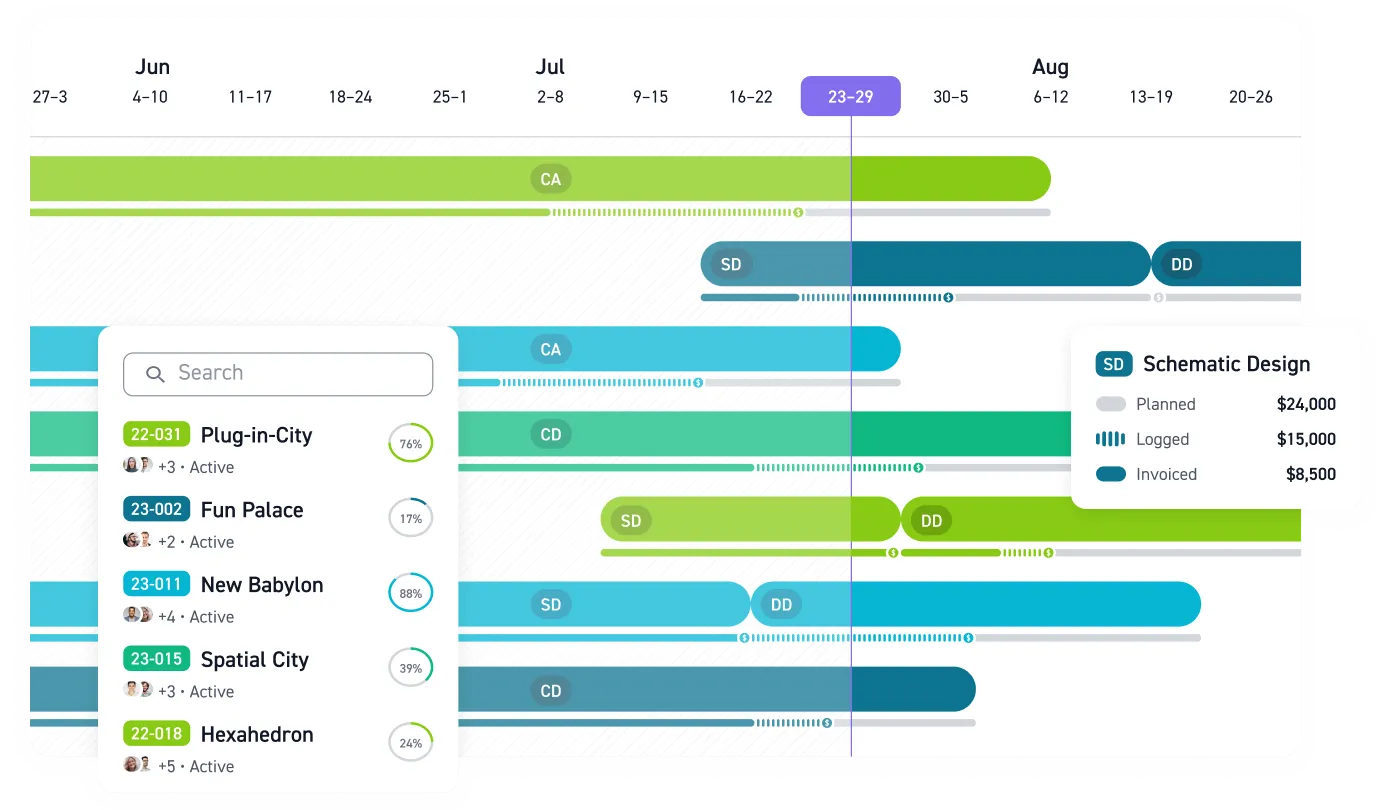
Monograph connects these workflows for A&E firms with real-time utilization monitoring, phase-based planning, and capacity forecasting. Monograph's MoneyGantt™ adds visual budget-to-cash progression across project phases, making financial progress easier to read at a glance. Across customer outcomes, the common thread is that better tracking surfaces revenue that was already there but invisible to the team.
Start by defining your utilization formula and applying it consistently across staff. Then connect utilization to realization and your net multiplier. Those numbers tell you whether your team's time is turning into collected revenue, and they give you enough signal to act before the monthly financials arrive too late to matter.
Stop Letting Utilization Gaps Turn Into Revenue Leaks
A utilization report only helps when the team can act on it fast and when it serves multiple stakeholders at once. Principals need visibility into capacity and revenue recovery. For project managers, the report has to surface phase-level data clean enough to use before budget drift becomes a write-down. Operations and finance leaders need timesheets, budgets, and billing connected so a single source can support staffing decisions, invoice timing, and cash flow.
Monograph brings those workflows together for A&E firms. With real-time utilization monitoring, phase-based planning, capacity forecasting, and Monograph's MoneyGantt™ budget-to-cash visibility, your team can see where billable time is slipping, where realization is falling, and where revenue is getting stuck before month-end closes the window to respond. Book a demo.
Frequently Asked Questions
How often should an A&E firm review utilization reports?
Review utilization often enough to support staffing and forecasting. If you're waiting until month-end to look at hours, realization, and budget burn, you're seeing the problem after revenue has already leaked.
What's the difference between utilization, billability, and realization?
Utilization measures billable hours against total available hours. Billability measures billable hours against hours worked, with PTO removed from the denominator. Realization measures hours invoiced and collected against hours billed, which shows whether the work your team performed actually turned into revenue.
What if our team resists time tracking?
Resistance usually drops when the data is used to improve planning instead of policing people. Staff are more likely to track time consistently when timesheets feed into project budgets, staffing decisions, and billing.
Can a small firm benefit from utilization reporting without a full finance team?
Yes. Even basic tracking improves visibility and performance. Small firms have less room to absorb hidden write-downs, delayed billing, and unfilled capacity, so a clean utilization report can have an outsized impact.
Data was collected as of April 2026.