


Firm management made easy

Architecture and engineering firms face a critical decision in 2025. Only 27% of AEC firms currently use AI for automation and decision-making. Meanwhile, 63% of engineering firms are developing strategies to use AI. The window for early adoption is narrowing fast.
The firms that move now aren't bleeding-edge innovators. They're just the ones preparing themselves before AI becomes table stakes. Traditional project progress reporting consumes significant administrative time that principals and project managers could redirect toward design, client relationships, and technical leadership.
Many firms manage project updates across multiple platforms. Project-based ERP systems, consultant collaboration tools, and billing systems all require coordination. According to a 2024 AIA survey, 84% of architects are optimistic about AI's potential to automate manual administrative tasks. Yet only 6% of architects currently use AI tools regularly, with just 8% of leading firms having integrated AI into workflows.
AI-powered reporting addresses this gap. It changes how A&E firms understand and manage project performance. The shift moves from weekly manual compilation to continuous automated aggregation. This provides real-time exception flagging and phase-based progress tracking aligned with design deliverables.
Understanding AI Capabilities for Project Progress Reporting
Modern AI platforms offer A&E firms eight distinct capabilities. These include computer vision-based progress monitoring, predictive analytics, intelligent document processing, quality control automation, generative AI for documentation, multi-source data aggregation, adaptive learning systems, and natural language processing for communications. Each of these fundamentally changes project management workflows.
Unlike generic business tools, these systems can understand design phases, consultant coordination, and project-based accounting requirements that make A&E firms unique. Computer vision systems track construction progress by analyzing site photos against BIM models. They provide objective completion percentages without manual site walks.
Natural language processing improves document management by automatically extracting key data from RFIs, submittals, and field reports. So instead of spending hours manually processing consultant communications, AI systems categorize information and flag urgent items requiring immediate attention.
Predictive analytics analyze historical project data to identify patterns invisible to manual review. These systems learn from every completed project, making institutional knowledge accessible across teams. The result is earlier intervention on budget overruns and schedule slips, not reactive management after problems compound.
Implementing AI Integration in Three Practical Phases
Successful AI implementation for A&E firms requires a structured approach that respects existing workflows while introducing automation incrementally. Research indicates that 64% of AEC firms use HR information systems, with 44% reporting AI capabilities. This highlights the importance of smart positioning as AI adoption accelerates within specific business functions.
Phase 1: Foundation and ERP Integration
Start with your existing project-based ERP system as the foundation for AI integration.Map current project reporting workflows to identify the highest-impact automation opportunities. Firms should focus on automating time-consuming tasks like email organization. Prioritize repetitive tasks that consume significant administrative time.
Establish success metrics aligned with A&E business models. Define specific KPIs for design phase progression and financial performance. Track design phase metrics including time to complete each design phase (SD, DD, CD, CA), consultant coordination efficiency through RFI response times, and drawing coordination quality via clash detection resolution.
Monitor financial performance metrics including project budget variance by phase and discipline, revenue recognition timing accuracy, utilization rate improvements by role, and administrative time reduction for PMs and principals. These metrics demonstrate ROI in terms that resonate with both technical teams and firm leadership.
Phase 2: Pilot Implementation with Small Wins (Months 4-6)
Start with small wins to build momentum rather than enterprise-wide change. Select 2-3 pilot projects representing diverse conditions. Choose different project delivery types, different design phases, varied fee structures, and projects requiring consultant coordination.
Essential pilot selection criteria include:
- Project variety: Mix architectural and engineering projects across different delivery types
- Phase diversity: Include projects in SD, DD, and CD phases to test phase-specific automation
- Consultant complexity: Choose projects requiring external coordination to validate multi-firm workflows
- Fee structure mix: Test both hourly and fixed-fee projects to ensure billing integration works correctly
Configure AI workflows to respect design milestone deliverables and integrate with drawing production schedules. External consultant access controls and permissions become critical during this phase. Integration with collaboration platforms like BIM 360 or ProjectWise ensures seamless coordination.
Phase 3: Firm-Wide Rollout and Continuous Improvement
Align AI reporting capabilities with revenue recognition practices essential for A&E firms. Percentage of completion calculations must tie to design phase progress. Timesheet approval automation should link to project phases. Budget variance alerting needs to respect phase-based fee structures.
These systems have to centralize project data as well as manage projects and people. AI progress reporting must enhance these core functions. Critical integration points include project accounting integration, timesheet approval automation, invoice generation based on milestone completion, and budget variance alerting for phase-based fees.
Establish continuous improvement frameworks that use industry peer networks. Compare your learnings to implementation successes and failures from similar firms. Annual benchmarking helps validate budgets and timelines against peer experiences.
Measuring ROI and Performance Improvements
Real-world results from implementing AI-powered project progress reporting demonstrate measurable improvements in administrative efficiency and project delivery. Cascadia Architects, an 11-19 employee firm, 1.5 hours saved per meeting on report preparation while growing 73% in staff size without proportional increases in administrative overhead.
And HDG Architecture changed operational planning across 50-60 monthly active projects. They can now anticipate several weeks or months out what's coming down the pike instead of jumping from deadline to deadline. This shift from reactive to proactive project management represents fundamental workflow change.
Industry evidence supports these outcomes. Bluebeam's 2026 report shows that 94% of AI users plan to increase investment, indicating positive returns justify continued commitment despite implementation challenges.
Integrating with A&E-Specific Workflows and Systems
Successful AI implementation requires deep integration with design phase workflows that generic project management tools cannot accommodate. The progression from Schematic Design through Construction Documents involves distinct deliverables, coordination requirements, and billing structures that AI systems must respect and enhance.
The true power of AI lies in automating tasks within existing project-based workflows rather than replacing them. This requires native integration with project accounting systems, BIM platforms, and consultant coordination tools.
Throughout project delivery, AI-powered systems enhance progress tracking and coordination. A&E firms are implementing AI across multiple project management areas including predictive analytics for schedule and resource planning, intelligent document processing for administrative automation, and multi-source data aggregation into real-time dashboards.
Project-based accounting integration becomes critical for firms managing complex fee structures. Our research shows A&E firms handle billing rates across 33 position levels while navigating fee structures ranging from hourly billing to percentage-of-construction-cost arrangements. AI automation handles this complexity while maintaining accuracy essential for profitability.
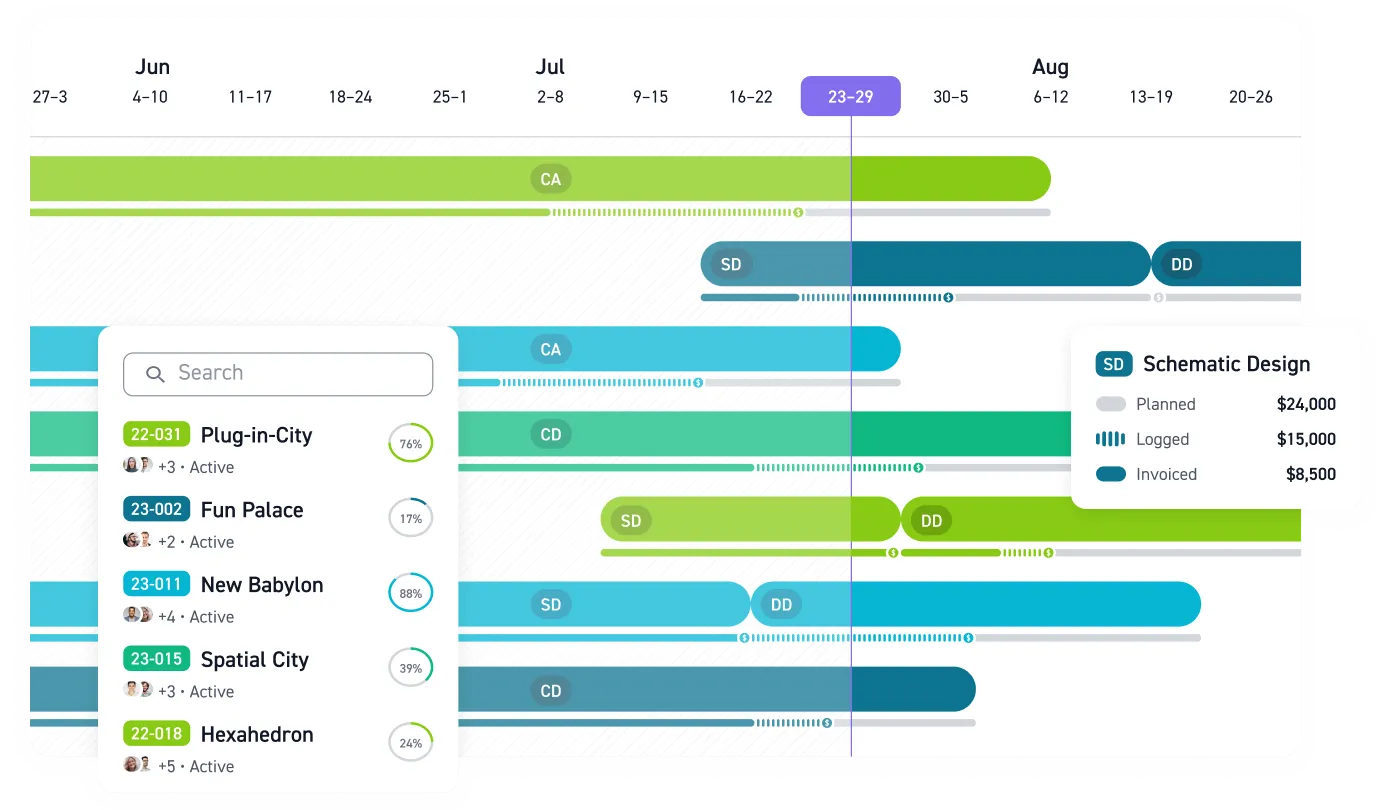
Modern platforms like Monograph provide a complete set of project accounting capabilities specifically designed for A&E workflows. Monograph serves 13,000+ architects and engineers across 1,800+ firms with automations that improve business operations from individual project tasks to firm-wide financial management. Monograph's signature MoneyGantt™ feature makes complex financial data visible and actionable through simple visual insights, showing budget-to-cash progression across all projects. These specialized solutions understand phase-based billing, consultant coordination, and real-time project profitability tracking that generic platforms cannot match.
Positioning for 2025-2026 Market Opportunity
The current adoption landscape presents a smart opportunity for firms implementing AI-powered project progress reporting in 2025. With 60.3% of AEC firms citing labor shortages as their top concern, automation becomes a direct response to industry-wide capacity constraints.
Firms delaying implementation beyond 2026 risk falling behind as AI-enabled competitors establish advantages in project delivery speed, resource efficiency, and profitability visibility. However, current adoption data indicates most peers remain in planning stages. The latest research estimates that only 27% of AEC firms currently use AI. But 94% of current users plan to increase investment in the next year.
Change Your Project Reporting with Monograph
You know the pain: three hours compiling status reports from spreadsheets, QuickBooks, and email threads while your team waits for project updates. Your principals spend mornings hunting for budget data instead of leading design reviews. Project managers chase consultants for coordination updates across five different platforms.
While your competitors implement generic project management tools that don't understand design phases or consultant coordination, Monograph delivers A&E-specific workflows that respect how you actually work. Built by former architects who spent years managing the same reporting chaos you face today, our platform handles phase-based billing, consultant coordination, and real-time profitability tracking that generic platforms cannot match.
Over 13,000 architects and engineers across 1,800+ firms have already made the switch. Firms using Monograph report 67% improvement in business task efficiency and invoice 2.3x faster than before. That's time redirected from administrative compilation to design excellence and client relationships.
Your competitors are already moving. Close the gap. Book a demo.
Frequently Asked Questions
Will AI-powered reporting work with our existing systems?
Yes. Modern AI reporting platforms are designed to integrate with existing project-based ERP systems like Deltek Vision and Vantagepoint rather than replace them. The key is choosing solutions that offer native integration with your accounting system. Monograph, for example, provides two-way QuickBooks Online synchronization while respecting phase-based billing structures and project accounting requirements. Start with your current ERP as the foundation and layer AI capabilities on top to enhance rather than disrupt existing workflows.
How long does it take to see ROI from AI project reporting?
Most A&E firms see measurable results within 2-4 months of pilot implementation. The three-phase implementation approach outlined in this guide provides a realistic timeline: foundation setup (months 1-3), pilot testing (months 4-6), and firm-wide rollout (months 7-12). Focus initial pilots on high-impact areas like status report compilation to demonstrate value quickly.
What if we don't have clean historical project data?
You don't need perfect historical data to start benefiting from AI-powered reporting. Begin by establishing clean data capture for new projects and pilot implementations, then gradually backfill historical information as time permits. AI systems actually help improve data quality over time by identifying gaps, inconsistencies, and patterns in your existing information. The key is starting with current projects where you can control data input while the system learns your firm's workflows.
Do we need technical expertise to implement AI reporting tools?
No programming or deep technical knowledge required. Modern AI reporting platforms for A&E firms are designed for practitioners, not developers. Solutions like Monograph handle AI automation behind the scenes while presenting familiar project management interfaces that architects and engineers already understand. Implementation focuses on configuring workflows to match your design phases, fee structures, and consultant coordination processes. These are decisions that require A&E expertise, not technical programming. Most firms complete pilot implementations with standard project manager involvement and minimal IT support.