
Monday morning, a client asks for a budget update, and suddenly you're toggling between a spreadsheet, your time tracking app, an email thread with your structural consultant, your MEP engineer's change order, and QuickBooks. All to piece together a number you should already have. By the time you've got the answer, an hour is gone. Multiply that across every project, every week, and you start to see the problem.
Architecture firms need more than better tools. They need a better way to connect the tools, data, and decisions that keep a practice running. That's what an architecture operating system is built to do.
The Real Cost of Running Your Firm on Disconnected Tools
More than half of A&E firms recognize their technology has fallen behind. Industry survey data shows that roughly two-thirds of firms flagged financial planning as the top process needing modernization, with task management and project management as separate processes requiring modernization. The result: a patchwork of spreadsheets, standalone time trackers, accounting software, and whatever project management app someone introduced years ago. It works. Until it doesn't. And when it fails, the cost is substantial. AIA benchmarking data indicates that indirect (non-billable) labor consumes nearly one-quarter of total firm revenue, representing a massive share of overhead that integrated systems could significantly reduce.
The downstream effects hit every part of the business:
- Profitability blindness. When time tracking lives in one system and project accounting in another, you can't calculate project profitability until well after problems have occurred, eliminating mid-project course correction.
- Cash flow disruption. Billing systems disconnected from project delivery mean invoicing delays, poor visibility into accounts receivable, and cash flow gaps that hit small firms hardest.
- Stale decision-making. By the time you've manually compiled utilization, budget burn, and project status from three different sources, the data is already outdated.
- Missed delivery targets. Firm performance data consistently shows that practices investing in project management software deliver projects on time and on budget more often, while firms that acknowledge their project management process needs modernization are more likely to not track project progress at all.
Firms don't lack data. But their data lives in silos, fragmented across time tracking systems, project management tools, accounting software, and spreadsheets that never communicate with each other.
What an Architecture Operating System Actually Is
An architecture operating system is an integrated practice management platform that connects every operational layer of your firm, from time tracking and project budgets to resource planning, invoicing, and business intelligence, within a single, real-time system built specifically for A&E workflows.
Picture a building's structural system. You don't see it, but everything depends on it. Without it, each floor operates independently and the whole thing is unstable. With it, every element works together.
The concept goes beyond swapping one tool for another. Replacing the patchwork of disconnected point solutions with a unified platform means that time logged on a Tuesday morning flows directly into project profitability calculations, resource forecasts, and invoicing, with no one re-entering data or reconciling spreadsheets. Monograph, for example, operates as an all-in-one platform built exclusively for architecture and engineering workflows, consolidating project management, business development, project delivery, and financial systems into a single environment. 13,000+ architects and engineers across 1,800+ firms use Monograph to work smarter, and firms using the platform add 21% more revenue on average in their first year.
The goal: one source of truth for your entire practice.
Why Generic Project Management Tools Fall Short
Asana, Monday.com, and Trello were not designed for architecture and engineering firms. The gap goes deeper than missing features. These tools are built around flexible, customizable workflows and multiple views (Kanban boards, Gantt charts, calendars) rather than assuming only linear task progression or agile sprints. They can be configured for multi‑disciplinary coordination, but most generic tools don't natively support the full phase‑gate structure with regulatory checkpoints that defines how many A&E firms actually deliver work.
Architecture projects demand workflows that generic tools simply can't accommodate:
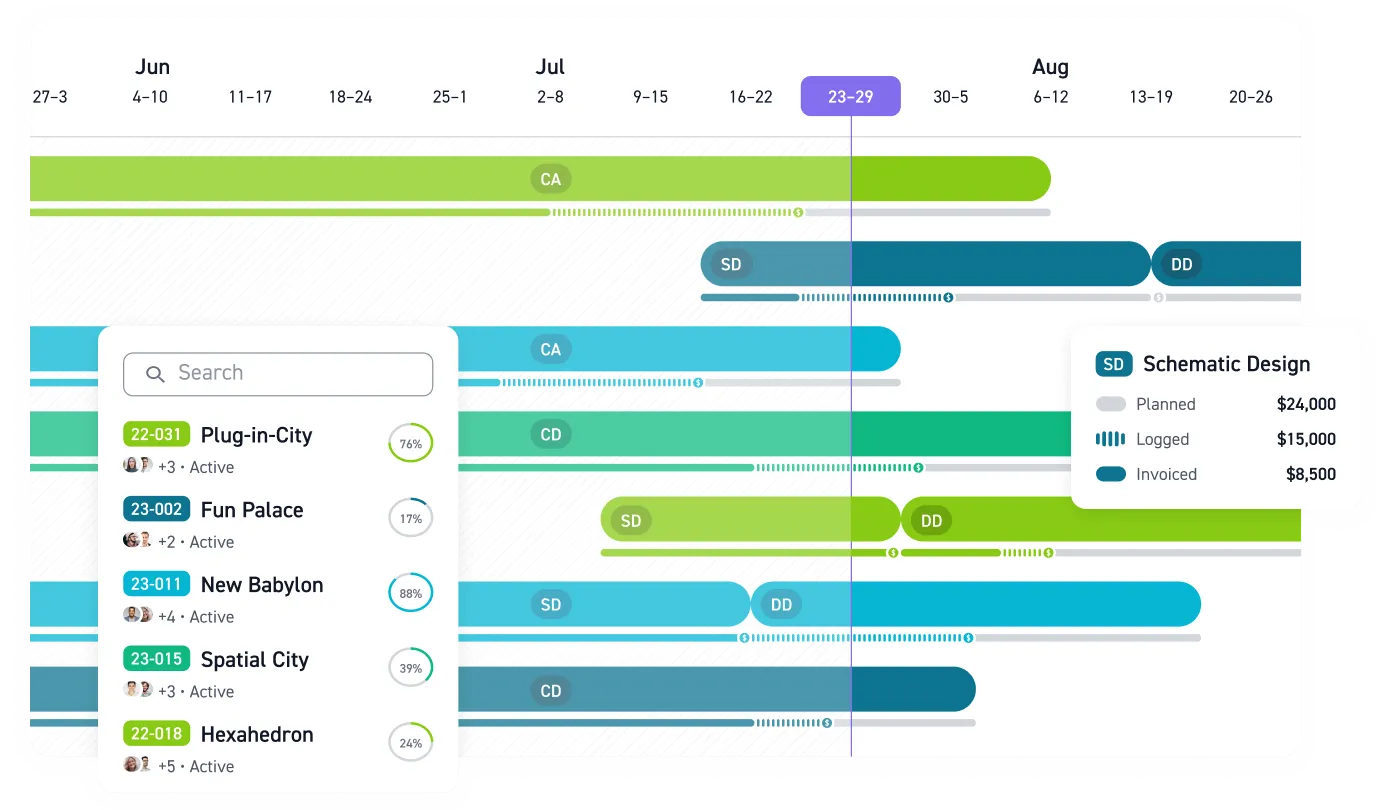
- Phase-gate delivery with regulatory approval checkpoints at each stage, from SD through CA, each with its own deliverables and approval gates
- Phase-based fee allocation (SD at 15%, DD at 20%, CD at 40%, CA at 20%) that doesn't fit hourly billing models
- Multi-disciplinary coordination across architects and multiple engineering consultants
- Construction document management with version control and specification tracking beyond simple file attachments
- Construction administration responsibilities including RFIs, submittals, and site observation that extend well beyond design completion
Then there's licensure. Professional licensing standards require architects to manage specific competencies around responding to changes in project scope and documenting project decisions. These are professional obligations that demand specialized workflows.
The friction comes from forcing A&E practice into tools that were never designed for it.
What an Architecture Operating System Should Include
Not every platform that claims to serve A&E firms actually delivers on the operating system concept. Here's what matters most for firm leaders evaluating their options:
- Phase-based financial tracking. Real-time visibility into how fees are burning across each project phase, not a retrospective report you get three weeks after the damage is done. Financial KPI guidance for A&E firms recommends that platforms show how dollars move from planned through logged, invoiced, and paid in one continuous view.
- Utilization and capacity planning. You need to know what your team will be working on three to six months out, not just what's happening this week. Under-utilized teams erode margins; over-utilized teams burn out.
- Hierarchical time tracking. Architecture billing requires understanding which project, which phase, and which task consumed hours. Software that supports project-stage-task hierarchies gives teams the clarity to log time accurately.
- Integrated invoicing and accounting. Project-level financial data should sync with your accounting system, like QuickBooks Online, without manual re-entry.
When these capabilities work together in a single platform, firms replace hours of spreadsheet hunting with live insight. Integrated A&E platforms have been shown to drive 25% profit gains for firms making the switch.
The Numbers Behind the Shift
The performance gap between firms that invest in integrated systems and those that don't is stark. A&E industry benchmarking shows that 67% of tech-forward firms project profit rates of at least 20%, compared to just 52% of tech-static firms. Tech-forward firms are also 2.5 times more likely to consider their project management and resource management processes very mature.
The utilization data tells a similar story. While the median utilization rate sits at 82.4%, top-quartile firms hit 95.2%. That 12.8-point gap translates to roughly five additional billable hours per employee per week. For a 15-person firm, that's 75 hours of recovered capacity every single week.
Meanwhile, recent billings data shows 43% of firms reporting chargeability rates lower than in recent years. With the Architecture Billings Index spending 35 months below 50, the margin for operational waste is gone.
Small firms that implement systematic profitability management often report 15–25% margin improvements within their first quarter. Jahn Studio, a 17-person Illinois firm that previously relied on Excel, achieved 25% profit growth after switching to an integrated platform. That kind of return comes immediately from getting your operational foundation right.
Stop Running Your Firm on Disconnected Tools
Every hour you spend hunting through spreadsheets, reconciling time entries, and chasing down budget updates is an hour you're not spending on design, client relationships, or growing your practice.
An architecture operating system gives principals real-time visibility into firm health, helps project managers catch budget problems before they spiral, and lets operations leaders finally stop stitching together reports from five different sources. The firms that figure this out first don't just run more efficiently. They win more work and keep better talent.
The gap between tech-forward and tech-static firms is widening. Book a demo.
Frequently Asked Questions
What's the difference between an architecture operating system and regular project management software?
Generic project management tools like Asana or Monday.com track tasks and deadlines, but they weren't built for how A&E firms actually work. An architecture operating system connects time tracking, phase-based budgets, invoicing, and resource planning into one system, so data flows automatically from timesheets to profitability reports to invoices without manual re-entry or reconciliation.
How long does it take to implement an architecture operating system?
Most firms get operational within 2–4 weeks. Purpose-built platforms designed for A&E workflows don't require months of customization because they already understand phase-based projects, consultant coordination, and fixed-fee structures. The key is choosing software that fits your existing processes rather than forcing you to rebuild everything from scratch.
Will an operating system integrate with tools we already use, like QuickBooks?
Yes, integration is the whole point. Look for platforms with two-way sync to QuickBooks Online so time entries flow into invoices and payments sync back automatically. The goal is eliminating double-entry and manual reconciliation, not adding another disconnected system to your stack.
Is this only for large firms, or can smaller practices benefit too?
Small and mid-size firms often see the biggest impact. Larger firms can absorb operational inefficiency with dedicated staff; a 10-person practice can't. When every principal wears multiple hats, the time saved on administrative chaos goes directly back into billable work and business development. Firms as small as 5 people routinely report 15–25% margin improvements in their first quarter.

.png)