

.png)

Firm management made easy

You've probably heard the question framed as a choice: ERP or CRM? But for architecture and engineering firms, that framing misses the point entirely. These systems solve fundamentally different operational problems, and understanding those differences determines whether your technology investment improves your practice nor just adds another layer of administrative complexity.
The stakes are real. Only 20% of architecture firms currently use CRM or ERP systems, according to AIA research. That's both a warning and an opportunity. Firms that implement the right systems gain competitive advantage. Those that don't (or those that choose poorly) can fall further behind.
What Professional Services Automation (PSA) Systems Do for A&E Firms
Traditional ERP systems were built for manufacturing: inventory management, supply chains, production scheduling. But that's not your world. For architecture and engineering practices, the relevant category is Professional Services Automation (PSA). These are project-based operational software systems designed specifically for firms that sell expertise and time.
PSA systems manage both your internal operations and client relationships throughout the engagement lifecycle. They answer questions like: Which projects are profitable? Who's overallocated this month? How much unbilled work is sitting on our books?
For A&E firms specifically, PSA capabilities center on several core functions:
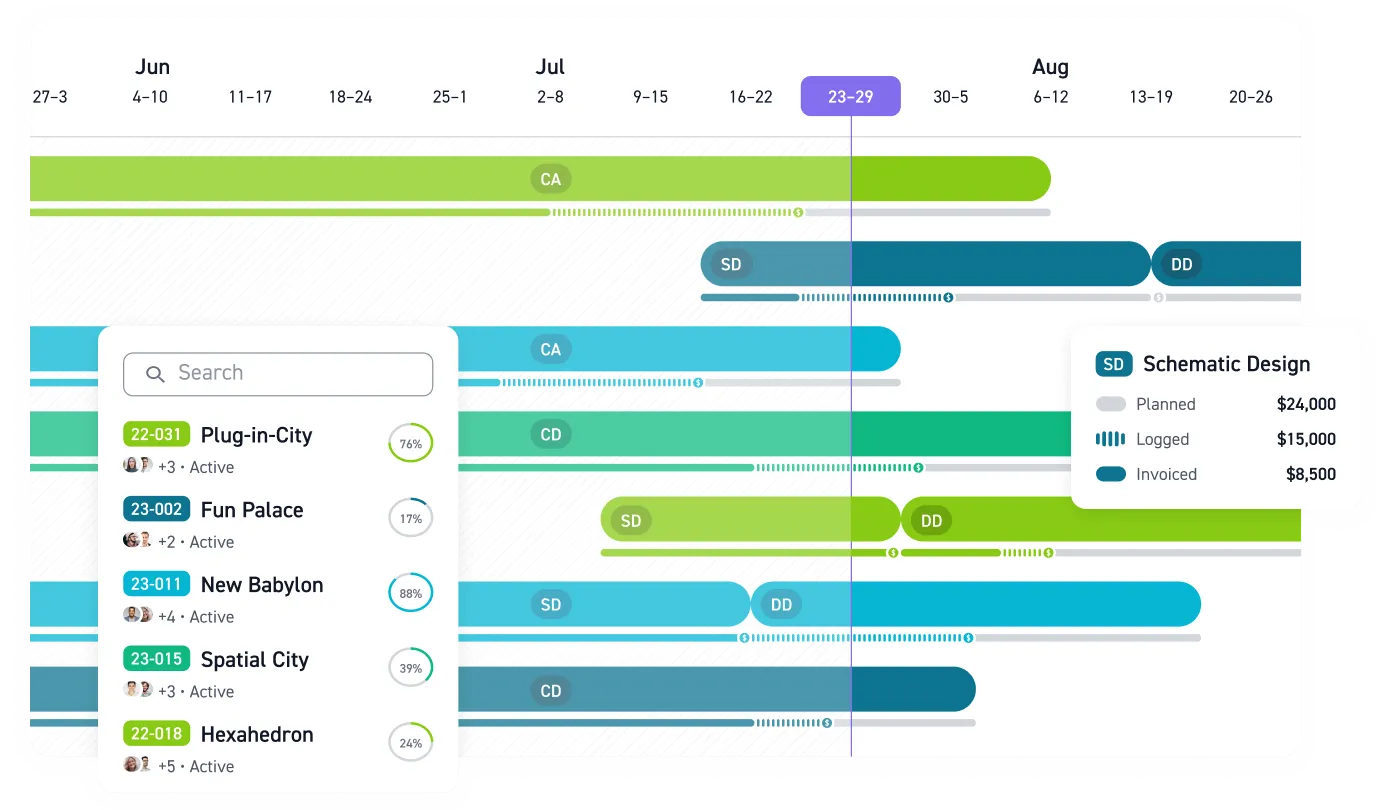
- Phase-based budget tracking that monitors costs within Schematic Design, Design Development, Construction Documents, and Construction Administration—tools like Monograph's MoneyGantt™ let firms visualize project finances against these phases in real-time
- Real-time project profitability comparing projected versus actual costs while projects are still active
- Resource utilization management showing which technical staff are over- or under-allocated across concurrent projects
- Time and expense connection linking billable hours directly to project accounting and client invoicing
These capabilities give firm leadership the financial clarity needed to make informed decisions during active projects—not just at year-end.
What CRM Systems Handle
CRM systems face outward. They manage client relationships, business development pipelines, proposal tracking, and marketing coordination. The questions they answer: What opportunities are we pursuing? When did we last talk to our best clients? Why are we losing proposals?
For A&E firms, CRM requirements differ substantially from traditional sales-focused platforms. Research shows that A&E firms operate with 80-85% repeat business, making long-term relationship management far more critical than transactional lead tracking. Zweig Group identifies that firms require a CRM system for lead response and proposal data management to compete effectively.
CRM capabilities for architecture firms should include:
- Pipeline visibility tracking opportunities from initial lead through proposal development to contract award
- Client relationship intelligence maintaining institutional knowledge about client organizations, decision-makers, and project history
- Proposal coordination managing go/no-go decisions and coordinating proposal development across teams
- Marketing campaign management coordinating firm marketing efforts, events, and client communications
Together, these functions ensure that client relationships and business development efforts remain visible across the entire firm.
The Functional Split That Matters
Here's the framework that clarifies the ERP vs CRM differences for most A&E firm decisions:
PSA systems address internal operational challenges:
- Insufficient project financial visibility
- Inefficient resource utilization across projects
- Inconsistent project delivery processes
- Manual time tracking and billing workflows
- Time-consuming financial reporting
CRM systems address external business development challenges:
- Invisible business development pipeline
- Siloed client relationship knowledge
- Declining proposal win rates
- Uncoordinated marketing efforts
- Unreliable pipeline forecasting
Harvard Business Review research on professional services firms emphasizes that successful practices must tightly align practices and clients rather than chasing after all kinds of business just to keep the lights on. This alignment requires both strong project delivery operations and strong client relationship management.
McKinsey's ERP research shows that only 20% of companies capture more than half the projected benefits from these systems. The firms that succeed treat technology as solving specific business problems, not as a generic upgrade.
Why Connection Trumps Individual Features
The research consistently points to one critical success factor: system connection. According to Monograph's implementation research, most A&E firms struggle because their CRM lives in isolation from project management, time tracking, and financial systems. This isolation creates data silos that require duplicate entry. The handoff from won opportunity to active project breaks institutional knowledge.
McKinsey's platform research recommends treating systems as a sum of capabilities rather than a monolithic stack. The insight for A&E firms: you likely need both PSA and CRM capabilities, but the connection between them matters more than any individual feature.
Leading firms implement both PSA and CRM systems with links between them, ensuring opportunities won in CRM flow seamlessly to project setup in PSA, client relationship data connects to project performance, and business development teams can see both pipeline opportunities and delivery capacity.
The Mid-Size Firm Challenge
PSMJ Resources' five decades of industry data reveal a striking pattern: mid-sized firms (20-100 people) reported average net margins of 8.2%: lower than both small firms (11.4%) and large firms (13.7%). Mid-size firms face what they call an "overhead paradox": large enough to require infrastructure but lacking scale to efficiently distribute costs.
This finding carries a warning: technology infrastructure without intentional implementation may reduce profitability rather than improve it. One A&E Industry Study found that only 18% of medium-sized firms have a plan for technology in place.
The upside is equally clear. Data shows that 67% of tech-forward firms project profit rates of at least 20%, compared to 52% of tech-static firms. About half of tech-forward firms consider their project and resource-management processes very mature, compared to one-fifth of tech-static firms. Workbench, a 30-person California firm, demonstrates what's possible when mid-size firms make intentional technology choices: after switching from BQE Core to Monograph, they achieved 8x faster staffing decisions, 4x faster billing cycles, and a 75% reduction in unbilled fees. All this directly addressed the operational inefficiencies that squeeze mid-size firm margins.
Making the Right Decision
While you're debating which system to implement first, firms across the street are already capturing value from connected workflows. The gap is widening.
If your most acute pain is project profitability visibility, resource utilization, and billing accuracy, prioritize PSA capabilities. Here at Monograph, we provide phase-based financial management, time tracking, and resource planning designed for A&E workflows. It connects bidirectionally with QuickBooks Online, delivering phase-level financial visibility and automated profitability reporting without replacing your general ledger.
If your most acute pain is business development pipeline visibility, client relationship tracking, and proposal coordination, prioritize CRM capabilities. Specifically, systems designed for professional services relationships with extended sales cycles and high repeat business rates, not transactional sales platforms.
Either way, plan for connection from the start. The firms capturing real value from technology investments link business development to project delivery, creating continuous visibility from first client conversation through final invoice.
Stop managing projects in the dark. Book a demo with Monograph.
Frequently Asked Questions
Should I implement PSA or CRM first?
Start with whichever system addresses your most painful operational problem. If you're losing money on projects because you can't track budgets in real-time, PSA comes first. If you're losing proposals because client relationship knowledge walks out the door with departing staff, prioritize CRM. Most A&E firms find project profitability is the more urgent issue—you can't grow a business development pipeline if active projects are bleeding cash.
Can I use a single system for both PSA and CRM functions?
Some platforms attempt both, but A&E firms typically get better results from purpose-built tools that connect well. Generic "all-in-one" systems often lack the phase-based project tracking architects need or the relationship depth CRM requires. The key is choosing systems with strong integration capabilities so data flows between them without duplicate entry.
How do I know if my firm actually needs CRM capabilities?
Ask yourself: Do you know which clients generated the most revenue over the past three years? Can you track proposal win rates by client type or project sector? If a principal leaves tomorrow, does their relationship knowledge leave with them? If you answered "no" to any of these, you have a CRM problem—even if you're not actively losing proposals.
What's a realistic timeline for connecting PSA and CRM systems?
Purpose-built A&E tools like Monograph can be operational in 2-4 weeks. CRM implementation typically takes 4-8 weeks depending on how much historical client data you're migrating. The connection between systems can happen simultaneously if you choose platforms designed for integration. The bigger timeline factor is internal adoption—budget 90 days for your team to consistently use both systems.
How do we measure ROI on these technology investments?
Track specific operational metrics before and after implementation: time spent on billing and invoicing, days from project completion to final invoice, proposal win rates, and project budget variance. Firms using Monograph report 2x faster invoicing and significant reductions in unbilled fees. For CRM, measure improvements in proposal response time and client retention rates. If you can't measure the problem today, that's your first sign you need better systems.